

On the streets of a working-class Abidjan neighborhood, hundreds of young people gather every week after class to dance the biama, a high-tempo combo of acrobatic twists, frenetic footwork and funny facial expressions.
The craze has gripped Ivory Coast — where nearly two-thirds of the population is aged under 25 — since it evolved from the country’s popular coupe-decale dance music a few years ago.
In Yopougon, the district where it all began, so-called biamasseurs organize the outdoor events where one DJ after another takes to the stage, which is little more than a vacant sandy piece of ground with some plastic chairs for spectators.

Photo: AFP
Dancers take part for free, while it costs between 1,000 and 2,000 CFA francs (between US$1.70 and US$3.50) to watch.
From 5pm, boys and girls in their teens don colorful sportswear of jogging pants and T-shirts to perform the high-energy moves of the quick-pace street dance.
“Biama means fun” in Nouchi, Ivorian slang, said 29-year-old Junior Koffi, known as “God of War,” who organizes the Wednesday evening events. “It’s danced to different rhythms, from zouk to zouglou and afrobeat.”
The music is often a mix of styles created by arrangers, who take their inspiration from the dance steps.
“It’s quite a funny dance,” said “le Pere Rogodogo” (“Father Rogodogo”), who was one of the first organizers of the regular street gatherings.
Young people “let their imagination run free to create their moves, dance with their eyes, pull faces,” he said.
Fans join Parfait Fidele Kposser, known as “Agbalais le Mystique” (“Agbalais the Mystic”) for dance practice in the street at the weekend.
On an afternoon last month, four boys aged 15 to 17, who call themselves the Daltons, worked on choreography with him as locals watched, some stopping to film.
With the tips they earn dancing in the evening they buy clothes and school supplies in a city with a cost of living that is one of the highest in Africa.
Biama was created by accident in 2021 in a video gaming room when a jubilant young man jumped up and started improvising dance moves to celebrate winning some money, filmed by his friend.
Today, Karl Guei, whose nickname is “Kalomaman,” has 2 million TikTok subscribers, according to culture journalist Toussaint Konan.
Since then, the dance has taken Abidjan, the country’s economic capital, and other cities by storm, with weekly events undeterred by the risk of the late-night noise disturbing nearby residents, who sometimes do complain.
They serve as a springboard for beginners and a showcase for the more accomplished whose rising fame and popularity is amplified by social media.
Videos by dancer and singer Dydy Yeman, one of the movement’s leading figures, have racked up tens of millions of views on YouTube.
The artist has already performed outside of Ivory Coast, elsewhere in Africa and in Europe, but his beginnings were humble.
He expressed “pride” in coming from Yopougon, the birthplace of biama, before going on stage in front of thousands at a festival in the fashionable neighborhood of Cocody, where entry prices were considerably higher at between 10,000 and 15,000 CFA francs.
The crowd, wearing fluorescent bracelets, their faces and T-shirts covered in paint, followed the steps led by Yeman and sang along to the lyrics of his songs.
“Even when I’m sitting, my legs start moving,” said Jean, 22, a first-year student.
Curiosity prompted Maimouna Tinta, 19, who has just graduated from high school, “to see if what’s on TV is true.”
Biama even has its own television program, a news bulletin about the dance broadcast on a private channel.
Sociologist Stephane Babo said the trend “fully deserves to exist” and might “last over time.”
“Beyond the passion ... there’s a whole economic side to it,” notably by creating jobs and even careers, Babo said.
“The dancers, during their performance, are paid after all,” he said, also pointing to other associated businesses such as the sale of clothing.
Arranger Elie-Michel Assie Diou sees “a market” in the biama movement’s success.
He said his studio had recorded more than 50 artists in just a few years.

Philippine Secretary of National Defense Gilberto Teodoro Jr on Tuesday hit out at China at an international forum after a memo asserting Beijing’s position over their longstanding maritime dispute was delivered to him while he was speaking on stage. The unusual incident was captured on video at the Seoul Defense Dialogue as the secretary was responding to a question about “gray zone” coercion in the South China Sea. The video shows what appears to be a conference staffer placing it on the table next to him while speaking. “I have a note here, I think this is from China,” he said, describing

PAINSTAKING PROCESS: Ice makers freeze water for up to 72 hours, replace tainted water with a fresh batch once freezing begins, and are constantly stirring In the historic Japanese city of Kanazawa, craftsmen painstakingly shape and slice blocks of ice destined to chill negronis in some of the world’s trendiest bars. The men work for Kuramoto Ice, a century-old company in Ishikawa on the Sea of Japan coast and one of dozens of Japanese firms producing ultra-clear, premium ice. This luxury product, believed by those in the industry to melt more slowly than regular blocks, is a staple of Japan’s cocktail culture, but its popularity is also spilling over to bars abroad, from the US to Australia, who pay as much as ¥200 (US$1.28) per cube. Kuramoto Ice

COMMITMENT: China could view reduced US-Seoul exercises as an opportunity to reassert itself, but the US had reassured Manila of its resolve, the defense chief said China could see recent cuts to US-South Korean military exercises as an opportunity to reassert itself in the Indo-Pacific region, Philippine Secretary of Defense Gilberto Teodoro said yesterday, though he said Washington had assured Manila that its commitments to the Philippines remained unchanged. Speaking to Reuters on the sidelines of the Seoul Defense Dialogue, Teodoro said there had been no reduction in US-Philippine military activities, and that bilateral and multilateral cooperation involving Manila continued to expand. US President Donald Trump’s decision last month to scale back military exercises with South Korea has prompted debate among security analysts over the credibility of US
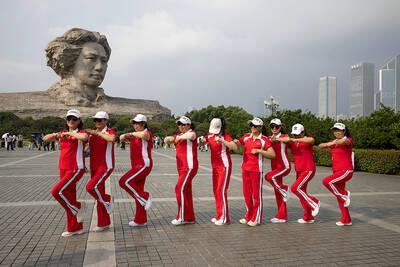
China yesterday marked half a century since the death of Mao Zedong (毛澤東), founder of the People’s Republic, who brought roughly one-quarter of the world’s population under communist rule and whose specter still haunts China’s future. Mao’s death on Sept. 9, 1976, at age 82, mourned by many and welcomed by some who suffered under his nearly three-decade rule, also hastened the end of the Cultural Revolution, a frenzied mass movement he launched in 1966. The party later condemned the Cultural Revolution as a grave error for which Mao bore primary responsibility, but still reveres him, saying his achievements outweigh his mistakes. Mao’s


 RSS
RSS