

Ojo Ayaninuola, a small-scale cocoa farmer from Akure in southwestern Nigeria, was initially reluctant to let exporters map and geolocate his farm as part of measures to comply with a looming EU anti-deforestation law.
However, when one of the country’s largest exporters and the buyer of all his cocoa beans, Sunbeth Global, warned that he could lose access to the EU, which buys 60 percent of the world’s cocoa, he eventually agreed.
Ayaninuola, who sells to a big and well-resourced exporter, is in an enviable position compared with other growers in the area and elsewhere.
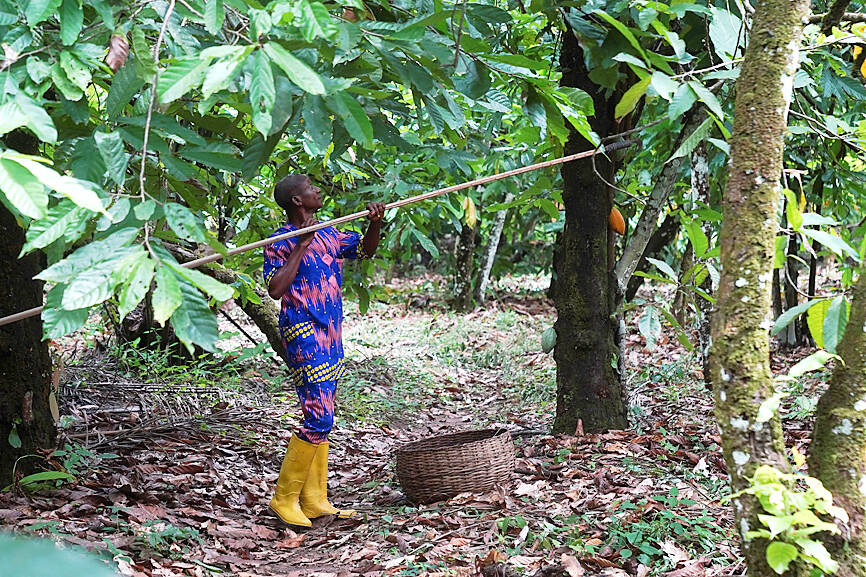
Photo: Reuters
Industry experts estimate that when the EU law banning commodity imports linked to deforestation comes into effect at the end of December, farmers who grow more than half the beans in the world’s fourth-largest cocoa producer could fail to meet the bloc’s rules. Nigeria has about 300,000 mostly small-scale cocoa farmers, according to the Nigerian Export Promotion Council.
The situation is similar across west Africa, including top grower Ivory Coast. Industry experts say struggles to comply with the law could squeeze the region’s exports to the EU and lead to higher costs for its chocolate makers.
The region grows about 70 percent of the world’s cocoa beans and ships about two-thirds to the EU, data from the World Bank, the EU and the UN shows.
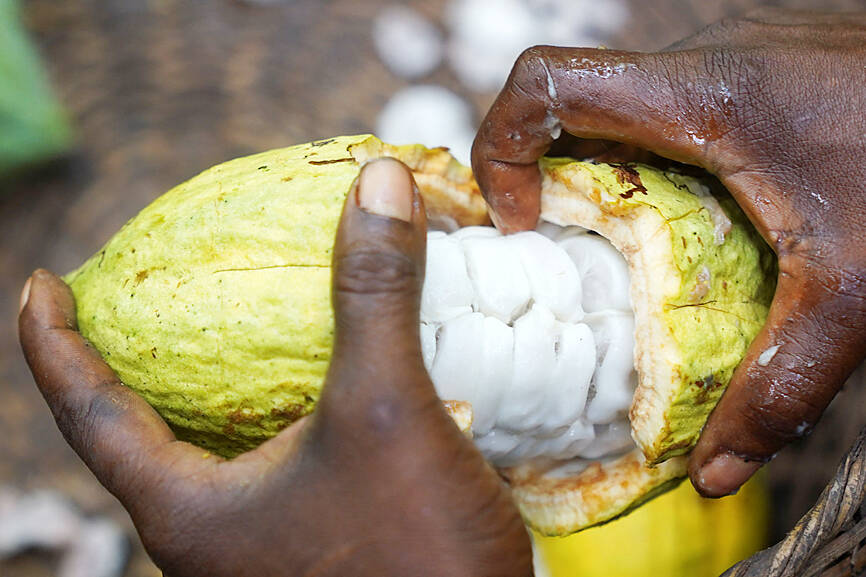
Photo: Reuters
“There’s a distinct possibility that in the early days of the law, EU importers won’t be able to get enough compliant cocoa from indirect or third party shippers from origins like Nigeria, from Ivory Coast, from anywhere,” said sustainability consultant Nicko Debenham, a former global cocoa trader.
Debenham estimates that the supply squeeze in the EU could last about two years, during which exporters who have invested in meeting the bloc’s rules would command a premium from chocolate makers for their beans.
Aimed at ending the 10 percent of global deforestation fueled by the bloc’s consumption of imported goods, the EU law will require that importers of commodities and related goods prove their products were not grown on recently deforested land by, among other measures, tracing their raw materials back to the plot where they were grown.
Twice delayed due to its complexity, the EU Deforestation Regulation (EUDR) also requires proof from importers that the goods were produced in accordance with laws in the country of origin.
Compliance is costly and challenging, cocoa buyers say, especially in countries like Nigeria, Ivory Coast and Ghana, where the industry comprises hundreds of thousands of small-scale farmers living in remote, rural areas.
Exporters have to map all the individual farms, verify land use and maintain — throughout a multilayered supply chain — digital traceability records that EU buyers can rely on.
In Ivory Coast, only about half the cocoa can be traced to where it was grown, non-profit Trase said in a study released in May, largely because the rest of the supply chain is indirect or involves several intermediaries.
Major Nigerian cocoa exporters such as Sunbeth Global say compliance is proving expensive, with EU buyers resisting efforts so far to pass on the costs.
Sunbeth said it spent the past three years mapping 124,000 hectares of farmland in southern Nigeria covering about 60,000 tonnes of cocoa in its supply chain, at a cost of US$30 to US$70 per tonne.
The company has also deployed hundreds of field agents over the past three years to train its farmers to comply with Nigerian laws, including those against child and forced labor, and hired a 35-person sustainability team that works with Amsterdam-based data verification specialist Meridia, it said.
“It is expensive to do this ... [and] in early conversations with our offtakers, there has been some pushback over who will bear the cost of EUDR compliance,” Sunbeth chief operating officer Nzubechukwu Anisiobi said. “The cost-benefit analysis right now is eating into our margins.”
Starlink Global and Ideal, Nigeria’s biggest cocoa exporter, which ships about 60,000 tonnes a year, said it has spent US$40 to US$80 a ton mapping and tracing its supply chain since 2023 — costs it says have yet to be recovered from European buyers.
A Chinese rocket carrying a communications satellite failed in its launch, state media said, attributing the failure to a “flight anomaly” as reports and videos suggested the spacecraft had exploded in mid-air. Beijing has plowed billions of dollars into its space program in the past few years to achieve what Chinese President Xi Jinping (習近平) calls the country’s “space dream.” Monday’s rare launch failure involved a Long March 7A carrier rocket, which lifted off from the Wenchang Space Launch Site in China’s southernmost province of Hainan at 8:02pm, state news agency Xinhua said. An “anomaly” occurred when the rocket, which was carrying the

UNITED STATES Russia frees US Marine Russia on Tuesday freed a former US Marine jailed there since 2022, President Donald Trump said, as the man returned to the US to be greeted with hamburgers and milkshakes. Russia agreed to release Robert Gilman, 32, to receive medical care in the US after discussions with Russian President Vladimir Putin, Trump wrote on social media. A Department of State plane carrying Gilman arrived at Washington Dulles International Airport late on Tuesday. Putin approved a pardon for him, US officials said. ZIMBABWE Ferry capsizing kills 15 At least 15 people were killed and 27 remain missing when

‘KOKUSHOBI’: Japan has recorded its first-ever ‘cruelly hot day,’ a new category introduced this year by the Japan Meteorological Agency for temperatures above 40°C In a potato field in Yanggu County, 130km northeast of Seoul, Lee Sang-hyuk dug into the soil and found nothing worth saving. A week earlier the crop, in Gangwon Province, had looked fine. Now the potatoes came up soft and collapsing, “like boiled potatoes,” spoiled by heat that had turned the ground into something closer to an oven. “It’s not just one or two fields like this. How can I even put it into words? It’s so upsetting,” he told local Seoul Broadcasting System. His ruined harvest is one thread in a punishing summer across east Asia, as record heat

US President Donald Trump’s war against Iran is stretching the limits of US aircraft carriers and leaving the western Pacific without one of the key US warships as China shows more signs of aggression. The USS George Washington is departing the Pacific and expected to replace the USS Abraham Lincoln in the Middle East amid growing concerns about mental health and supply issues aboard the long-deployed carrier. The Lincoln has had its time at sea extended from its original May return date to support operations against Iran. The lack of a US carrier in the Pacific might be short-lived if


 RSS
RSS