


Thailand’s parliament was dissolved yesterday for new elections early next year as the country engaged in deadly fighting with Cambodia.
Thai Prime Minister Anutin Charnvirakul dissolved the House of Representatives after getting approval from King Maha Vajiralongkorn, whose endorsement became effective with its publication in the Royal Gazette.
Anutin on Thursday signaled the move with a Facebook post saying: “I’d like to return power to the people.”
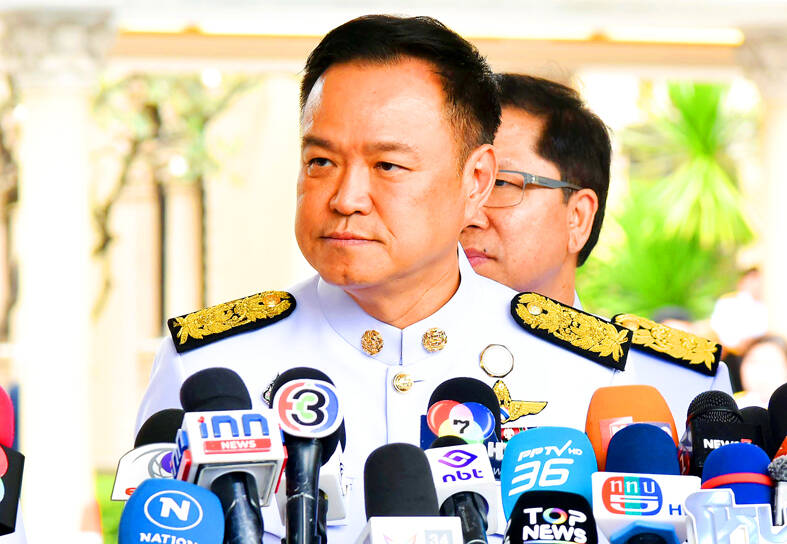
Photo: EPA, Royal Thai Government
The election must be held 45 to 60 days after the royal endorsement, a period during which Anutin would head a caretaker government with limited powers that cannot approve a new budget.
The move comes at a tricky political moment, as Thailand is engaged in large-scale combat with Cambodia over a longstanding border dispute.
Anutin has been prime minister for just three months. He won the September vote in the Thai parliament with support from the main opposition People’s Party in exchange for a promise to dissolve the parliament within four months and organize a referendum on the drafting of a new Thai constitution by an elected constituent assembly.
The party, which runs on progressive platforms, has long sought changes to the constitution, imposed during a military government, saying they want to make it more democratic.
The issue of constitutional change appeared to trigger the dissolution, after the People’s Party on Thursday prepared to call a no-confidence vote. That threat came after lawmakers from Anutin’s Bhumjaithai Party voted in favor of a bill to amend the constitution, which the opposition felt ran against the spirit of the agreement they reached in September.
The People’s Party holds the largest number of seats in the Thai House of Representatives and is seen as the main challenger to Bhumjaithai.
Opposition leaders said they hoped Anutin would honor the agreement to arrange a constitutional referendum.
With Thailand now again engaged in heavy combat against Cambodia, Anutin has embraced an aggressive military posture to appeal to nationalistic public sentiment, and has said Thailand would keep fighting until its sovereignty and safety are guaranteed.
After the five days of border fighting in July, US President Donald Trump pushed the two countries to agree on a ceasefire by threatening to withhold trade privileges from them.
Trump has vowed again to make peace between them, after widespread fighting flared up again this week. If he employs the cudgel of high tariffs on Thai exports should Bangkok fail to comply with his peacemaking effort, it could cause serious damage to its already sluggish economy.
Trump twice this week said he expected to speak by phone with Thai and Cambodian leaders, expressing confidence that he could persuade them to stop the fighting.
Anutin yesterday confirmed that he was scheduled to speak with Trump later in the evening, saying he would brief him on the latest situation along the border.
As of Thursday, about two dozen people had been reported killed in this week’s fighting, while hundreds of thousands have been displaced on both sides. The Thai military estimates that 165 Cambodian soldiers have been killed, although no number has been officially announced by Phnom Penh.

PARLIAMENT CHAOS: Police forcibly removed Brazilian Deputy Glauber Braga after he called the legislation part of a ‘coup offensive’ and occupied the speaker’s chair Brazil’s lower house of Congress early yesterday approved a bill that could slash former Brazilian president Jair Bolsonaro’s prison sentence for plotting a coup, after efforts by a lawmaker to disrupt the proceedings sparked chaos in parliament. Bolsonaro has been serving a 27-year term since last month after his conviction for a scheme to stop Brazilian President Luiz Inacio Lula da Silva from taking office after the 2022 election. Lawmakers had been discussing a bill that would significantly reduce sentences for several crimes, including attempting a coup d’etat — opening up the prospect that Bolsonaro, 70, could have his sentence cut to
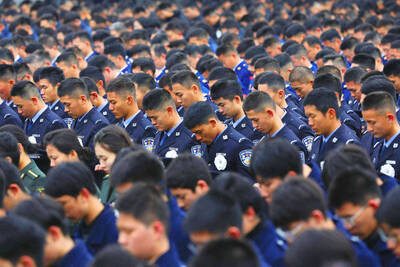
China yesterday held a low-key memorial ceremony for the 1937 Nanjing Massacre, with Chinese President Xi Jinping (習近平) not attending, despite a diplomatic crisis between Beijing and Tokyo over Taiwan. Beijing has raged at Tokyo since Japanese Prime Minister Sanae Takaichi last month said that a hypothetical Chinese attack on Taiwan could trigger a military response from Japan. China and Japan have long sparred over their painful history. China consistently reminds its people of the 1937 Nanjing Massacre, in which it says Japanese troops killed 300,000 people in what was then its capital. A post-World War II Allied tribunal put the death toll

A passerby could hear the cacophony from miles away in the Argentine capital, the unmistakable sound of 2,397 dogs barking — and breaking the unofficial world record for the largest-ever gathering of golden retrievers. Excitement pulsed through Bosques de Palermo, a sprawling park in Buenos Aires, as golden retriever-owners from all over Argentina transformed the park’s grassy expanse into a sea of bright yellow fur. Dog owners of all ages, their clothes covered in dog hair and stained with slobber, plopped down on picnic blankets with their beloved goldens to take in the surreal sight of so many other, exceptionally similar-looking ones.
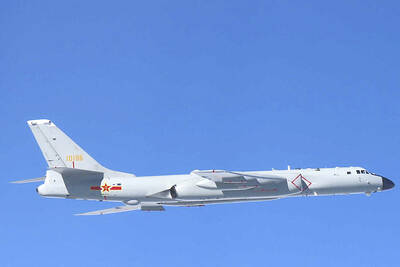
‘UNWAVERING ALLIANCE’: The US Department of State said that China’s actions during military drills with Russia were not conducive to regional peace and stability The US on Tuesday criticized China over alleged radar deployments against Japanese military aircraft during a training exercise last week, while Tokyo and Seoul yesterday scrambled jets after Chinese and Russian military aircraft conducted joint patrols near the two countries. The incidents came after Japanese Prime Minister Sanae Takaichi triggered a dispute with Beijing last month with her remarks on how Tokyo might react to a hypothetical Chinese attack on Taiwan. “China’s actions are not conducive to regional peace and stability,” a US Department of State spokesperson said late on Tuesday, referring to the radar incident. “The US-Japan alliance is stronger and more


 RSS
RSS