


The Philippine defense and military chiefs rejected a call from protestors for the country’s armed forces to withdraw support from Philippine President Ferdinand Marcos Jr in response to public outrage over allegations of massive corruption in flood control projects that have implicated several congressmen and public works officials and sparked pockets of street protests.
Philippine Secretary of National Defense Gilbert Teodoro Jr and Armed Forces of the Philippines Chief of Staff General Romeo Brawner Jr issued a joint statement late on Friday expressing their rejection of “all attempts to patronize the Armed Forces of the Philippines by certain groups that insinuate or suggest unconstitutional, unilateral interventions.”
They did not elaborate, but underscored that the 160,000-member military was non-partisan, professional and “abides by the constitution through the chain-of-command.”
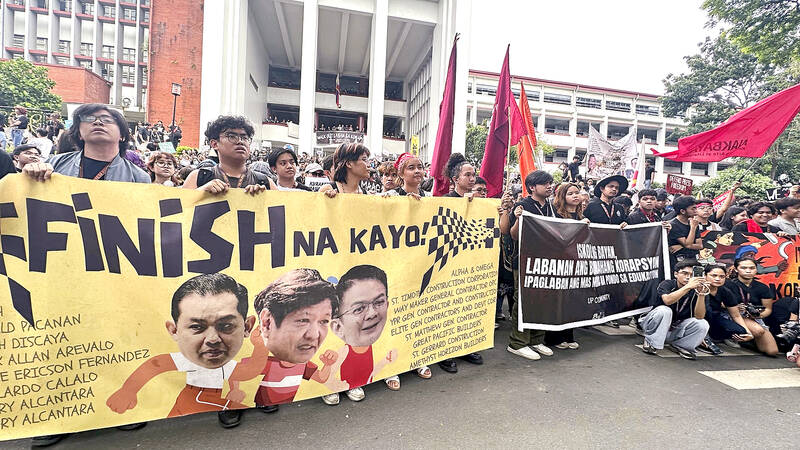
Photo: AP
The Philippines House of Representatives, Senate and Marcos’ administration have been investigating alleged substandard and non-existent flood control projects in separate televised inquiries.
Dozens of Philippine legislators, senators, construction companies and public works engineers were identified and accused of pocketing huge kickbacks that financed lavish lifestyles and high-stakes casino gambling.
The corruption scandal has been especially sensitive in the poverty-stricken Southeast Asian country, which is prone to deadly typhoons and flooding that devastate entire towns and villages multiple times each year.
Unlike recent violent protests in Nepal and Indonesia, street rallies against alleged abuses in the Philippines have been smaller and relatively peaceful. Outrage is largely vented online, including by Catholic church leaders, business executives and retired generals.
During a recent rally, a speaker called on the military to withdraw its loyalty from Marcos and called on Filipinos to stage a non-violent “people power” revolt similar to army-backed uprisings that ousted former Philippine presidents Ferdinand Marcos — the current president’s late father and namesake — and Joseph Estrada in 1986 and 2001 respectively.
Two high-ranking national security and defense officials said there was no currently monitored threat of secessionism within the military and the police forces. They spoke on condition of anonymity because of a lack of authority to discuss the delicate issue publicly.
Drastic movements in the military and other uniformed service are very unlikely due to strong loyalty and patriotism ... to Constitution, the flag and the president,” a condidential intelligence assessment said.
The Philippines has spent an estimated 545 billion pesos (US$9.53 billion) for thousands of flood mitigation projects in the past three years. The projects were under government review to determine which ones are substandard or non-existent, as Marcos said he has found during recent inspections he led in some flood-prone provinces, including in Bulacan, a densely populated province north of Manila.
Marcos formed an independent commission to investigate the massive anomalies he described as “horrible,” prompting him to withhold funding for flood control projects at least for next year and accept the resignation of Philippine Secretary of Public Works and Highways Manuel M. Bonoan.
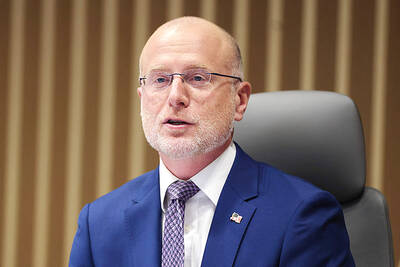
FAKE NEWS? ‘When the government demands the press become a state mouthpiece under the threat of punishment, something has gone very wrong,’ a civic group said The top US broadcast regulator on Saturday threatened media outlets over negative coverage of the Middle East war, after US President Donald Trump slammed critical headlines from the “Fake News Media.” The US president since his first term has derided mainstream media as “fake news” and has sued major outlets over what he sees as unfair coverage. Brendan Carr, head of the US Federal Communications Commission — which oversees the nation’s radio, television and Internet media — said broadcasters risked losing their licenses over news coverage. “The law is clear. Broadcasters must operate in the public interest, and they will
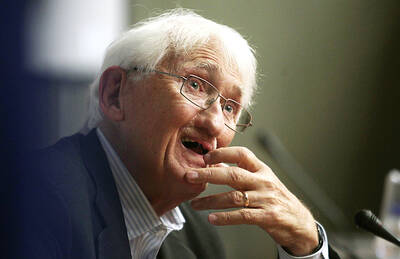
INFLUTENTIAL THEORIST: Habermas was particularly critical of the ‘limited interest’ shown by German politicians in ‘shaping a politically effective Europe Jurgen Habermas, whose work on communication, rationality and sociology made him one of the world’s most influential philosophers and a key intellectual figure in his native Germany, has died. He was 96. Habermas’ publisher, Suhrkamp, said he died on Saturday in Starnberg, near Munich. Habermas frequently weighed in on political matters over several decades. His extensive writing crossed the boundaries of academic and philosophical disciplines, providing a vision of modern society and social interaction. His best-known works included the two-volume Theory of Communicative Action. Habermas, who was 15 at the time of Nazi Germany’s defeat, later recalled the dawn of
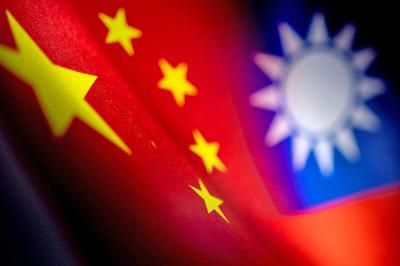
The Chinese public maintains relatively warm sentiments toward Taiwan and strongly prefers non-military paths to improving cross-strait relations, a recent survey conducted by the Atlanta, Georgia-based Carter Center and Emory University showed. The “China Pulse” research project, which polled 2,506 adults between Oct. 27 last year and Jan. 1 this year, found that 86 percent of respondents support strengthening cultural ties, while 81 percent favor deepening economic interaction. The report, co-authored by political scientists at Emory University and advisors at the Carter Center, indicates that the Chinese public views Taiwan’s importance through a lens of shared history and culture rather than geopolitical

Cannabis-based medicines have shown little evidence of effectiveness for treating most mental health and substance-use disorders, according to a large review of past studies published in a major medical journal on Monday. Medical use of cannabinoids has been expanding, including in the US, Canada and Australia, where many patients report using cannabis products to manage conditions such as anxiety, post-traumatic stress disorder and sleep problems. Researchers reviewed data from 54 randomized clinical trials conducted between 1980 and May last year involving 2,477 participants for their analysis published in The Lancet. The studies assessed cannabinoids as a primary treatment for mental disorders or substance-use


 RSS
RSS