


US Vice President J.D. Vance was yesterday to visit Greenland at a time when US President Donald Trump is renewing his insistence that Washington should take control of the semi-autonomous Danish territory.
In a scaled-back version of a trip plan that had angered authorities in Greenland and Denmark, Vance was expected to fly to the US military base at nchin the north of the arctic island.
Under the terms of a 1951 agreement, the US is entitled to visit its base whenever it wants, as long as it notifies Greenland and Copenhagen.
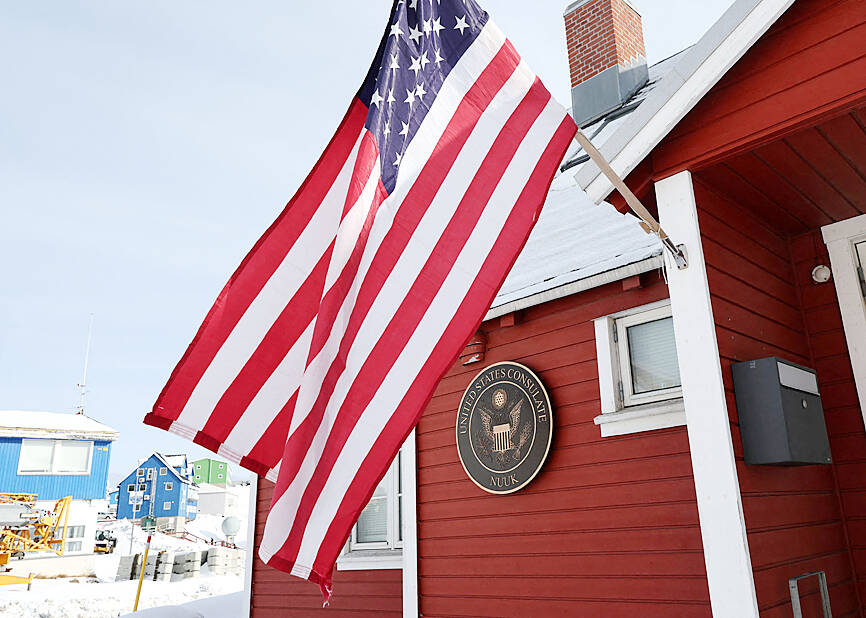
Photo: Reuters
The initial plan had been for Vance’s wife, Usha, to visit a popular dog-sled race together with US National Security Adviser Mike Waltz even though they were not invited by authorities in either Greenland or Denmark.
Waltz, who has faced pressure over Trump administration officials’ discussion of sensitive Houthi attack plans on the Signal messaging app, would still be on the Greenland trip, a White House source said.
Greenland acting prime minister Mute Egede called the visit a provocation as the country had yet to form a new government after a March 11 election.
Local media on Thursday reported that Greenland’s Democrats were to announce a four-party coalition government yesterday.
Danish Prime Minister Mette Frederiksen called the US visit “unacceptable” although Danish Minister of Foreign Affairs Lars Lokke Rasmussen welcomed news of the revised visit as a positive, de-escalating step.
By changing the trip, the Trump administration is seeking to refocus the discussion on the topics it is interested in: the US presence on Greenland, military capabilities available and the wider security of the arctic region, said Catherine Sendak, director of the Transatlantic Defense and Security Program at the Center for European Policy Analysis, a Washington-based think tank.
“A change of course was needed,” Sendak said. “It is positive, given the very public back and forth between the Danish and Greenland governments and the Trump administration about the intent of the initial visit.”
Still, Trump reiterated his desire to take over Greenland, saying the US needs the strategically island for national and international security.
“So, I think we’ll go as far as we have to go. We need Greenland and the world needs us to have Greenland, including Denmark,” he said on Wednesday.
Danish Minister of Defense Troels Lund Poulsen condemned what he called Trump’s escalated rhetoric.
The question now is how far Trump is willing to push his idea of taking over the island, said Andreas Oesthagen, a senior researcher on arctic politics and security at the Oslo-based Fridtjof Nansen Institute.
“It is still unlikely that the United States will use military means to try to get full control over Greenland,” he said.
That would break with many fundamental principles and rules that the US has benefited from and has been a pillar for, Oesthagen said.
However, “it is unfortunately likely that President Trump and Vice President Vance will continue to use other means of pressure, such as ambiguous statements, semi-official visits to Greenland and economic instruments,” he added.
“The real winner in this unnecessary drama is Russia, who gets exactly what they want: discord in the transatlantic relationship,” he said.
Tom Dans, a businessman and former member of the US Arctic Research Commission during Trump’s first presidency, said Vance’s visit would help the Trump administration understand where it can collaborate further with Greenland.
“They’re trying to put the picture together for the future and understand where the best intersections are going to be for US policy and investments to help Greenland,” Dans said.
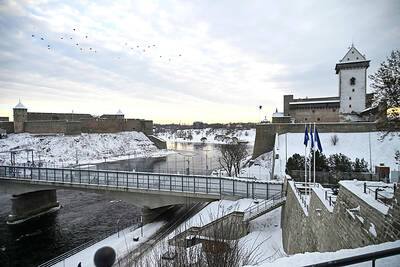
Two medieval fortresses face each other across the Narva River separating Estonia from Russia on Europe’s eastern edge. Once a symbol of cooperation, the “Friendship Bridge” connecting the two snow-covered banks has been reinforced with rows of razor wire and “dragon’s teeth” anti-tank obstacles on the Estonian side. “The name is kind of ironic,” regional border chief Eerik Purgel said. Some fear the border town of more than 50,0000 people — a mixture of Estonians, Russians and people left stateless after the fall of the Soviet Union — could be Russian President Vladimir Putin’s next target. On the Estonian side of the bridge,

Jeremiah Kithinji had never touched a computer before he finished high school. A decade later, he is teaching robotics, and even took a team of rural Kenyans to the World Robotics Olympiad in Singapore. In a classroom in Laikipia County — a sparsely populated grasslands region of northern Kenya known for its rhinos and cheetahs — pupils are busy snapping together wheels, motors and sensors to assemble a robot. Guiding them is Kithinji, 27, who runs a string of robotics clubs in the area that have taken some of his pupils far beyond the rural landscapes outside. In November, he took a team

Civil society leaders and members of a left-wing coalition yesterday filed impeachment complaints against Philippine Vice President Sara Duterte, restarting a process sidelined by the Supreme Court last year. Both cases accuse Duterte of misusing public funds during her term as education secretary, while one revives allegations that she threatened to assassinate former ally Philippine President Ferdinand Marcos Jr. The filings come on the same day that a committee in the House of Representatives was to begin hearings into impeachment complaints against Marcos, accused of corruption tied to a spiraling scandal over bogus flood control projects. Under the constitution, an impeachment by the
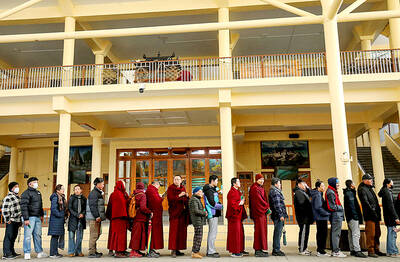
Exiled Tibetans began a unique global election yesterday for a government representing a homeland many have never seen, as part of a democratic exercise voters say carries great weight. From red-robed Buddhist monks in the snowy Himalayas, to political exiles in megacities across South Asia, to refugees in Australia, Europe and North America, voting takes place in 27 countries — but not China. “Elections ... show that the struggle for Tibet’s freedom and independence continues from generation to generation,” said candidate Gyaltsen Chokye, 33, who is based in the Indian hill-town of Dharamsala, headquarters of the government-in-exile, the Central Tibetan Administration (CTA). It


 RSS
RSS