


A member of China’s powerful Central Military Commission has been suspended and put under investigation, the Chinese Ministry of National Defense said on Thursday.
Miao Hua (苗華) was director of the political work department on the commission, which oversees the People’s Liberation Army (PLA), the world’s largest standing military. He was one of five members of the commission in addition to its leader, Chinese President Xi Jinping (習近平).
Ministry spokesman Colonel Wu Qian (吳謙) said Miao is under investigation for “serious violations of discipline,” which usually alludes to corruption.
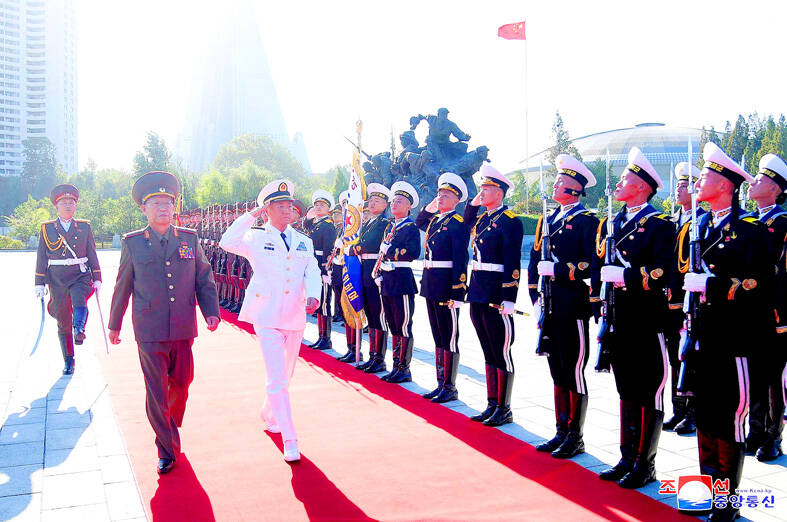
Photo: KCNA via Reuters
It is the third recent major shakeup for China’s defense establishment. China in June announced that former Chinese minister of national defense Li Shangfu (李尚福) and his predecessor, Wei Fenghe (魏鳳和), had been expelled from the Chinese Communist Party and accused of corruption.
Yet, the high-level investigation is not likely to have any significant consequences, given Xi’s tight grip on power.
“Most countries would incur at least some reputational cost to their international reputation were such frequent, high-profile personnel purges to have happened in their own armed forces, but the PRC [People’s Republic of China] is no ordinary country,” James Char, a research fellow at the Institute of Defence and Strategic Studies at Nanyang Technological University in Singapore, said in an e-mail. “These purges can go on so long as its commander-in-chief approves of them.”
In Xi’s first term as party secretary, he was known for a multiyear campaign against corruption that has brought down numerous high-profile political rivals and thousands of officials. This has led some to allege a widespread purge of officers suspected of conspiring with outside forces or simply being insufficiently loyal to Xi.
The president’s dedication to his anti-corruption campaign has continued throughout his rule. High-ranking officers occupy an elevated position in Chinese politics and can command extensive privileges, official and unofficial.
Miao being placed under investigation comes after the Financial Times reported that Chinese Minister of National Defense Dong Jun (董軍) was under investigation for corruption.
Miao’s position on the commission outranks Dong and anyone who holds the position of defense minister, as Chinese Communist Party positions are more powerful than government institutions in China.
Experts say a possible corruption investigation would not be a surprise, given the PLA’s history.
In the 1990s, the PLA was allowed to run businesses as the nation opened up during the “reform and opening up” period, when the country stopped many of its planned economic policies and transitioned to a more market-based economy.
Miao has come up through the political department in the military and had served as the political commissar of the PLA Navy. He was already fairly senior before Xi came to power in 2012.
“If the investigation is about corruption, it’s not out of line with people’s expectations,” said Yen Tiehlin (閻鐵麟), deputy director at the Taiwan Center for Security Studies, who studies the PLA. “It’s very difficult for anyone not to have have blemishes if you were a mid-level or senior cadre in the 1990s.”
Wu said that Dong was not under any investigation and called the newspaper report a “sheer fabrication.”
In response to a question about who the defense minister was, Wu smiled and raised his hands in a shrug.
“Why do you ask this nonsensical question? I just said this many times: Minister Dong Jun,” he said.
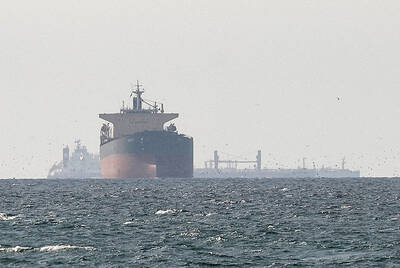
A ship that appears to be taking on the identity of a scrapped gas carrier exited the Strait of Hormuz on Friday, showing how strategies to get through the waterway are evolving as the Middle East war progresses. The vessel identifying as liquefied natural gas (LNG) carrier Jamal left the Strait on Friday morning, ship-tracking data show. However, the same tanker was also recorded as having beached at an Indian demolition yard in October last year, where it is being broken up, according to market participants and port agent’s reports. The ship claiming to be Jamal is likely a zombie vessel that

German Chancellor Friedrich Merz’s conservative Christian Democratic Union (CDU) yesterday faced a regional election battle in Rhineland-Palatinate, now held by the center-left Social Democratic Party (SPD). Merz’s CDU has enjoyed a narrow poll lead over the SPD — their coalition partners at the national level — who have ruled the mid-sized state for 35 years. Polling third is the far-right Alternative for Germany (AfD), which spells a greater threat to the two centrist parties in several state elections in September in the country’s ex-communist east. The picturesque state of Rhineland-Palatinate, bordering France, Belgium and Luxembourg and with a population of about 4 million,

Ugandan wildlife authorities have reintroduced rhinos into a remote protected area where they were once poached into extinction, an event seen by conservationists as a milestone in efforts to support the recovery of a species threatened by poaching. On Tuesday, two southern white rhinos from a private ranch in the East African country were reintroduced into Kidepo Valley National Park in the country’s northeast. Two more rhinos in metallic crates arrived on Thursday. There have been no rhinos in the park since 1983, the result of poaching. However, a private ranch in central Uganda — the Ziwa Rhino Sanctuary — has been
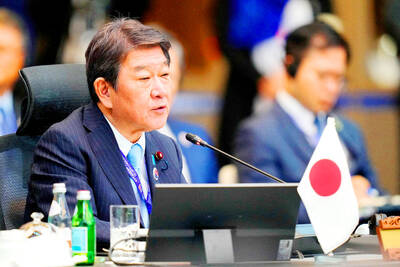
LAW CONSTRAINTS: The US has been pressing allies to send warships to open the Strait, but Tokyo’s military actions are limited under its postwar pacifist constitution Japan could consider deploying its military for minesweeping in the Strait of Hormuz if a ceasefire is reached in the war on Iran, Japanese Minister of Foreign Affairs Toshimitsu Motegi said yesterday. “If there were to be a complete ceasefire, hypothetically speaking, then things like minesweeping could come up,” Motegi said. “This is purely hypothetical, but if a ceasefire were established and naval mines were creating an obstacle, then I think that would be something to consider.” Japan’s military actions are limited under its postwar pacifist constitution, but 2015 security legislation allows Tokyo to use its Self-Defense Forces overseas if an attack,


 RSS
RSS