


Booming indigenous Maori “haka” chants yesterday rang out across New Zealand’s capital, as tens of thousands rallied against a conservative push to redefine the nation’s founding treaty.
More than 35,000 demonstrators poured into the harborside city of Wellington, police said, shutting down busy streets as their spirited procession inched its way toward parliament.
Bare-chested men draped in traditional feather cloaks were joined by horse riders waving the red, white and black Maori flag. Children marched alongside adults bearing distinctive full-face Maori moko tattoos and clutching ceremonial wooden weapons.
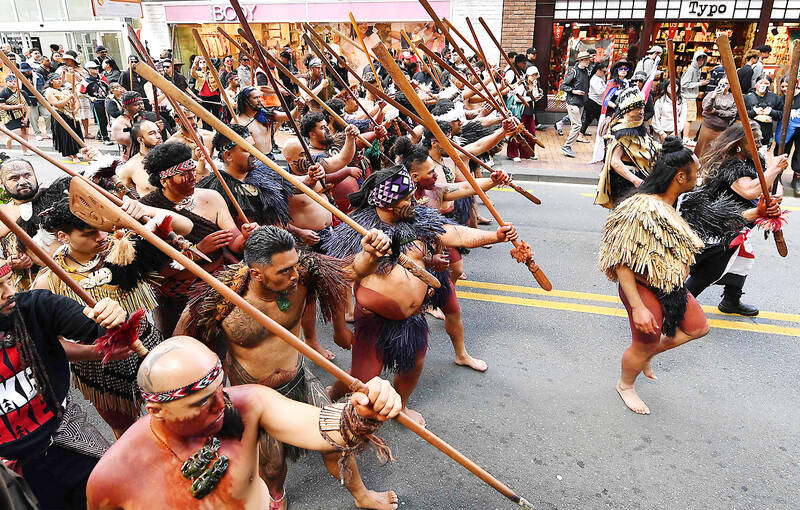
Photo: AFP
Protests have been swelling throughout New Zealand after a minor party in the conservative coalition government drafted a bill to redefine the 1840 Treaty of Waitangi. Although the bill has almost no chance of passing, its mere introduction has triggered one of the largest protests in the nation in decades.
After it was presented for debate in parliament last week, 22-year-old Maori Party MP Hana-Rawhiti Maipi-Clarke took to her feet in the chamber, ripped the bill in half and launched into a haka. She joined the crowds of protesters gathered on the lawns yesterday outside New Zealand’s beehive-shaped parliament building.
“I may have been suspended for 24 hours and not let into the gates of the debating chambers, but the next day I showed up outside the steps with a hundred thousand of my people, marching with our heads held high and our flags waving with pride,” she told them.
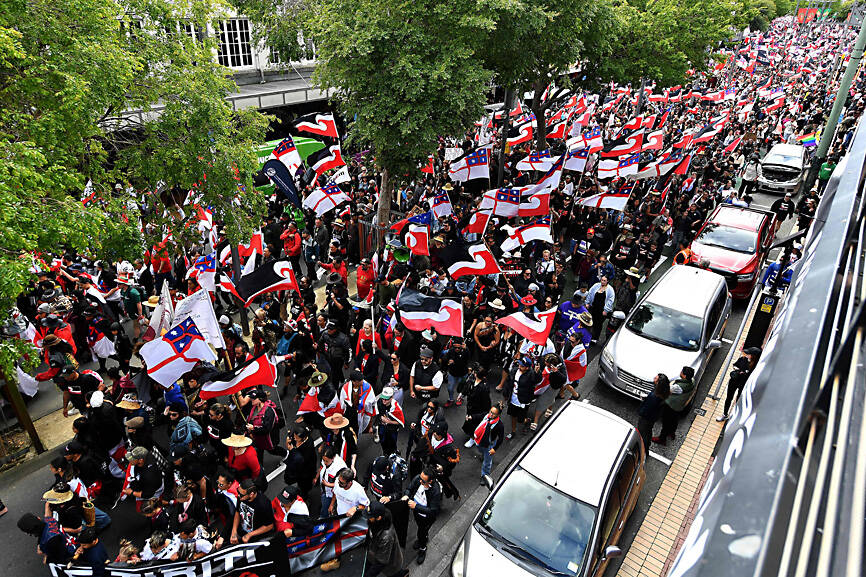
Photo: AFP
“We are the king makers, we are the sovereign people of this land and the world is watching us here,” she said.
Many critics of the bill — including some of New Zealand’s most respected lawyers — see it as an attempt to strip long-agreed rights from the nation’s 900,000 strong Maori population.
“It’s not the best way to have a conversation. We will not accept unilateral change to a treaty that involves two parties,” said Ngira Simmonds, a key adviser to New Zealand’s Maori queen.
“There is a better way,” he said.
Many demonstrators arrived in Wellington after a nine-day hikoi (protest march) that began hundreds of kilometers away at New Zealand’s northern tip.
At the center of the outcry is government minister David Seymour, the outspoken leader of the libertarian ACT Party — a minor partner in the governing coalition.
Seymour has long railed against affirmative action policies designed to help Maori, who remain far more likely to die early, live in poverty or wind up in prison. His bill would look to wind back these so-called “special rights.”
New Zealand Prime Minister Christopher Luxon has voiced his opposition to Seymour’s bill, meaning it is all but doomed to fail when it comes to a parliamentary vote.
However, former conservative prime minister Jenny Shipley said just putting it forward threatened to “divide New Zealand in a way that I haven’t lived through in my adult life.”
Seen as the nation’s founding document, the Treaty of Waitangi was signed in 1840 to bring peace between 540 Maori chiefs and colonizing British forces. Its principles today underpin efforts to foster partnership between indigenous and non-indigenous New Zealanders and protect the interests of the Maori community.
The anniversary of the treaty’s signing remains a national holiday.
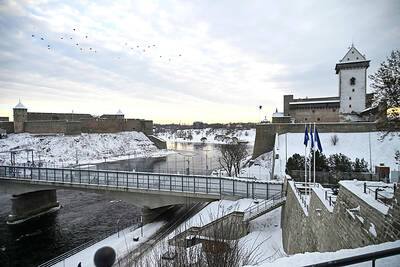
Two medieval fortresses face each other across the Narva River separating Estonia from Russia on Europe’s eastern edge. Once a symbol of cooperation, the “Friendship Bridge” connecting the two snow-covered banks has been reinforced with rows of razor wire and “dragon’s teeth” anti-tank obstacles on the Estonian side. “The name is kind of ironic,” regional border chief Eerik Purgel said. Some fear the border town of more than 50,0000 people — a mixture of Estonians, Russians and people left stateless after the fall of the Soviet Union — could be Russian President Vladimir Putin’s next target. On the Estonian side of the bridge,

Jeremiah Kithinji had never touched a computer before he finished high school. A decade later, he is teaching robotics, and even took a team of rural Kenyans to the World Robotics Olympiad in Singapore. In a classroom in Laikipia County — a sparsely populated grasslands region of northern Kenya known for its rhinos and cheetahs — pupils are busy snapping together wheels, motors and sensors to assemble a robot. Guiding them is Kithinji, 27, who runs a string of robotics clubs in the area that have taken some of his pupils far beyond the rural landscapes outside. In November, he took a team

Civil society leaders and members of a left-wing coalition yesterday filed impeachment complaints against Philippine Vice President Sara Duterte, restarting a process sidelined by the Supreme Court last year. Both cases accuse Duterte of misusing public funds during her term as education secretary, while one revives allegations that she threatened to assassinate former ally Philippine President Ferdinand Marcos Jr. The filings come on the same day that a committee in the House of Representatives was to begin hearings into impeachment complaints against Marcos, accused of corruption tied to a spiraling scandal over bogus flood control projects. Under the constitution, an impeachment by the
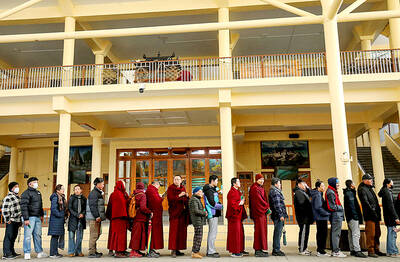
Exiled Tibetans began a unique global election yesterday for a government representing a homeland many have never seen, as part of a democratic exercise voters say carries great weight. From red-robed Buddhist monks in the snowy Himalayas, to political exiles in megacities across South Asia, to refugees in Australia, Europe and North America, voting takes place in 27 countries — but not China. “Elections ... show that the struggle for Tibet’s freedom and independence continues from generation to generation,” said candidate Gyaltsen Chokye, 33, who is based in the Indian hill-town of Dharamsala, headquarters of the government-in-exile, the Central Tibetan Administration (CTA). It


 RSS
RSS