


Two NASA astronauts who flew to the International Space Station (ISS) in June aboard Boeing’s faulty Starliner capsule would need to return to Earth on a Space Exploration Technologies (SpaceX) vehicle early next year, NASA officials said on Saturday, deeming issues with Starliner’s propulsion system too risky to carry its first crew home as planned.
Veteran NASA astronauts Butch Wilmore and Suni Williams, both former military test pilots, became the first crew to ride Starliner on June 5 when they were launched to the ISS for what was expected to be an eight-day test mission.
However, Starliner’s propulsion system experienced a series of glitches in the first 24 hours of its flight to the ISS that has so far kept the astronauts on the station for 79 days as Boeing scrambled to investigate the issues.
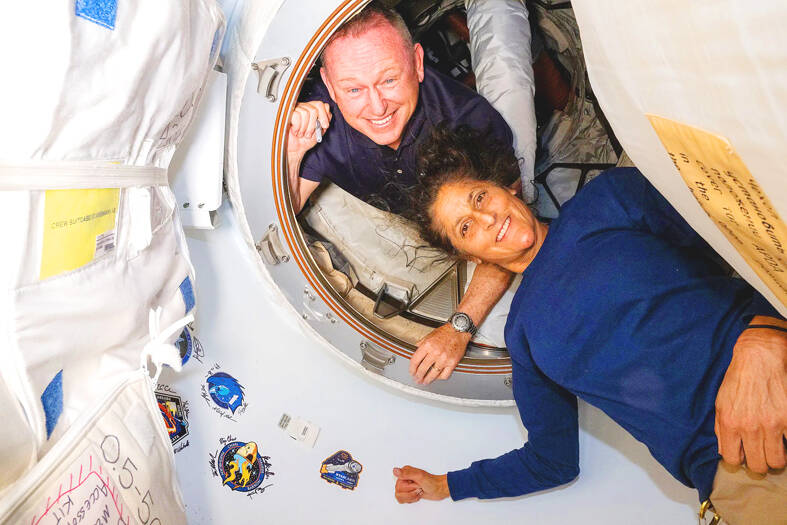
Photo: EPA-EFE / NASA
NASA officials told reporters during a news conference in Houston that Wilmore and Williams are safe and prepared to stay even longer.
They would use their extra time to conduct science experiments alongside the station’s other seven astronauts, NASA said.
In a rare reshuffling of NASA’s astronaut operations, the two astronauts are expected to return in February next year on a SpaceX Crew Dragon spacecraft due to launch next month as part of a routine astronaut rotation mission. Two of the Crew Dragon’s four astronaut seats would be kept empty for Wilmore and Williams.
The agency’s decision, tapping Boeing’s top space rival to return the astronauts, is one of NASA’s most consequential in years. Boeing had hoped its Starliner test mission would redeem the troubled program after years of development problems and more than US$1.6 billion in budget overruns since 2016.
Five of Starliner’s 28 thrusters failed during flight and it sprang several leaks of helium, which is used to pressurize the thrusters. It was still able to dock with the station, a football field-sized laboratory that has housed rotating crews of astronauts for over two decades.
Starliner would undock from the ISS without a crew in “early September,” NASA said in a statement.
The spacecraft would attempt to return to Earth autonomously, forgoing a core test objective of having a crew present and in control for the return trip.
“I know this is not the decision we had hoped for, but we stand ready to carry out the action’s necessary to support NASA’s decision,” Boeing’s Starliner chief Mark Nappi told employees in an e-mail.
“The focus remains first and foremost on ensuring the safety of the crew and spacecraft,” Nappi said.
Several senior NASA officials and Boeing representatives made the decision during a Saturday morning meeting in Houston.
Agency officials unanimously voted for Crew Dragon to bring the astronauts home, NASA Associate Administrator for Space Operations Ken Bowersox said.
Boeing voted for Starliner, which it said was safe.
Nelson told reporters at the news conference in Houston that he discussed the agency’s decision with Boeing’s new CEO Kelly Ortberg and was confident Boeing would continue its Starliner program.
Nelson said he was “100 percent” certain the spacecraft would fly another crew.
Boeing struggled for years to develop Starliner, a gumdrop-shaped capsule designed to compete with Crew Dragon as a second US option for transporting astronauts to and from Earth’s orbit. The company is also struggling with quality issues on production of commercial planes, its most important products.

The death of a former head of China’s one-child policy has been met not by tributes, but by castigation of the abandoned policy on social media this week. State media praised Peng Peiyun (彭珮雲), former head of China’s National Family Planning Commission from 1988 to 1998, as “an outstanding leader” in her work related to women and children. The reaction on Chinese social media to Peng’s death in Beijing on Sunday, just shy of her 96th birthday, was less positive. “Those children who were lost, naked, are waiting for you over there” in the afterlife, one person posted on China’s Sina Weibo platform. China’s
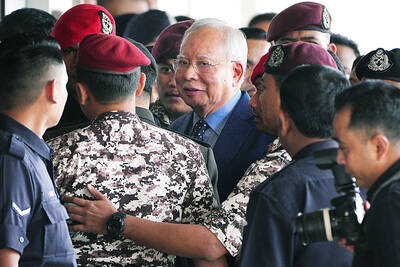
‘NO COUNTRY BUMPKIN’: The judge rejected arguments that former prime minister Najib Razak was an unwitting victim, saying Najib took steps to protect his position Imprisoned former Malaysian prime minister Najib Razak was yesterday convicted, following a corruption trial tied to multibillion-dollar looting of the 1Malaysia Development Berhad (1MDB) state investment fund. The nation’s high court found Najib, 72, guilty on four counts of abuse of power and 21 charges of money laundering related to more than US$700 million channeled into his personal bank accounts from the 1MDB fund. Najib denied any wrongdoing, and maintained the funds were a political donation from Saudi Arabia and that he had been misled by rogue financiers led by businessman Low Taek Jho. Low, thought to be the scandal’s mastermind, remains
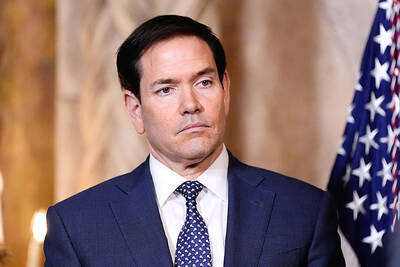
‘POLITICAL LOYALTY’: The move breaks with decades of precedent among US administrations, which have tended to leave career ambassadors in their posts US President Donald Trump’s administration has ordered dozens of US ambassadors to step down, people familiar with the matter said, a precedent-breaking recall that would leave embassies abroad without US Senate-confirmed leadership. The envoys, career diplomats who were almost all named to their jobs under former US president Joe Biden, were told over the phone in the past few days they needed to depart in the next few weeks, the people said. They would not be fired, but finding new roles would be a challenge given that many are far along in their careers and opportunities for senior diplomats can

Australian Prime Minister Anthony Albanese yesterday announced plans for a national bravery award to recognize civilians and first responders who confronted “the worst of evil” during an anti-Semitic terror attack that left 15 dead and has cast a heavy shadow over the nation’s holiday season. Albanese said he plans to establish a special honors system for those who placed themselves in harm’s way to help during the attack on a beachside Hanukkah celebration, like Ahmed al-Ahmed, a Syrian-Australian Muslim who disarmed one of the assailants before being wounded himself. Sajid Akram, who was killed by police during the Dec. 14 attack, and


 RSS
RSS