


A jailed Kurdish leader and a Turkish writer on the other side of the bars have used their penpal exchanges to write one of Turkey’s highest-selling books.
The crime novel Duet in Purgatory, which features a retired left-wing lawyer and a bitter aging general with a tortuous past, has been a roaring success.
The two writers developed the story, which spans the past 40 years of Turkey’s tumultuous history and the long-standing Kurdish conflict, without ever discussing the plot.
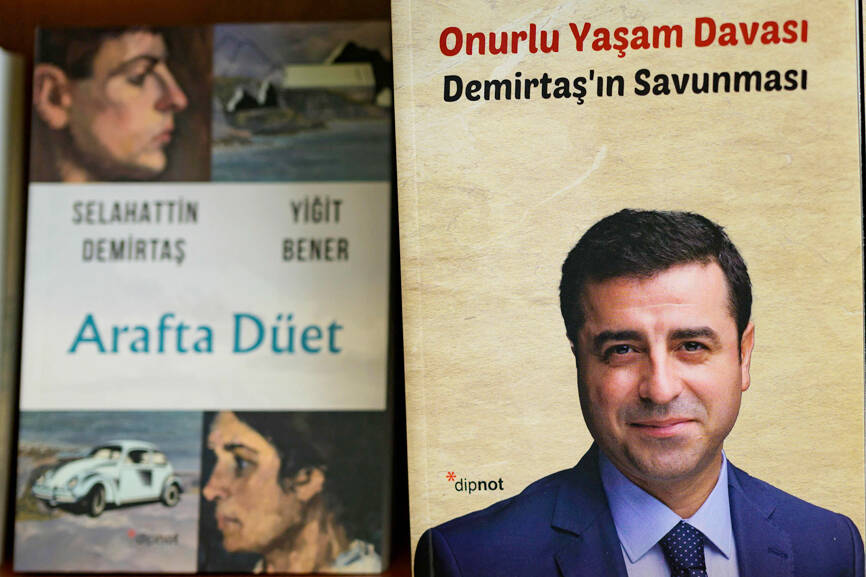
Photo: AFP
“It was a risky gamble to try and write a novel like you’d play chess, move by move, without agreeing on the plot, the characters or the style — nothing,” Selahattin Demirtas told a literary critic in an interview from prison.
The writing of the story began when author and translator Yigit Bener sent the jailed Kurdish leader Demirtas, who is serving a 42-year sentence, a copy of Louis-Ferdinand Celine’s classic novel Journey to the End of the Night.
He also put a note inside — “the expression of my solidarity.”
Demirtas, who is 51 and a former co-president of the third-largest political party in Turkey’s parliament, was jailed in 2016, with the European Court of Human Rights later condemning his detention as political and calling for his release.
“I couldn’t accept that this man for whom, like 6 million others, I had voted for, and whose ideas I share, found himself behind bars while I am free,” Bener said.
Bener, who lived in exile in the 1980s, had praised Demirtas’s collection of short stories Dawn, and the two began corresponding via the politician’s lawyer.
The re-election of Turkish President Recep Tayyip Erdogan in May last year killed Demirtas’ hope of an early release, so Bener pitched the idea of taking their correspondence further.
“What if we wrote a novel, both of us?” Bener suggested, although he had not thought about a plot or characters and had not intended it as a serious project.
While the idea originally sought to keep the prisoner busy, the duo soon wrapped up 13 chapters. Bener refused to say who wrote first, but said that the pair took turns to write.
“We had a lot of fun, but we had to finish,” Bener said. “We put it aside for two months before we had a few friends read it.”
Demirtas’ publishing house, Dipnot, which has put out his previous novels and short stories, initially printed 55,000 copies last month, with more to come next month.
“Our personal stories, mine and Yigit’s trajectories, contributed to shaping the novel. He motivated me when I needed it,” the Kurdish political leader said.
The secret behind the novel’s success is its timely relevance, Bener said.
“The book poses the question of reconciliation through two characters from the same generation of losers who share the same feeling of defeat,” Bener said. “The idea speaks to today’s Turkey which is more polarized than ever.”
Bener was “extremely emotional” when he finally got permission to meet Demirtas in Edirne prison in northwest Turkey on the day of the book’s release, as the opposition leader is in isolation and only allowed weekly visits from his lawyer or family.
Exceptionally, he was let out of the small cell where he has been locked up for eight years, which he shares with a former mayor of the Kurdish city of Diyarbakir, Adnan Selcuk Mizrakli.
Critics have praised the “funny, fast-paced and spirited narrative,” with readers rushing to see the free half of the writing duo as he tours bookshops.

The death of a former head of China’s one-child policy has been met not by tributes, but by castigation of the abandoned policy on social media this week. State media praised Peng Peiyun (彭珮雲), former head of China’s National Family Planning Commission from 1988 to 1998, as “an outstanding leader” in her work related to women and children. The reaction on Chinese social media to Peng’s death in Beijing on Sunday, just shy of her 96th birthday, was less positive. “Those children who were lost, naked, are waiting for you over there” in the afterlife, one person posted on China’s Sina Weibo platform. China’s

‘NO COUNTRY BUMPKIN’: The judge rejected arguments that former prime minister Najib Razak was an unwitting victim, saying Najib took steps to protect his position Imprisoned former Malaysian prime minister Najib Razak was yesterday convicted, following a corruption trial tied to multibillion-dollar looting of the 1Malaysia Development Berhad (1MDB) state investment fund. The nation’s high court found Najib, 72, guilty on four counts of abuse of power and 21 charges of money laundering related to more than US$700 million channeled into his personal bank accounts from the 1MDB fund. Najib denied any wrongdoing, and maintained the funds were a political donation from Saudi Arabia and that he had been misled by rogue financiers led by businessman Low Taek Jho. Low, thought to be the scandal’s mastermind, remains

‘POLITICAL LOYALTY’: The move breaks with decades of precedent among US administrations, which have tended to leave career ambassadors in their posts US President Donald Trump’s administration has ordered dozens of US ambassadors to step down, people familiar with the matter said, a precedent-breaking recall that would leave embassies abroad without US Senate-confirmed leadership. The envoys, career diplomats who were almost all named to their jobs under former US president Joe Biden, were told over the phone in the past few days they needed to depart in the next few weeks, the people said. They would not be fired, but finding new roles would be a challenge given that many are far along in their careers and opportunities for senior diplomats can

Australian Prime Minister Anthony Albanese yesterday announced plans for a national bravery award to recognize civilians and first responders who confronted “the worst of evil” during an anti-Semitic terror attack that left 15 dead and has cast a heavy shadow over the nation’s holiday season. Albanese said he plans to establish a special honors system for those who placed themselves in harm’s way to help during the attack on a beachside Hanukkah celebration, like Ahmed al-Ahmed, a Syrian-Australian Muslim who disarmed one of the assailants before being wounded himself. Sajid Akram, who was killed by police during the Dec. 14 attack, and


 RSS
RSS