


Ukrainian President Volodymyr Zelenskiy on Friday said he expects Russia to step up its offensive in the northeast and warned that Kyiv only has one-quarter of the air defenses it needs to hold the front line.
Russian forces, which made only moderate advances in the past few months, launched a surprise assault in the Kharkiv region on Friday last week that has resulted in their biggest territorial gains in a year and a half.
Russian troops have advanced 5km to 10km along the northeastern border before being stopped by Ukrainian forces, but the region could be the “first wave” in a wider offensive, Zelenskiy said.
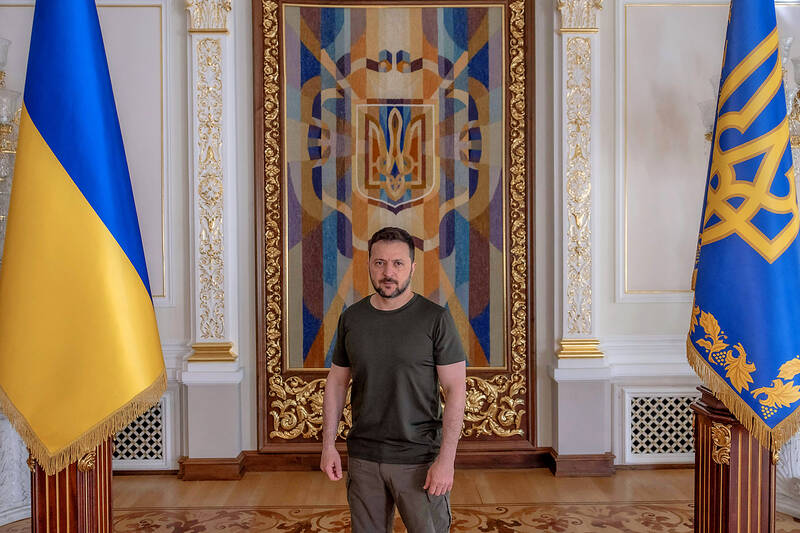
Photo: AFP
“I won’t say it’s a great success [for Russia], but we have to be sober and understand that they are going deeper into our territory,” he said, speaking from Kyiv in his first interview with foreign media since the offensive began.
Zelenskiy said the situation in the Kharkiv region has been “controlled,” but “not stabilized.”
He doubled down on pleas to allies to send more air defense and fighter jets to combat Russia’s air superiority as the war grinds through its third year.
“Today, we have about 25 percent of what we need to defend Ukraine. I’m talking about air defense,” he said.
Ukraine needs “120 to 130” F-16 jets or other advanced aircraft to achieve air “parity” with Russia, Zelenskiy said.
Russian President Vladimir Putin said during a trip to China this week that the northeastern offensive was in retaliation for Ukraine’s shelling of border regions and that Moscow was trying to create a “security zone.”
Russian forces took 278km2 between Thursday last week and Wednesday, their biggest gains since the end of 2022, data from the Institute for the Study of War showed.
Kharkiv Governor Oleg Synegubov yesterday said that the Ukrainian Armed Forces of Ukraine armed forces had repelled two attempts to break through defenses overnight, with the situation “under control.”
Ukrainian officials have accused Russian soldiers in Vovchansk of capturing dozens of civilians to use as “human shields” to defend their command headquarters — a claim Agence France-Presse was unable to immediately verify.
“In the area of the city of Vovchansk, Ukrainian troops are reinforcing their defense to improve the tactical situation,” Synegubov said.
Ukraine has evacuated almost 10,000 people from the northeast border area since Russia launched the assault.
Putin said there was no intention at this stage to take Kharkiv, Ukraine’s second city, about 30km from the border.
More than 1 million people still live there.
Military analysts say the northeastern offensive could aim to further stretch Ukrainian troops and resources, with Russia pressing its force size and ammunition advantage.
Ukrainian Armed Forces Commander-in-Chief chief Oleksandr Syrsky said Russia was trying to force Ukraine to pull up even more troops from its reserves.
“We realize that there will be heavy fighting ahead and the enemy is preparing for it,” he said.
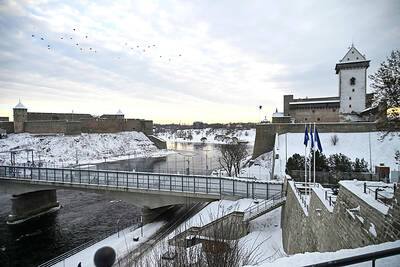
Two medieval fortresses face each other across the Narva River separating Estonia from Russia on Europe’s eastern edge. Once a symbol of cooperation, the “Friendship Bridge” connecting the two snow-covered banks has been reinforced with rows of razor wire and “dragon’s teeth” anti-tank obstacles on the Estonian side. “The name is kind of ironic,” regional border chief Eerik Purgel said. Some fear the border town of more than 50,0000 people — a mixture of Estonians, Russians and people left stateless after the fall of the Soviet Union — could be Russian President Vladimir Putin’s next target. On the Estonian side of the bridge,

Jeremiah Kithinji had never touched a computer before he finished high school. A decade later, he is teaching robotics, and even took a team of rural Kenyans to the World Robotics Olympiad in Singapore. In a classroom in Laikipia County — a sparsely populated grasslands region of northern Kenya known for its rhinos and cheetahs — pupils are busy snapping together wheels, motors and sensors to assemble a robot. Guiding them is Kithinji, 27, who runs a string of robotics clubs in the area that have taken some of his pupils far beyond the rural landscapes outside. In November, he took a team

Civil society leaders and members of a left-wing coalition yesterday filed impeachment complaints against Philippine Vice President Sara Duterte, restarting a process sidelined by the Supreme Court last year. Both cases accuse Duterte of misusing public funds during her term as education secretary, while one revives allegations that she threatened to assassinate former ally Philippine President Ferdinand Marcos Jr. The filings come on the same day that a committee in the House of Representatives was to begin hearings into impeachment complaints against Marcos, accused of corruption tied to a spiraling scandal over bogus flood control projects. Under the constitution, an impeachment by the
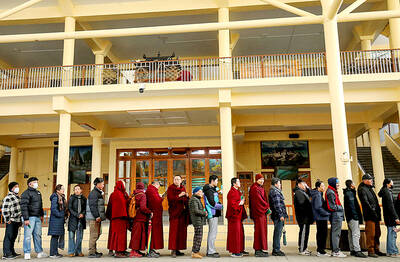
Exiled Tibetans began a unique global election yesterday for a government representing a homeland many have never seen, as part of a democratic exercise voters say carries great weight. From red-robed Buddhist monks in the snowy Himalayas, to political exiles in megacities across South Asia, to refugees in Australia, Europe and North America, voting takes place in 27 countries — but not China. “Elections ... show that the struggle for Tibet’s freedom and independence continues from generation to generation,” said candidate Gyaltsen Chokye, 33, who is based in the Indian hill-town of Dharamsala, headquarters of the government-in-exile, the Central Tibetan Administration (CTA). It


 RSS
RSS