


Half of Gazans are experiencing “catastrophic” hunger, with famine projected to hit the north of the territory by May unless there is urgent intervention, a UN-backed food security assessment said on Monday.
“People in Gaza are starving to death right now. The speed at which this manmade hunger and malnutrition crisis has ripped through Gaza is terrifying,” World Food Programme (WFP) Executive Director Cindy McCain said.
The Integrated Food Security Phase Classification (IPC) partnership on Monday estimated that 1.1 million people — half the population, according to UN data — were facing catastrophic conditions.
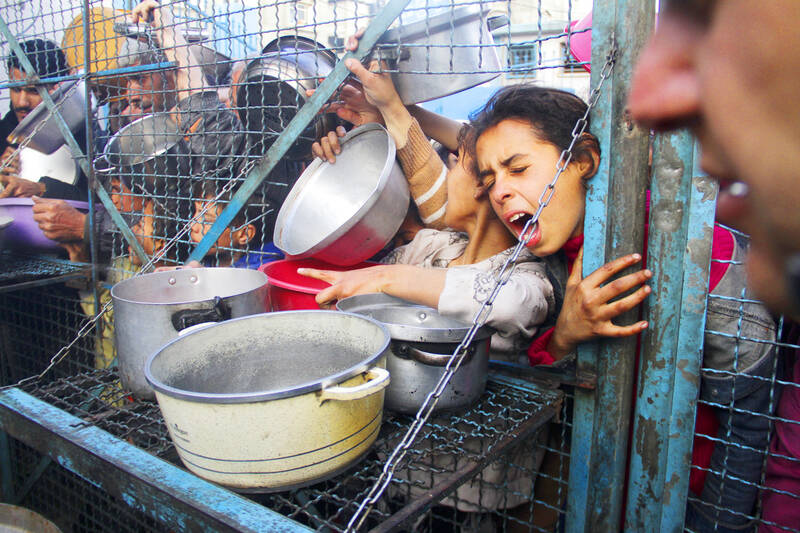
Photo: AP
“To have 50 percent of an entire population in catastrophic, near-famine levels, is unprecedented,” Food and Agriculture Deputy Director-General Beth Bechdol said.
The WFP said this was the “highest number of people ever recorded as facing catastrophic hunger” under the IPC system, originally developed in 2004.
The situation is particularly dire in the north of Gaza, where the UN says there are about 300,000 people — and where the IPC said famine was “imminent ... projected to occur anytime between mid-March and May.”
UN Undersecretary-General for Humanitarian Affairs and Emergency Relief Coordinator Martin Griffiths urged Israel to allow unfettered access for aid to the besieged Palestinian territory, saying there was “no time to lose.”
“The international community should hang its head in shame for failing to stop this,” he said.
US Department of State spokesman Vedant Patel said the findings were “alarming” and revealed a “heartwrenching” picture of “children who are starving.”
“That is why we believe so strongly that everything must be done to scale up the delivery of humanitarian assistance,” he said.
The bloodiest-ever Gaza war broke out after Hamas launched an unprecedented attack on Israel on Oct. 7, to which Israel responded with a relentless bombing campaign and ground offensive in the Hamas-run Palestinian territory.
With aid agencies reporting huge difficulties gaining access to Gaza, particularly the north, the UN has warned for weeks that a famine is looming.
The IPC on Monday that while the technical criteria for famine had not yet been met, “all evidence points towards a major acceleration of deaths and malnutrition.”
The report highlighted the horrific toll on children.
“Hunger is a slow and painful death,” said Hiba Tibi, country director for the CARE international aid group, who reported aid workers seeing children “who can barely talk and walk” for lack of food.
A famine is declared when 20 percent of households face an extreme food shortage, which is the case in Gaza, the UN says.
Other criteria are that one in three children are acutely malnourished, and that at least two in every 10,000 people die every day of starvation or malnutrition.
“One in three children below the age of two is now acutely malnourished, or ‘wasted,’” meaning they are dangerously thin, according to the WFP.
In a statement, the World Health Organization pointed to the lasting effects of malnutrition, particularly on children, warning that the “current situation will have long-term effects on the lives and health of thousands.”
“This compromises the health and well-being of an entire future generation,” it added.
WFP chief economist Arif Husain said the final criteria for declaring a famine — the mortality rate — could be met within weeks.
The FAO said it could be already happening in the north, where data is patchy.
“Waiting for a retrospective famine classification before acting is indefensible,” the IPC said.
Donors have turned to deliveries by air or sea, but these are not viable alternatives to land deliveries, UN agencies say.
Aid charity Oxfam on Monday accused Israel of continuing to “systematically and deliberately block and undermine” the delivery of aid into Gaza, in contravention of international humanitarian law.
Gazans are “turning to alternative sources” for food, including animal feed and “inedible items, purely out of desperation,” Bechdol said.
A ship that appears to be taking on the identity of a scrapped gas carrier exited the Strait of Hormuz on Friday, showing how strategies to get through the waterway are evolving as the Middle East war progresses. The vessel identifying as liquefied natural gas (LNG) carrier Jamal left the Strait on Friday morning, ship-tracking data show. However, the same tanker was also recorded as having beached at an Indian demolition yard in October last year, where it is being broken up, according to market participants and port agent’s reports. The ship claiming to be Jamal is likely a zombie vessel that

Japan is to downgrade its description of ties with China from “one of its most important” in an annual diplomatic report, according to a draft reviewed by Reuters, as relations with Beijing worsen. This year’s Diplomatic Bluebook, which Japanese Prime Minister Sanae Takaichi’s government is expected to approve next month, would instead describe China as an important neighbor and the relationship as “strategic” and “mutually beneficial.” The draft cites a series of confrontations with Beijing over the past year, including export controls on rare earths, radar lock-ons targeting Japanese military aircraft and increased pressure around Taiwan. The shift in tone underscores a deterioration

LAW CONSTRAINTS: The US has been pressing allies to send warships to open the Strait, but Tokyo’s military actions are limited under its postwar pacifist constitution Japan could consider deploying its military for minesweeping in the Strait of Hormuz if a ceasefire is reached in the war on Iran, Japanese Minister of Foreign Affairs Toshimitsu Motegi said yesterday. “If there were to be a complete ceasefire, hypothetically speaking, then things like minesweeping could come up,” Motegi said. “This is purely hypothetical, but if a ceasefire were established and naval mines were creating an obstacle, then I think that would be something to consider.” Japan’s military actions are limited under its postwar pacifist constitution, but 2015 security legislation allows Tokyo to use its Self-Defense Forces overseas if an attack,

German Chancellor Friedrich Merz’s conservative Christian Democratic Union (CDU) yesterday faced a regional election battle in Rhineland-Palatinate, now held by the center-left Social Democratic Party (SPD). Merz’s CDU has enjoyed a narrow poll lead over the SPD — their coalition partners at the national level — who have ruled the mid-sized state for 35 years. Polling third is the far-right Alternative for Germany (AfD), which spells a greater threat to the two centrist parties in several state elections in September in the country’s ex-communist east. The picturesque state of Rhineland-Palatinate, bordering France, Belgium and Luxembourg and with a population of about 4 million,


 RSS
RSS