


A whale as long as a train car that died after straying into a port in Osaka last month is set to be buried until it naturally becomes a skeletal specimen for a local museum.
It is the third year in a row that whales have become stranded in the area, raising questions about the reasons why and the cost of handling the incidents.
The animal is believed to be a male sperm whale, about 12m long and weighing an estimated 20 tonnes, and was earlier spotted in Sakai Semboku Port in the middle of last month.
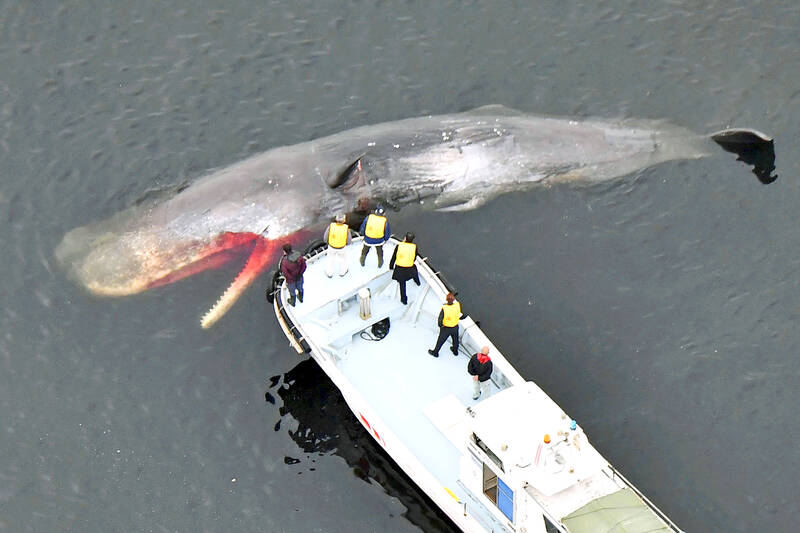
Photo: AP / Kyodo News
It had since been spotted in a number of locations in Osaka Bay, until Sunday, when a boat captain reported to the coast guard that the whale was not breathing.
Prefectural officials and experts took a boat out to check on the whale and on Monday confirmed its death, presumably due to starvation.
Osaka officials have decided to bury the dead whale at a section of a nearby industrial waste disposal complex after cetacean experts carried out an autopsy, collecting samples to determine the cause of the whale’s death, prefectural environmental department official Toshihiro Yamawaki said.
Television footage showed the dead whale being carefully lifted by a crane and transported to the burial site, where it is to stay underground for a few years until it becomes naturally skeletonized.
Officials will then dig it up and donate it to the local natural museum.
The cause of the stranding is unknown.
Yamawaki said whales have been sighted on and off not only in Osaka Bay, but across Japan, noting experts’ view that whales generally follow the movement of the warm Kuroshio tide.
Those that somehow miscalculated the distance and went too close to the coast may become stranded, scientists think.
On average, more than 300 whale strandings have been reported across Japan annually, although the number fluctuates every year.
In 2020, more than 370 strandings were reported, while the number decreased to 116 last year, the National Museum of Nature and Science’s whale stranding site showed.
The Osaka case involved a single animal as with most other strandings, although sometimes several whales have been seen stranded on nearby coasts.
Experts have cited a number of possible causes for the stranding, including tidal fluctuations, diseases and climate change, but they are still under investigation.
Some experts said the structure of Osaka Bay, which has many narrow passages, may make it difficult for stray whales to go back to the sea.
As soon as the whale was spotted, prefectural officials had started discussing what to do in case it died in the bay. They learned their lesson the hard way last year, when another stranded sperm whale, Yodo-chan, died only four days after it showed up and began to decompose, at a cost to the public purse of more than ¥80 million (US$$532,800), triggering criticism.
The cost of the offshore burial was nearly 10 times the amount spent in 2021 on another stray whale that was buried on land.
“The cost will be much lower this time,” Osaka Governor Hirofumi Yoshimura reassured residents.

FAKE NEWS? ‘When the government demands the press become a state mouthpiece under the threat of punishment, something has gone very wrong,’ a civic group said The top US broadcast regulator on Saturday threatened media outlets over negative coverage of the Middle East war, after US President Donald Trump slammed critical headlines from the “Fake News Media.” The US president since his first term has derided mainstream media as “fake news” and has sued major outlets over what he sees as unfair coverage. Brendan Carr, head of the US Federal Communications Commission — which oversees the nation’s radio, television and Internet media — said broadcasters risked losing their licenses over news coverage. “The law is clear. Broadcasters must operate in the public interest, and they will
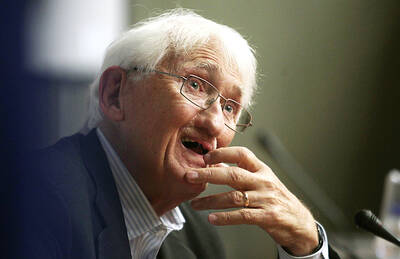
INFLUTENTIAL THEORIST: Habermas was particularly critical of the ‘limited interest’ shown by German politicians in ‘shaping a politically effective Europe Jurgen Habermas, whose work on communication, rationality and sociology made him one of the world’s most influential philosophers and a key intellectual figure in his native Germany, has died. He was 96. Habermas’ publisher, Suhrkamp, said he died on Saturday in Starnberg, near Munich. Habermas frequently weighed in on political matters over several decades. His extensive writing crossed the boundaries of academic and philosophical disciplines, providing a vision of modern society and social interaction. His best-known works included the two-volume Theory of Communicative Action. Habermas, who was 15 at the time of Nazi Germany’s defeat, later recalled the dawn of

The Chinese public maintains relatively warm sentiments toward Taiwan and strongly prefers non-military paths to improving cross-strait relations, a recent survey conducted by the Atlanta, Georgia-based Carter Center and Emory University showed. The “China Pulse” research project, which polled 2,506 adults between Oct. 27 last year and Jan. 1 this year, found that 86 percent of respondents support strengthening cultural ties, while 81 percent favor deepening economic interaction. The report, co-authored by political scientists at Emory University and advisors at the Carter Center, indicates that the Chinese public views Taiwan’s importance through a lens of shared history and culture rather than geopolitical

Cannabis-based medicines have shown little evidence of effectiveness for treating most mental health and substance-use disorders, according to a large review of past studies published in a major medical journal on Monday. Medical use of cannabinoids has been expanding, including in the US, Canada and Australia, where many patients report using cannabis products to manage conditions such as anxiety, post-traumatic stress disorder and sleep problems. Researchers reviewed data from 54 randomized clinical trials conducted between 1980 and May last year involving 2,477 participants for their analysis published in The Lancet. The studies assessed cannabinoids as a primary treatment for mental disorders or substance-use


 RSS
RSS