


The US Supreme Court on Friday allowed Idaho to enforce its strict abortion ban, even in medical emergencies, while a legal fight continues.
The justices said they would hear arguments in April and put on hold a lower court ruling that had blocked the Idaho law in hospital emergencies, based on a lawsuit filed by the administration of US President Joe Biden.
The Idaho case gives the court its second major abortion dispute since the justices in 2022 overturned Roe v Wade and allowed states to severely restrict or ban abortion. The court also in the coming months is to hear a challenge to the US Food and Drug Administration’s rules for obtaining mifepristone, one of two medications used in the most common method of abortion in the nation.
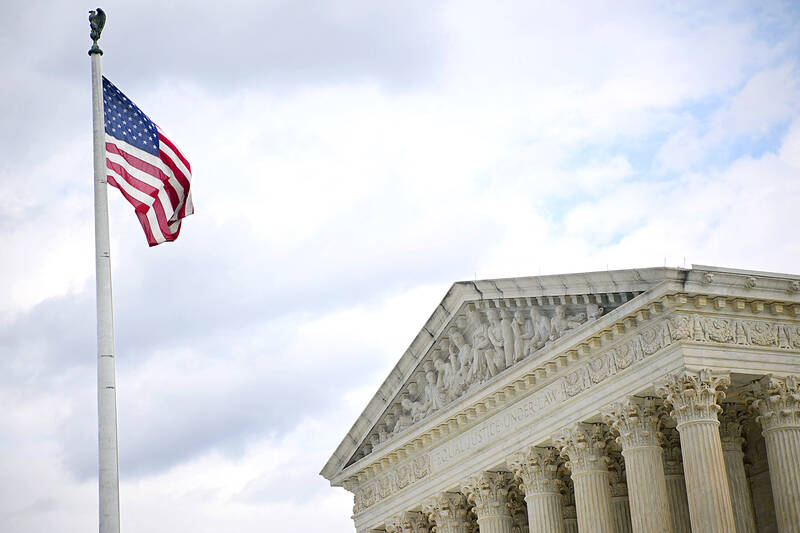
Photo: AFP
In the case over hospital emergencies, the Biden administration has argued that hospitals that receive Medicare funds are required by federal law to provide emergency care, potentially including abortion, no matter if there is a state law banning abortion.
The administration issued guidance about the federal law, the Emergency Medical Treatment and Labor Act (EMTALA), two weeks after the high court ruling in 2022. The Democratic administration sued Idaho a month later.
US District Judge B. Lynn Winmill in Idaho agreed with the administration, but in a separate case in Texas, a judge sided with the state.
In a statement on Friday night, Biden objected to the high court’s decision and said his administration “will continue to defend a woman’s ability to access emergency care under federal law.”
Idaho makes it a crime with a prison term of up to five years for anyone who performs or assists in an abortion.
The administration argues that EMTALA requires healthcare providers to perform abortions for emergency room patients when needed to treat an emergency medical condition, even if doing so might conflict with a state’s abortion restrictions.
Those conditions include severe bleeding, preeclampsia and some pregnancy-related infections.
“For certain medical emergencies, abortion care is the necessary stabilizing treatment,” US Solicitor General Elizabeth Prelogar wrote in an administration filing at the Supreme Court.
The state argued that the administration was misusing a law intended to prevent hospitals from dumping patients and imposing “a federal abortion mandate” on states.
“EMTALA says nothing about abortion,” Idaho Attorney General Raul Labrador told the court in a brief.
On Tuesday, the federal appeals court in New Orleans came to the same conclusion as Labrador. A three-judge panel ruled that the administration cannot use EMTALA to require hospitals in Texas to provide abortions for women whose lives are at risk due to pregnancy. Two of the three judges are appointees of former US president Donald Trump, and the other was appointed by another former Republican US president, George W. Bush.
The appeals court affirmed a ruling by US District Judge James Wesley Hendrix, also a Trump appointee. Hendrix wrote that adopting the Biden administration’s view would force physicians to place the health of the pregnant person over that of the fetus or embryo even though EMTALA “is silent as to abortion.”
After Winmill, an appointee of former Democratic US president Bill Clinton, issued his ruling, Idaho lawmakers won an order allowing the law to be fully enforced from an all-Republican, Trump-appointed panel of the 9th US Circuit Court of Appeals.
However, a larger contingent of 9th Circuit judges threw out the panel’s ruling and had set arguments in the case for late this month.
The justices’ order on Friday takes the case away from the appeals court. A decision is expected by early summer.

The death of a former head of China’s one-child policy has been met not by tributes, but by castigation of the abandoned policy on social media this week. State media praised Peng Peiyun (彭珮雲), former head of China’s National Family Planning Commission from 1988 to 1998, as “an outstanding leader” in her work related to women and children. The reaction on Chinese social media to Peng’s death in Beijing on Sunday, just shy of her 96th birthday, was less positive. “Those children who were lost, naked, are waiting for you over there” in the afterlife, one person posted on China’s Sina Weibo platform. China’s
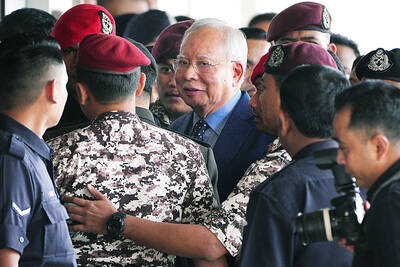
‘NO COUNTRY BUMPKIN’: The judge rejected arguments that former prime minister Najib Razak was an unwitting victim, saying Najib took steps to protect his position Imprisoned former Malaysian prime minister Najib Razak was yesterday convicted, following a corruption trial tied to multibillion-dollar looting of the 1Malaysia Development Berhad (1MDB) state investment fund. The nation’s high court found Najib, 72, guilty on four counts of abuse of power and 21 charges of money laundering related to more than US$700 million channeled into his personal bank accounts from the 1MDB fund. Najib denied any wrongdoing, and maintained the funds were a political donation from Saudi Arabia and that he had been misled by rogue financiers led by businessman Low Taek Jho. Low, thought to be the scandal’s mastermind, remains

Australian Prime Minister Anthony Albanese yesterday announced plans for a national bravery award to recognize civilians and first responders who confronted “the worst of evil” during an anti-Semitic terror attack that left 15 dead and has cast a heavy shadow over the nation’s holiday season. Albanese said he plans to establish a special honors system for those who placed themselves in harm’s way to help during the attack on a beachside Hanukkah celebration, like Ahmed al-Ahmed, a Syrian-Australian Muslim who disarmed one of the assailants before being wounded himself. Sajid Akram, who was killed by police during the Dec. 14 attack, and

VISHNU VANDALS: A Cambodian official accused Thailand of destroying a statue in a disputed border area, with video showing the Hindu structure being torn down The Thai military said ceasefire talks with Cambodia, set to begin yesterday, are expected to conclude with a meeting of the countries’ defense ministers on Saturday, as the two sides seek to end weeks of deadly clashes. The talks started at 4pm in Thailand’s Chanthaburi Province, which borders Cambodia. The Thai Ministry of Defense outlined several demands to be discussed ahead of the bilateral meeting of the General Border Committee (GBC) on Saturday. If secretariat-level discussions fail to reach agreement on key technical frameworks such as troop deployments, the Thai side would not proceed with the GBC meeting or sign any agreement on


 RSS
RSS