


Dismissed from the military amid speculation of rights abuses, exiled in Jordan and banned from traveling to the US on account of his alleged dark past, Indonesian Minister of Defense Prabowo Subianto is now in pole position to be the nation’s next leader.
The two-time presidential loser on Sunday announced that he would contest the post for a third time in the February election, with Indonesian President Joko Widodo’s son as his running mate.
“We are ready to move forward for Indonesia,” Prabowo told a news conference.
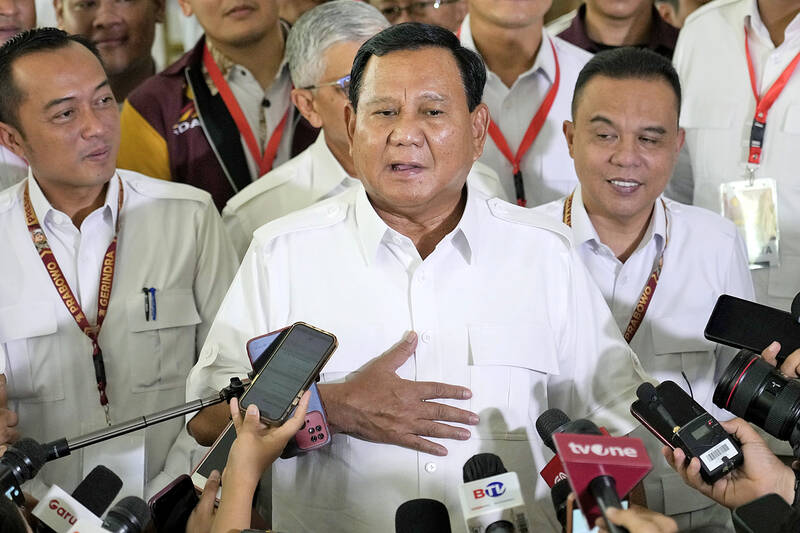
Photo: AP
The former special forces commander has undergone a remarkable transformation since being appointed defense minister in 2019, cultivating a persona that is more charismatic statesman than fiery, pious nationalist, analysts say.
The former son-in-law of late Indonesian president Suharto, Prabowo is accused of involvement in the kidnapping of student activists in 1998 and rights abuses in Papua province and East Timor. The allegations are unproven, and Prabowo has always denied any responsibility.
As the 72-year-old gears up for the election campaign, the numbers suggest his rebranding is working.
An opinion poll published by Lembaga Survei Indonesia (LSI) this month showed Prabowo ahead of his two opponents with 34 percent support.
In a two-way race against his closest competitor, former Central Java governor Ganjar Pranowo, he had an 11-point lead.
“His chance at winning is now the strongest,” LSI executive director Djayadi Hanan said. “Part of the reason for that is the president’s endorsement.”
Unable to run after serving the maximum two terms, Widodo has signaled hat he backs his once bitter enemy. Widodo defeated Prabowo in the 2014 and 2019 elections.
With his 36-year-old son as a possible vice president, Widodo is seeking to retain some influence in government, analysts say.
By appointing Prabowo to his Cabinet in 2019, Widodo provided the former general with a level of validation and visibility he previously lacked, such as seeing his de facto travel ban to the US erased in 2020 when he visited the Pentagon.
As minister, Prabowo has embarked on an ambitious upgrade of the country’s aging military hardware, signing defense deals in Europe, the US and Middle East, with red carpets rolled out for him from Paris to Beijing.
To his almost 6 million Instagram followers, Prabowo’s profile is regularly updated with snaps from his day job, interspersed with offerings of his cats, artistic black and white portraits, and vintage family photographs of his parents and childhood
“Prabowo’s team is clearly portraying Prabowo in a ‘softer’ way in an effort to win over undecided voters. It’s a change from previous campaigns where we’ve seen nationalist populist Prabowo, and pro-Islamist Prabowo,” said Ross Tapsell, a researcher at the Australian National University’s College of Asia and the Pacific.
As the campaign heats up, the question is whether the approach continues.
“In 2019, he started quite politely and calmly, and by the end he was claiming the election was rigged,” Tapsell added.
In another sign of the image makeover, in a recent television interview with journalist Najwa Shihab, the former general, known for his legendary temper, came across as humorous and avuncular.
Referring to his time as a soldier Prabowo said: “Maybe the perception of me was that I was tough, scary. I am not scary now, right?” he said.
“He obviously has very savvy PR people who have helped to shape his image. He has been much more restrained in direct interviews and has avoided open press conferences,” said Andreas Harsono, Indonesia researcher at Human Rights Watch.
With more than 100 million Indonesians under the age of 40 registered in next February’s polls, all candidates are vying for the millennial vote.
Many are too young to know the details of the accusations leveled against Prabowo, which he says are not widely discussed in the Indonesian media anymore, Harsono said.
“The younger generation does not know much about what Prabowo did in Jakarta, East Timor, Papua,” he said. “He has never been held accountable.”


When a hiker fell from a 55m waterfall in wild New Zealand bush, rescuers were forced to evacuate the badly hurt woman without her dog, which could not be found. After strangers raised thousands of dollars for a search, border collie Molly was flown to safety by a helicopter pilot who was determined to reunite the pet and the owner. A week earlier, an emergency rescue helicopter found the woman with bruises and lacerations after a fall at a rocky spot at the waterfall on the South Island’s West Coast. She was airlifted on March 24, but they were forced to

HIGH HOPES: The power source is expected to have a future, as it is not dependent on the weather or light, and could be useful for places with large desalination facilities A Japanese water plant is harnessing the natural process of osmosis to generate renewable energy that could one day become a common power source. The possibility of generating power from osmosis — when water molecules pass from a less salty solution to a more salty one — has long been known. However, actually generating energy from that has proved more complicated, in part due the difficulty of designing the membrane through which the molecules pass. Engineers in Fukuoka, Japan, and their private partners think they might have cracked it, and have opened what is only the world’s second osmotic power plant. It generates
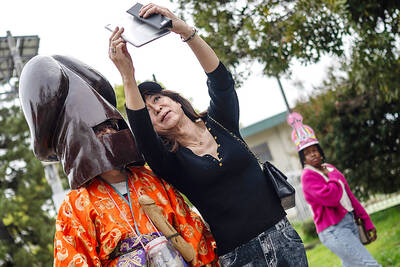
Showcasing phallus-shaped portable shrines and pink penis candies, Japan’s annual fertility festival yesterday teemed with tourists, couples and families elated by its open display of sex. The spring Kanamara Matsuri near Tokyo features colorfully dressed worshipers carrying a trio of giant phallic-shaped objects as they parade through the street with glee. The festival, as legend has it, honors a local blacksmith in the Edo Period (1603-1868) who forged an iron dildo to break the teeth of a sharp-toothed demon inhabiting a woman’s vagina that had been castrating young men on their wedding nights. A 1m black steel phallus sits in the courtyard of

JAN. 1 CLAUSE: As military service is voluntary, applications for permission to stay abroad for over three months for men up to age 45 must, in principle, be granted A little-noticed clause in sweeping changes to Germany’s military service policy has triggered an uproar after it emerged that the law requires men aged up to 45 to get permission from the armed forces before any significant stay abroad, even in peacetime. The legislation, which went into effect on Jan. 1 aims to bolster the military and demands all 18-year-old men fill out a questionnaire to gauge their suitability to serve in the armed forces, but stops short of conscription. If the “modernized” model fails to pull in enough recruits, parliament will be compelled to discuss the reintroduction of compulsory service, German


 RSS
RSS