


Members of the US House of Representatives are using a special counsel’s report to renew their argument that federal law enforcement is tainted by political bias.
John Durham, who recently completed his report on the FBI’s investigation of former US president Donald Trump’s 2016 campaign, was to testify yesterday before the House Judiciary Committee one day after Durham met behind closed doors with members of the House Intelligence Committee.
Durham produced one conviction in a four-year investigation, and his report said that FBI agents withheld key information from judges and disregarded reasons not to investigate Trump’s campaign.
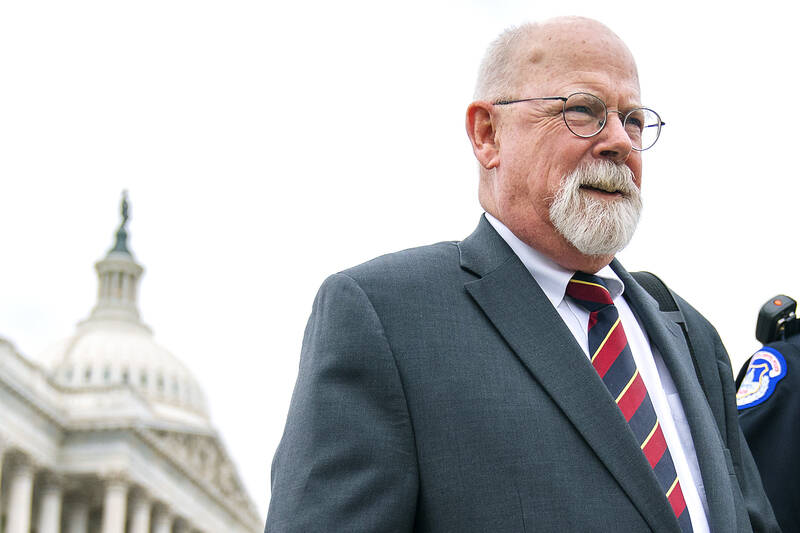
Photo: AP
The 2016 campaign probe, known as “Crossfire Hurricane,” has prompted calls for curbs on the FBI in exchange for renewing surveillance powers known as Section 702 that expire at the end of this year.
Durham was appointed by former US attorney-general William Barr to review the origins of the investigation into Trump’s 2016 campaign.
He concluded that the FBI acted too hastily and without sufficient justification to launch a full investigation and that it showed more caution on allegations that former US secretary of state Hillary Rodham Clinton mishandled classified information on her private e-mail server.
He also said that the FBI cited the so-called Steele dossier before the primary US surveillance court even after investigators failed to corroborate “a single substantive allegation” within it.
The Clinton campaign partially funded creation of the dossier and agreed last year with the Democratic National Committee to pay a US$113,000 fine for misreporting campaign spending on research.
The FBI is also facing criticism of how it handles intelligence collected electronically under Section 702, which allows US spy agencies to collect foreign telephone calls and e-mails for their investigations.
However, a declassified surveillance court opinion found that the FBI had run thousands of unsupported searches of Americans.
Previewing Durham’s meeting with the Intelligence Committee, US Representative Mike Turner, the panel’s chairman, last week said that the FBI “went off the rails” and hurt the justice system’s credibility.
“Rules and laws need to be changed so that these mechanisms cannot be used again in this way to really harm the American public,” he said.
FBI Director Chris Wray has acknowledged errors in how the FBI handled the Trump probe.
In a statement on Tuesday, the FBI said that it had “already implemented dozens of corrective actions, which have now been in place for some time.”
The Durham report “reinforces the importance of ensuring the FBI continues to do its work with the rigor, objectivity, and professionalism the American people deserve and rightly expect,” the statement said.
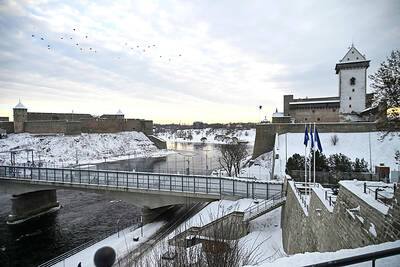
Two medieval fortresses face each other across the Narva River separating Estonia from Russia on Europe’s eastern edge. Once a symbol of cooperation, the “Friendship Bridge” connecting the two snow-covered banks has been reinforced with rows of razor wire and “dragon’s teeth” anti-tank obstacles on the Estonian side. “The name is kind of ironic,” regional border chief Eerik Purgel said. Some fear the border town of more than 50,0000 people — a mixture of Estonians, Russians and people left stateless after the fall of the Soviet Union — could be Russian President Vladimir Putin’s next target. On the Estonian side of the bridge,

Jeremiah Kithinji had never touched a computer before he finished high school. A decade later, he is teaching robotics, and even took a team of rural Kenyans to the World Robotics Olympiad in Singapore. In a classroom in Laikipia County — a sparsely populated grasslands region of northern Kenya known for its rhinos and cheetahs — pupils are busy snapping together wheels, motors and sensors to assemble a robot. Guiding them is Kithinji, 27, who runs a string of robotics clubs in the area that have taken some of his pupils far beyond the rural landscapes outside. In November, he took a team
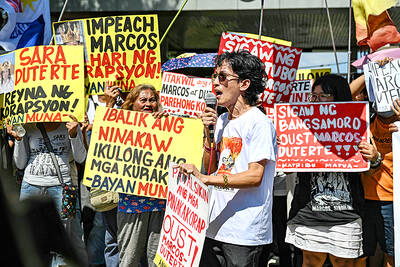
Civil society leaders and members of a left-wing coalition yesterday filed impeachment complaints against Philippine Vice President Sara Duterte, restarting a process sidelined by the Supreme Court last year. Both cases accuse Duterte of misusing public funds during her term as education secretary, while one revives allegations that she threatened to assassinate former ally Philippine President Ferdinand Marcos Jr. The filings come on the same day that a committee in the House of Representatives was to begin hearings into impeachment complaints against Marcos, accused of corruption tied to a spiraling scandal over bogus flood control projects. Under the constitution, an impeachment by the
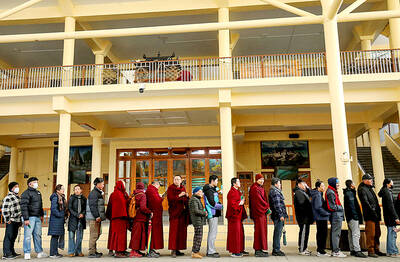
Exiled Tibetans began a unique global election yesterday for a government representing a homeland many have never seen, as part of a democratic exercise voters say carries great weight. From red-robed Buddhist monks in the snowy Himalayas, to political exiles in megacities across South Asia, to refugees in Australia, Europe and North America, voting takes place in 27 countries — but not China. “Elections ... show that the struggle for Tibet’s freedom and independence continues from generation to generation,” said candidate Gyaltsen Chokye, 33, who is based in the Indian hill-town of Dharamsala, headquarters of the government-in-exile, the Central Tibetan Administration (CTA). It


 RSS
RSS