


Philippine officials yesterday began evacuating thousands of people, shut down schools and offices and imposed a no-sail ban as Typhoon Mawar approached the country’s northern provinces a week after battering the US territory of Guam.
The typhoon was packing maximum sustained winds of 155kpm and gusts of up to 190kph, but was forecast to spare the mountainous region a direct hit. Current projections show the typhoon veering northeast toward Taiwan or southern Japan.
Although it is expected to slow down considerably, authorities warned of dangerous tidal surges, flash floods and landslides as it blows past the northernmost province of Batanes from today to tomorrow.
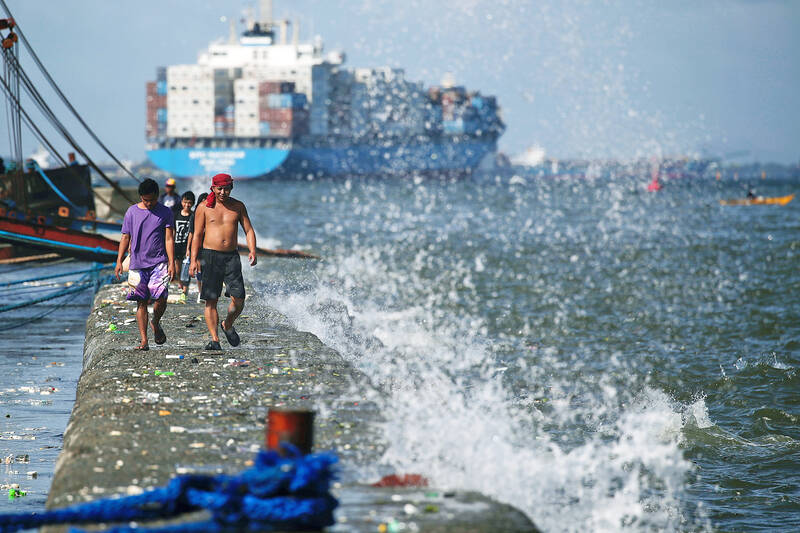
Photo: EPA-EFE
Disaster-preparedness officials said the typhoon’s course could change abruptly and there was no room for complacency.
“Even if the sun is up, the weather is so unpredictable nowadays and could change any time so we should always stay on the side of safety,” Philippine Office of Civil Defense Assistant Secretary Raffy Alejandro said. “We’re talking here of potential threats to lives.”
Mawar tore through Guam last week as the strongest typhoon to hit the US Pacific territory in more than two decades, flipping vehicles, tearing off roofs and knocking out power.
“These typhoons, earthquakes and natural calamities have been a part of our lives,” Batanes Vice Governor Ignacio Villa said. “We cannot afford not to prepare because that would potentially mean the loss of lives and major damage.”
Military personnel, police, firefighters and volunteer groups were standing by for search-and-rescue operations in northern provinces and more than 1 million food packs have been prepared for any contingency, officials said.
More than 4,800 people have been evacuated to emergency shelters in Cagayan, Batanes and other provinces, Alejandro said.
He added that the number of the displaced was expected to rise given the precautionary evacuations that were under way yesterday in flood and landslide-prone regions.
Classes and office work, except those involved in disaster-preparedness, have been suspended in most of Cagayan and Batanes provinces, where occasional downpours and gusty wind were reported on Sunday night. Flights to and from the provinces have been canceled and fishing and passenger vessels prohibited from sailing.
In at least one province, officials imposed a liquor ban.
Villa said the local government lent ropes to villagers living in high-risk communities to strengthen their houses as the typhoon approached.
About 20 typhoons and storms each year batter the Philippine archipelago, which also lies on seismic faults where volcanic eruptions and earthquakes occur, making the Southeast Asian nation one of the world’s most disaster-prone.
In November 2013, Typhoon Haiyan left more than 7,300 people dead or missing, flattened entire villages, swept ships inland, demolished about 1 million shanties and houses and displaced more than 5 million in one of the country’s poorest regions in the central Philippines.

Two medieval fortresses face each other across the Narva River separating Estonia from Russia on Europe’s eastern edge. Once a symbol of cooperation, the “Friendship Bridge” connecting the two snow-covered banks has been reinforced with rows of razor wire and “dragon’s teeth” anti-tank obstacles on the Estonian side. “The name is kind of ironic,” regional border chief Eerik Purgel said. Some fear the border town of more than 50,0000 people — a mixture of Estonians, Russians and people left stateless after the fall of the Soviet Union — could be Russian President Vladimir Putin’s next target. On the Estonian side of the bridge,

Jeremiah Kithinji had never touched a computer before he finished high school. A decade later, he is teaching robotics, and even took a team of rural Kenyans to the World Robotics Olympiad in Singapore. In a classroom in Laikipia County — a sparsely populated grasslands region of northern Kenya known for its rhinos and cheetahs — pupils are busy snapping together wheels, motors and sensors to assemble a robot. Guiding them is Kithinji, 27, who runs a string of robotics clubs in the area that have taken some of his pupils far beyond the rural landscapes outside. In November, he took a team

Civil society leaders and members of a left-wing coalition yesterday filed impeachment complaints against Philippine Vice President Sara Duterte, restarting a process sidelined by the Supreme Court last year. Both cases accuse Duterte of misusing public funds during her term as education secretary, while one revives allegations that she threatened to assassinate former ally Philippine President Ferdinand Marcos Jr. The filings come on the same day that a committee in the House of Representatives was to begin hearings into impeachment complaints against Marcos, accused of corruption tied to a spiraling scandal over bogus flood control projects. Under the constitution, an impeachment by the
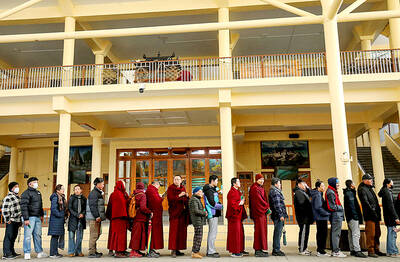
Exiled Tibetans began a unique global election yesterday for a government representing a homeland many have never seen, as part of a democratic exercise voters say carries great weight. From red-robed Buddhist monks in the snowy Himalayas, to political exiles in megacities across South Asia, to refugees in Australia, Europe and North America, voting takes place in 27 countries — but not China. “Elections ... show that the struggle for Tibet’s freedom and independence continues from generation to generation,” said candidate Gyaltsen Chokye, 33, who is based in the Indian hill-town of Dharamsala, headquarters of the government-in-exile, the Central Tibetan Administration (CTA). It


 RSS
RSS