


Iran on Tuesday said it submitted a “written response” to what has been described as a final road map to restore its tattered nuclear deal with world powers.
Iran’s state-run Islamic Republic News Agency (IRNA) offered no details on the substance of its response, but suggested that Tehran still would not take the EU-mediated proposal, despite warnings there would be no more negotiations.
“The differences are on three issues, in which the United States has expressed its verbal flexibility in two cases, but it should be included in the text,” the IRNA report said. “The third issue is related to guaranteeing the continuation of [the deal], which depends on the realism of the United States.”
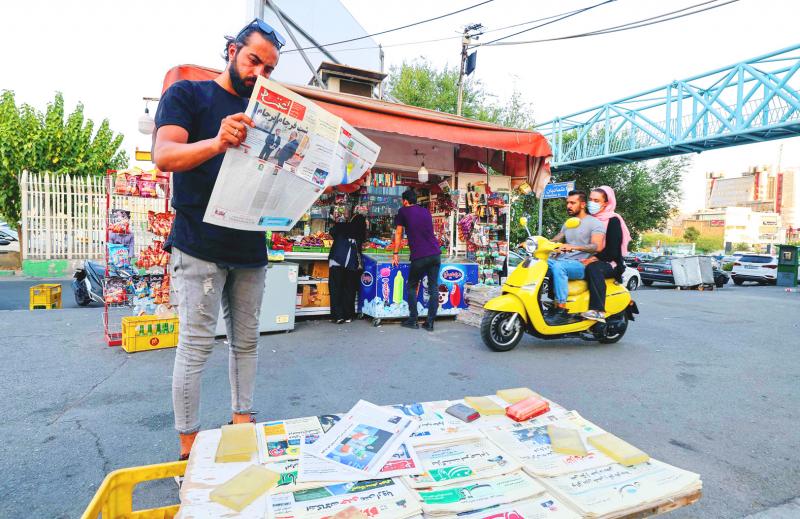
Photo: AFP
Tehran under Iranian President Ebrahim Raisi has repeatedly tried to blame Washington for the delay in reaching an accord. Monday was reported to have been a deadline for Iran’s response.
EU spokesperson for Foreign Affairs and Security Policy Nabila Massrali said that the EU received Iran’s response on Monday night.
“We are studying it and are consulting with the other JCPOA [Joint Comprehensive Plan of Action] participants and the US on the way ahead,” she said, using an acronym for the formal name for the nuclear deal.
The EU has been the go-between in the indirect talks as Iran refused to negotiate directly with the US since then-US president Donald Trump unilaterally withdrew the country from the accord in 2018.
US Department of State spokesperson Ned Price told reporters in Washington that the US had also received Iran’s comments through the EU and was “in the process of studying them.”
“We are, at the same time, engaged in consultations with the EU and our European allies on the way ahead,” he said.
Price reiterated that the US agrees with the EU’s “fundamental point” that “what could be negotiated over the course of these past 16, 17 months has been negotiated.”
In previous comments on Monday, Price accused Iran of making “unacceptable demands” beyond the text of the 2015 nuclear deal, which saw Tehran drastically limit its enrichment of uranium in exchange for the lifting of economic sanctions.
“If Iran wants these sanctions lifted, they will need to alter their underlying conduct,” Price said. “They will need to change the dangerous activities that gave rise to these sanctions in the first place.”
As of the last public count, Iran has a stockpile of about 3,800kg of enriched uranium. Under the deal, Tehran could enrich uranium to 3.67 percent purity, while maintaining a stockpile of uranium of 300kg under constant scrutiny of surveillance cameras and international inspectors.
Iran now enriches uranium up to 60 percent purity — a level it never reached before and one that is a short, technical step away from 90 percent.
Nonproliferation experts say Iran has enough uranium enriched to 60 percent to reprocess into fuel for at least one nuclear bomb.
Meanwhile, the surveillance cameras have been turned off and other footage has been seized by Iran.
However, Iran still would need to design a bomb and a delivery system for it, likely a months-long project. Tehran insists its program is peaceful, although the West and the International Atomic Energy Agency say Iran had an organized military nuclear program until 2003.
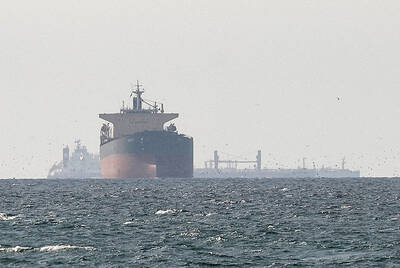
A ship that appears to be taking on the identity of a scrapped gas carrier exited the Strait of Hormuz on Friday, showing how strategies to get through the waterway are evolving as the Middle East war progresses. The vessel identifying as liquefied natural gas (LNG) carrier Jamal left the Strait on Friday morning, ship-tracking data show. However, the same tanker was also recorded as having beached at an Indian demolition yard in October last year, where it is being broken up, according to market participants and port agent’s reports. The ship claiming to be Jamal is likely a zombie vessel that
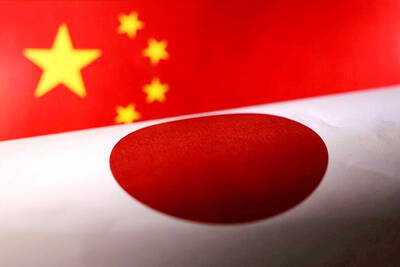
Japan is to downgrade its description of ties with China from “one of its most important” in an annual diplomatic report, according to a draft reviewed by Reuters, as relations with Beijing worsen. This year’s Diplomatic Bluebook, which Japanese Prime Minister Sanae Takaichi’s government is expected to approve next month, would instead describe China as an important neighbor and the relationship as “strategic” and “mutually beneficial.” The draft cites a series of confrontations with Beijing over the past year, including export controls on rare earths, radar lock-ons targeting Japanese military aircraft and increased pressure around Taiwan. The shift in tone underscores a deterioration
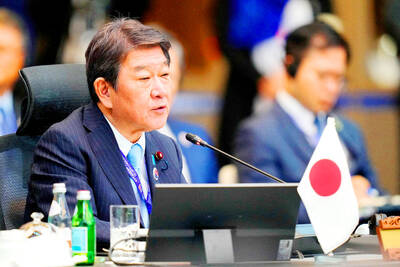
LAW CONSTRAINTS: The US has been pressing allies to send warships to open the Strait, but Tokyo’s military actions are limited under its postwar pacifist constitution Japan could consider deploying its military for minesweeping in the Strait of Hormuz if a ceasefire is reached in the war on Iran, Japanese Minister of Foreign Affairs Toshimitsu Motegi said yesterday. “If there were to be a complete ceasefire, hypothetically speaking, then things like minesweeping could come up,” Motegi said. “This is purely hypothetical, but if a ceasefire were established and naval mines were creating an obstacle, then I think that would be something to consider.” Japan’s military actions are limited under its postwar pacifist constitution, but 2015 security legislation allows Tokyo to use its Self-Defense Forces overseas if an attack,

German Chancellor Friedrich Merz’s conservative Christian Democratic Union (CDU) yesterday faced a regional election battle in Rhineland-Palatinate, now held by the center-left Social Democratic Party (SPD). Merz’s CDU has enjoyed a narrow poll lead over the SPD — their coalition partners at the national level — who have ruled the mid-sized state for 35 years. Polling third is the far-right Alternative for Germany (AfD), which spells a greater threat to the two centrist parties in several state elections in September in the country’s ex-communist east. The picturesque state of Rhineland-Palatinate, bordering France, Belgium and Luxembourg and with a population of about 4 million,


 RSS
RSS