


Ukrainian President Volodymyr Zelenskiy late on Thursday lashed out at Amnesty International after it accused his forces of breaching international law and endangering civilians in their defense against Russia’s invasion.
The sharp rebuke came as three more ships loaded with more than 58,000 tonnes of Ukrainian grain were yesterday set to depart from Black Sea ports under an agreement between Moscow and Kyiv aimed at easing a global food shortage.
In a report on Thursday, the rights group listed incidents in 19 cities and towns in which Ukrainian forces appeared to have put civilians in harm’s way by establishing bases in residential areas — findings Zelenskiy equated to victim-blaming in his evening address.
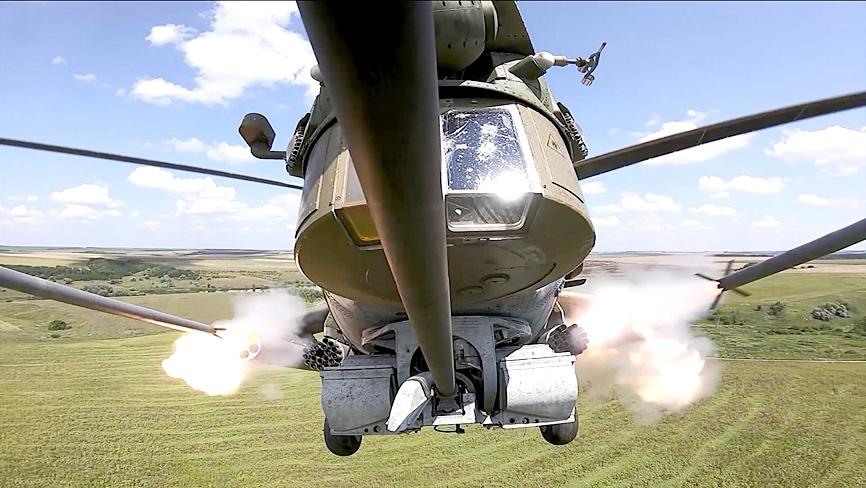
Photo: EPA-EFE
The group sought to offer “amnesty [to] the terrorist state and shift the responsibility from the aggressor to the victim,” he said. “There is no condition, even hypothetically, under which any Russian strike on Ukraine becomes justified. Aggression against our state is unprovoked, invasive and terrorist.”
“If someone makes a report in which the victim and the aggressor are supposedly equal in some way ... then this cannot be tolerated,” he said.
After a four-month investigation, Amnesty International said it had found that the Ukrainian military had established bases in schools and hospitals, and launched attacks from populated areas, asserting that the tactics breached international humanitarian law.
However, the group said the tactics “in no way justify Russia’s indiscriminate attacks,” which have battered civilian populations.
On Thursday, Russian bombardments targeted several towns and villages, including Mykolaiv in the south, where residential buildings were damaged in two neighborhoods, the city mayor said.
Eight people were killed and four injured by a Russian strike that hit a bus stop in Toretsk, near the eastern front line, the regional governor said.
In Kharkiv, the country’s second-most populous city, local authorities reported Russian missile attacks on industrial zones.
Ukrainian forces are conducting a counteroffensive in the south, where they claim to have retaken more than 50 villages previously controled by Moscow.
Meanwhile, three more ships laden with Ukrainian maize were set to depart yesterday morning — two from Chornomorsk and one from Odessa, where the first grain shipment to leave Ukraine since the war began set sail on Monday.
Grain shipments to global markets have been able to resume under a deal struck last month between Kyiv and Moscow — mediated by Turkey and under the aegis of the UN — in a bid to alleviate a crisis that has seen food prices soar in several countries.
The deal provides for the establishment of secure corridors in the Black Sea to allow merchant ships to export 20 million to 25 million tonnes of Ukrainian grain held up in port.
Separately, the EU on Thursday said it is to sanction former Ukrainian president Viktor Yanukovych and his son, Oleksandr Yanukovych, for allegedly undermining Ukraine’s security.
Victor Yanukovych’s administration was in 2014 overthrown by a popular uprising against its pro-Russian stance.
Following his ouster, Moscow moved to annex Ukraine’s Crimean peninsula and the eastern Donbas region.
The EU said the 72-year-old former president, who is based in Russia, still plays a “role in undermining or threatening the territorial integrity, sovereignty and independence of Ukraine, and the state’s stability and security.”
The sanctions document accuses him of plotting to return to power if the Russian invasion succeeds in toppling Zelenskiy, while his son stands accused of “conducting transactions with the separatist groups in the Donbas region,” a reference to Russian proxy forces.
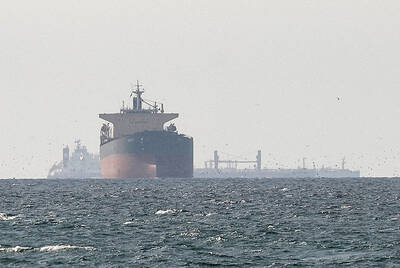
A ship that appears to be taking on the identity of a scrapped gas carrier exited the Strait of Hormuz on Friday, showing how strategies to get through the waterway are evolving as the Middle East war progresses. The vessel identifying as liquefied natural gas (LNG) carrier Jamal left the Strait on Friday morning, ship-tracking data show. However, the same tanker was also recorded as having beached at an Indian demolition yard in October last year, where it is being broken up, according to market participants and port agent’s reports. The ship claiming to be Jamal is likely a zombie vessel that
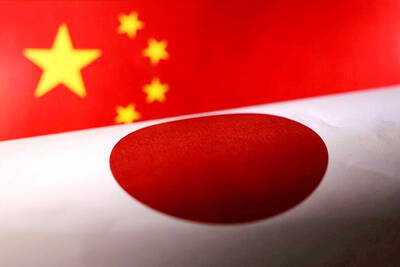
Japan is to downgrade its description of ties with China from “one of its most important” in an annual diplomatic report, according to a draft reviewed by Reuters, as relations with Beijing worsen. This year’s Diplomatic Bluebook, which Japanese Prime Minister Sanae Takaichi’s government is expected to approve next month, would instead describe China as an important neighbor and the relationship as “strategic” and “mutually beneficial.” The draft cites a series of confrontations with Beijing over the past year, including export controls on rare earths, radar lock-ons targeting Japanese military aircraft and increased pressure around Taiwan. The shift in tone underscores a deterioration
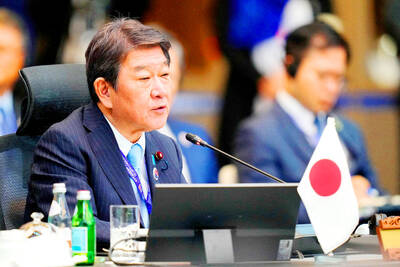
LAW CONSTRAINTS: The US has been pressing allies to send warships to open the Strait, but Tokyo’s military actions are limited under its postwar pacifist constitution Japan could consider deploying its military for minesweeping in the Strait of Hormuz if a ceasefire is reached in the war on Iran, Japanese Minister of Foreign Affairs Toshimitsu Motegi said yesterday. “If there were to be a complete ceasefire, hypothetically speaking, then things like minesweeping could come up,” Motegi said. “This is purely hypothetical, but if a ceasefire were established and naval mines were creating an obstacle, then I think that would be something to consider.” Japan’s military actions are limited under its postwar pacifist constitution, but 2015 security legislation allows Tokyo to use its Self-Defense Forces overseas if an attack,

German Chancellor Friedrich Merz’s conservative Christian Democratic Union (CDU) yesterday faced a regional election battle in Rhineland-Palatinate, now held by the center-left Social Democratic Party (SPD). Merz’s CDU has enjoyed a narrow poll lead over the SPD — their coalition partners at the national level — who have ruled the mid-sized state for 35 years. Polling third is the far-right Alternative for Germany (AfD), which spells a greater threat to the two centrist parties in several state elections in September in the country’s ex-communist east. The picturesque state of Rhineland-Palatinate, bordering France, Belgium and Luxembourg and with a population of about 4 million,


 RSS
RSS