


Macau casino shares yesterday plunged as the Chinese territory embarked on a week-long lockdown to curb its worst COVID-19 outbreak, while neighboring Hong Kong said it was mulling a mainland-style health code system.
Share prices of six gaming conglomerates — Sands China, Galaxy Entertainment, SJM Holdings, Melco International, MGM China and Wynn Macau — fell by between 6 and nearly 9 percent in yesterday morning trade.
It is the first casino lockdown in more than two years, overriding a previous deal between the industry and the Macau government that only those found with infections would need to close temporarily.
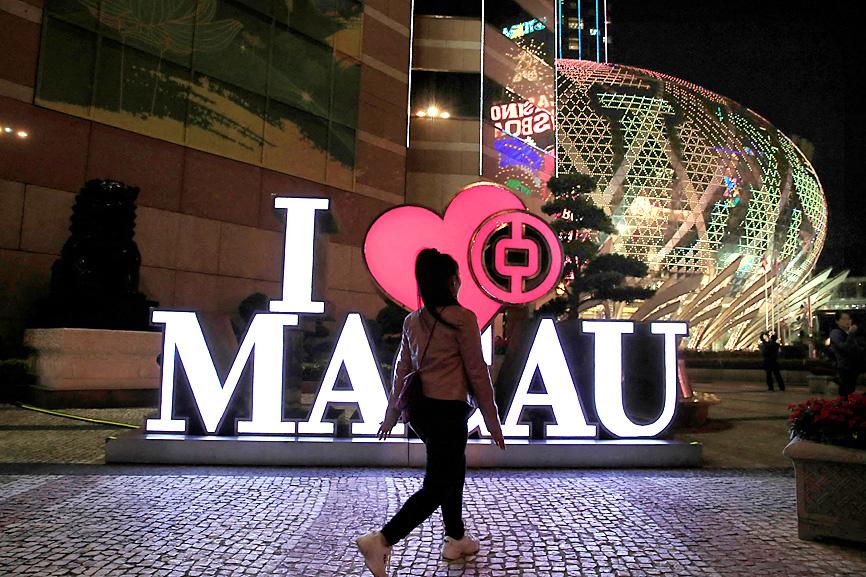
Photo: Reuters
Macau, the world’s biggest gambling hub, is the only place in China where casinos are legal, but the COVID-19 pandemic has hammered its fortunes as it adheres to Beijing’s “zero COVID-19” model.
While casinos have remained open throughout most of the pandemic they have seen a fraction of pre-COVID-19 business.
A Bloomberg gauge of the territory’s six licensed casino operators is down 20 percent this year.
Authorities announced a week of lockdowns starting yesterday after recording more than 1,500 infections in the past three weeks despite multiple rounds of compulsory mass testing of Macau’s 650,000 people.
All residents must stay home except to go shopping for daily necessities and to get tested for the virus, with rule-breakers facing up to two years in jail.
Some public services and businesses such as supermarkets and pharmacies can stay open, and only people with special permission or a low-risk health code can use public transportation.
China uses mandatory health code apps to trace people’s movements and COVID-19 outbreaks. Only those with green codes can move freely.
It is a system that Hong Kong’s government is now considering employing, Hong Kong Secretary of Health Lo Chung-mau (盧寵茂) said yesterday.
“So-called freedom can sometimes be easily confused with selfishness,” Lo told public broadcaster Radio Television Hong Kong.
“Infected people should not have the freedom to go wherever they want and affect our health,” he added.
Hong Kong is being remolded in the authoritarian mainland’s image after huge democracy protests three years ago.
The territory has hewed to a lighter version of the “zero COVID-19” model, which has battered the economy and left Hong Kong internationally cut off for more than two years.
The newly installed administration of Hong Kong Chief Executive John Lee (李家超), a former security official, has vowed to stamp out infections and restart travel to the mainland and outside world.
To do that, authorities might need to deploy more mainland-style mass monitoring of the population.
Hong Kong currently uses a less restrictive mobile phone app than the mainland one, which keeps a resident’s vaccination record and is used to check into businesses and venues.

‘CROSSING THE LINE’: China’s embassy in Seoul criticized US Forces Korea Commander General Xavier Brunson, asking if his ‘hostile’ remarks were authorized by Washington South Korea and the US are in talks over recent public remarks by the commander of US Forces Korea, Seoul’s presidential office said yesterday, after the comments drew sharp criticism from China. In a recent podcast interview, US Forces Korea Commander General Xavier Brunson described South Korea as “the dagger in the heart of Asia” from China’s east coast, prompting the Chinese embassy in Seoul to say that he had “truly crossed the line.” The interview came amid growing speculation that Washington might seek to expand the role of US Forces Korea in countering the growing regional influence of China, a key

SEEKING ORDER: Rodrigo Paz said that ‘anyone who wants to destroy the nation will have to deal with this president and the full force of the constitution’ Bolivian President Rodrigo Paz on Wednesday said that the nation was at a “breaking point” after nearly a month of protests that have caused shortages of food, fuel and medicine. Paz, who took office six months ago amid the worst economic crisis there in four decades, is battling a groundswell of fury over his policies. The political capital, La Paz, has been besieged by low-income workers and members of the indigenous majority calling for his resignation. “The country needs order and is reaching breaking point,” the 58-year-old said at a public event in La Paz, renewing his appeal for dialogue. On Tuesday, the Bolivian

Through the noise of rushing papers and whirring belts at a print factory in Kyoto, two creators watch their photo essay come to life in broadsheet form — part of an effort to win new audiences in the age of artificial intelligence (AI). Despite the decline of the publishing industry, self-publication and handmade “zine” magazines are growing in popularity in Japan, reflecting the nation’s enduring love of paper in the digital era. While speaking to Agence France-Presse at the plant, his hands black with ink, one of the creators, Kazuma Obara, said: “I think [paper] is a medium that engages all five

Australian researchers have trained lab-grown brain cells on a silicon computer chip to play the 1990s shooter game Doom and said they are just scratching the surface of what the neurons could be capable of doing. It is the science-fiction work of biotech boffins at Cortical Labs, who researched and developed the technology that harnesses the workings of the brain’s networking system. Each so-called “biological computer” contains about 200,000 living human brain cells, grown from stem cells that were harvested from blood donations. Having mastered the simple computer game Pong, where a paddle is moved up and down to send a ball


 RSS
RSS