


Sri Lanka’s new prime minister yesterday struggled to forge a unity government and forestall an imminent economic collapse, as opposition lawmakers refused to join his Cabinet and demanded fresh elections.
Ranil Wickremesinghe was sworn in late on Thursday to navigate his country through the worst downturn in its history as an independent nation, with months of shortages and blackouts inflaming public anger.
The 73-year-old insists that he has enough support to govern and approached several legislators to join him, but three opposition parties have already said his premiership lacks legitimacy.
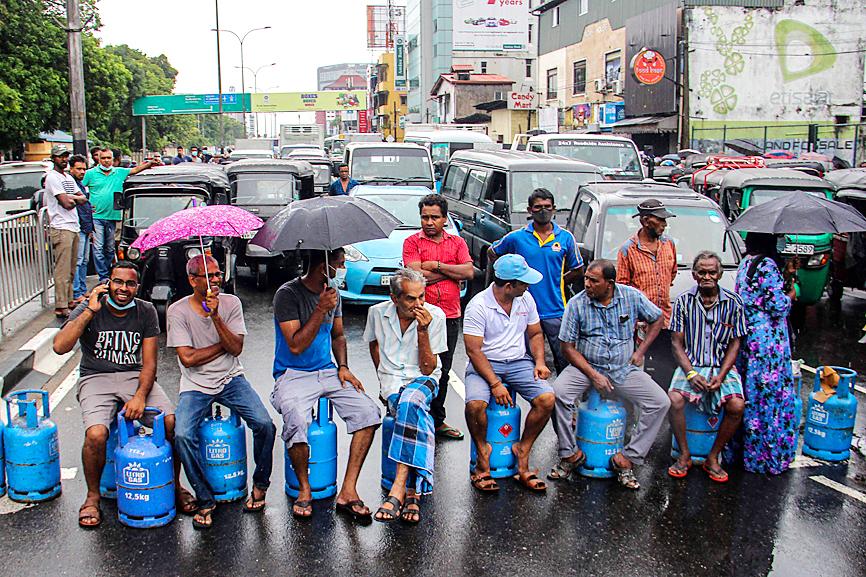
Photo: AFP
Senior opposition lawmaker Harsha de Silva rejected an overture to take charge of the finance ministry and said he would instead push for the government’s resignation.
“People are not asking for political games and deals, they want a new system that will safeguard their future,” he said in a statement.
De Silva said that he was joining “the people’s struggle” to topple Sri Lankan President Gotabaya Rajapaksa and would not support any political settlement that left the leader in place.
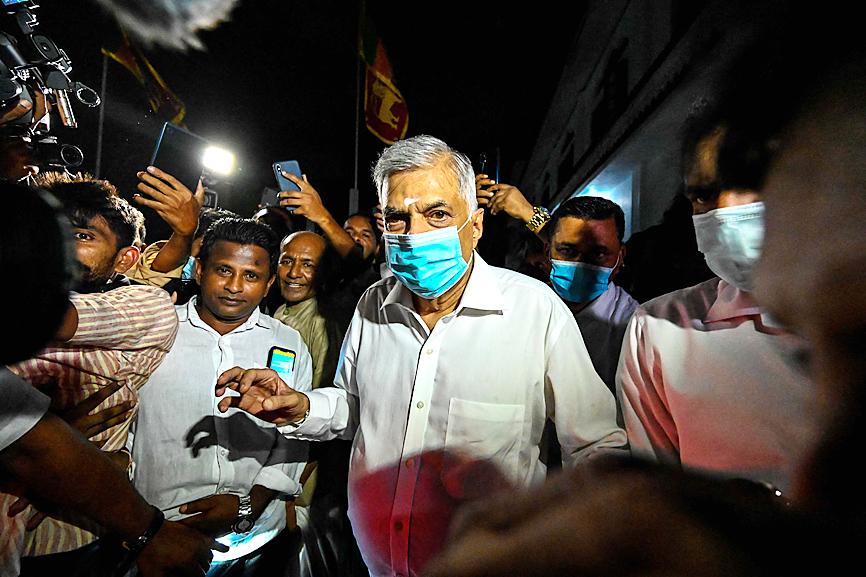
Photo: AFP
Huge public demonstrations have for weeks condemned Rajapaksa over his administration’s mismanagement of the worsening economic crisis.
Hundreds remain outside his seafront office in the capital, Colombo, at a protest camp that has for the past month campaigned for him to step down.
De Silva is a member of the Samagi Jana Balawegaya, the largest single opposition grouping in parliament, which had appeared ready to split over the question of whether to support Wickremesinghe.
The head of the possible splinter faction, Harin Fernando, yesterday said he had returned to the fold.
“I will not support Wickremesinghe’s government,” Fernando said.
Two smaller parties have also signaled that they would not join any unity government.
The Tamil National Alliance said that Rajapaksa’s administration had “completely lost legitimacy” with the appointment of Wickremesinghe, a five-time former prime minister who most recently held office in 2019.
The leftist People’s Liberation Front (JVP) said that new national elections were the only way out of the current impasse.
“We can’t solve the economic crisis by having an illegitimate government,” JVP leader Anura Dissanayake told reporters in Colombo. “We demand fresh elections.”
The cash-strapped government is unlikely to be able to afford polls, or even print ballots, at a time when a national paper shortage forced schools to postpone exams.
Parliamentary elections are not due until August 2025.
Sri Lankans have experienced months of severe shortages of food, fuel and medicine — as well as long power cuts — after the country burnt through foreign currency reserves needed to pay for vital imports.
Wickremesinghe on Thursday warned that the dire situation could get worse in the coming months and called for international assistance.
“We want to return the nation to a position where our people will once again have three meals a day,” he said.
Mahinda Rajapaksa, the president’s brother, resigned as prime minister on Monday after his supporters attacked anti-government demonstrators who had been protesting peacefully.
A ship that appears to be taking on the identity of a scrapped gas carrier exited the Strait of Hormuz on Friday, showing how strategies to get through the waterway are evolving as the Middle East war progresses. The vessel identifying as liquefied natural gas (LNG) carrier Jamal left the Strait on Friday morning, ship-tracking data show. However, the same tanker was also recorded as having beached at an Indian demolition yard in October last year, where it is being broken up, according to market participants and port agent’s reports. The ship claiming to be Jamal is likely a zombie vessel that

Cannabis-based medicines have shown little evidence of effectiveness for treating most mental health and substance-use disorders, according to a large review of past studies published in a major medical journal on Monday. Medical use of cannabinoids has been expanding, including in the US, Canada and Australia, where many patients report using cannabis products to manage conditions such as anxiety, post-traumatic stress disorder and sleep problems. Researchers reviewed data from 54 randomized clinical trials conducted between 1980 and May last year involving 2,477 participants for their analysis published in The Lancet. The studies assessed cannabinoids as a primary treatment for mental disorders or substance-use

NATIONWIDE BLACKOUT: US President Donald Trump cut off Venezuelan oil shipments to Cuba, strangling the Caribbean island’s already antiquated grid Cuba’s national electric grid collapsed on Monday, the nation’s grid operator said, leaving about 10 million people without power amid a US-imposed oil blockade that has crippled the already obsolete generation system. Grid operator UNE on social media said that it is investigating the causes of the blackout, the latest in a series of widespread outages that last for hours or days and that this weekend sparked a rare violent protest in the communist-run nation. Officials ruled out a major power plant failure, but had still not pinpointed the root cause of the grid collapse, suggesting a problem with transmission. Officials said that
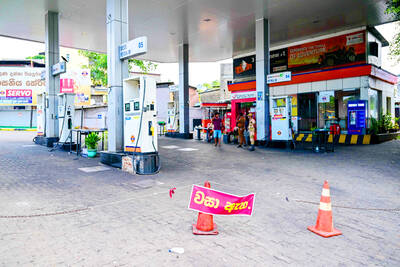
CONSERVING FUEL: State institutions are to operate only four days a week starting tomorrow, with the measures also applying to schools and universities Sri Lanka on Monday announced a shorter working week to conserve its scarce fuel reserves as it prepares for a prolonged war in the Middle East. The Strait of Hormuz, a key waterway through which about 20 percent of global exports pass in peacetime, has been effectively closed by Iran in retaliation over the US and Israeli war against it, now in its third week. Sri Lankan Commissioner-General of Essential Services Prabath Chandrakeerthi said state institutions would operate only four days a week starting tomorrow. The new austerity measures would also apply to schools and universities, and would remain in place indefinitely. “We are


 RSS
RSS