


Shanghai yesterday tightened the first phase of a two-stage COVID-19 lockdown, asking some residents to stay indoors unless they are getting tested as the number of new daily cases exceeded 4,400.
The financial hub, home to 26 million people, is in its second day of a lockdown authorities have imposed by dividing the city roughly along the Huangpu River, splitting the historic center from the eastern financial and industrial district of Pudong to allow for staggered testing.
While Shanghai’s caseload remains modest by global standards — a record 4,381 asymptomatic cases and 96 symptomatic cases for Monday — the city has become a testing ground for China’s “zero COVID” strategy as it tries to bring the Omicron variant of SARS-CoV-2 under control.

Photo: AFP
Residents east of the Huangpu were locked down in their housing compounds on Monday.
Three residents yesterday told reporters that neighborhood committees had told them they were no longer allowed to step outside their homes.
“Children were still having picnics yesterday and having fun,” said one of them, who declined to be identified, citing privacy concerns.
Wu Qianyu, an official with the municipal health commission, told a briefing that a “clear request” had been made to residents not to leave their apartments, even to take pets for a walk or throw out trash, during “a key stage in nucleic acid testing.”
Wu said that 8.26 million tests were performed by as many as 17,000 testing personnel in the city’s locked-down districts on Monday.
“The vast numbers of medical staff, grass-roots cadres, community workers and volunteers shared the very hard work on the front line of epidemic prevention and control, and should be thanked,” she said.
There were signs of frustration on China’s social media, with dozens of residents seeking help for relatives, with some struggling to access medical services.
Although China is sticking to its “zero COVID” plan, experts elsewhere remain sceptical about the efficacy of lockdowns.
“It is clear from Australia and elsewhere in the world that lockdowns are simply not effective against Omicron — so expect a big wave coming,” said Adrian Esterman, an expert in biostatistics at the University of South Australia.
Drone footage published by state media showed empty streets below the skyscrapers of the city’s Lujiazui District.
Public transport in the east has been shut and all unapproved vehicles ordered off the streets.
Residents in the west of the city have been stocking up at shops and markets in anticipation of their lockdown from Friday.
The city government rolled out new measures to try to support businesses affected by the restrictions, including rent exemptions and tax rebates.
The Global Times quoted Peking University economist Cao Heping (曹和平) as saying that while the city’s growth would be hit, the national economy would not suffer greatly.

Shamans in Peru on Monday gathered for an annual New Year’s ritual where they made predictions for the year to come, including illness for US President Donald Trump and the downfall of Venezuelan President Nicolas Maduro. “The United States should prepare itself because Donald Trump will fall seriously ill,” Juan de Dios Garcia proclaimed as he gathered with other shamans on a beach in southern Lima, dressed in traditional Andean ponchos and headdresses, and sprinkling flowers on the sand. The shamans carried large posters of world leaders, over which they crossed swords and burned incense, some of which they stomped on. In this
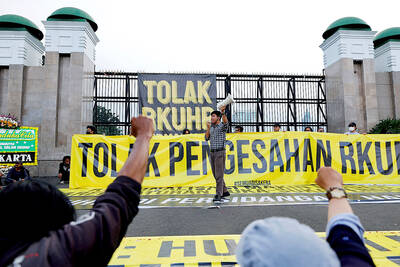
Indonesia yesterday began enforcing its newly ratified penal code, replacing a Dutch-era criminal law that had governed the country for more than 80 years and marking a major shift in its legal landscape. Since proclaiming independence in 1945, the Southeast Asian country had continued to operate under a colonial framework widely criticized as outdated and misaligned with Indonesia’s social values. Efforts to revise the code stalled for decades as lawmakers debated how to balance human rights, religious norms and local traditions in the world’s most populous Muslim-majority nation. The 345-page Indonesian Penal Code, known as the KUHP, was passed in 2022. It

Near the entrance to the Panama Canal, a monument to China’s contributions to the interoceanic waterway was torn down on Saturday night by order of local authorities. The move comes as US President Donald Trump has made threats in the past few months to retake control of the canal, claiming Beijing has too much influence in its operations. In a surprising move that has been criticized by leaders in Panama and China, the mayor’s office of the locality of Arraijan ordered the demolition of the monument built in 2004 to symbolize friendship between the countries. The mayor’s office said in

‘TRUMP’S LONG GAME’: Minnesota Governor Tim Walz said that while fraud was a serious issue, the US president was politicizing it to defund programs for Minnesotans US President Donald Trump’s administration on Tuesday said it was auditing immigration cases involving US citizens of Somalian origin to detect fraud that could lead to denaturalization, or revocation of citizenship, while also announcing a freeze of childcare funds to Minnesota and demanding an audit of some daycare centers. “Under US law, if an individual procures citizenship on a fraudulent basis, that is grounds for denaturalization,” US Department of Homeland Security Assistant Secretary Tricia McLaughlin said in a statement. Denaturalization cases are rare and can take years. About 11 cases were pursued per year between 1990 and 2017, the Immigrant Legal Resource


 RSS
RSS