

Thousands of demonstrators on Saturday hit the streets across Spain protesting the soaring cost of food, electricity and fuel, which have been exacerbated by Russia’s invasion of Ukraine.
The rallies, which took place in Spain’s main cities, were called by the far-right Vox party, which sought to tap into growing social discontent over the spiraling cost of living that has left many families struggling to pay their bills.
Outside Madrid City Hall, a crowd of several thousand people gathered, waving hundreds of Spanish flags and chanting angry slogans calling for the resignation of Spanish Prime Minister Pedro Sanchez.
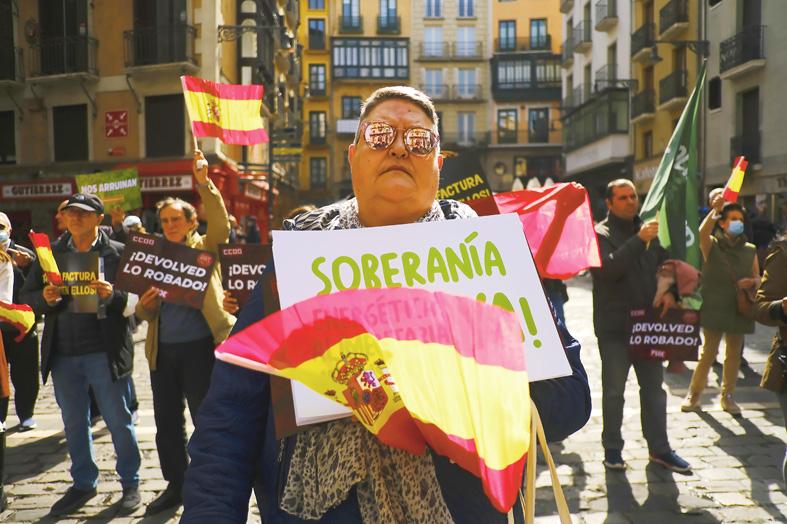
Photo: AP
“Sanchez, you’re rubbish, bring down our bills,” they shouted, between patriotic cries of “Long live Spain” at a rally demanding government action to lower prices.
“We have the worst possible government... It’s not even a government, it’s a misery factory ... which plunders and extorts workers through abusive taxes,” Vox leader Santiago Abascal told the rally to rousing cheers. “We will not leave the streets until this illegitimate government is expelled.”
This government “is taking everything from us,” said Anabel, a 56-year-old demonstrator who did not give her surname.
“They hike the light and gas prices, and say it’s because of [Russian President Vladimir] Putin, but that’s a lie. It was like this before,” she said. “Light prices really affect [my family] because some of us work from home, and we can hardly put the heating on because the price of gas has almost doubled over the past six months.”
Many said that the government should be lowering taxes to help those struggling.
“A country that raises prices in this way and doesn’t help its citizens by partially lowering taxes, is abandoning its people,” said Francisco, 53, who is unemployed and did not give his family name. “We have to force the government to act — or remove them, for Spain’s sake.”
Spain’s main right-wing opposition Popular Party (PP) has also demanded that the government immediately lower taxes.
“Taxes must be lowered at once. We can’t live with prices that are over 7 percent and growing,” incoming PP leader Alberto Nunez Feijoo said on Saturday, referring to Spain’s annual inflation, which jumped to 7.6 percent last month, its highest in 35 years.
Last year, energy prices soared 72 percent in Spain, one of the highest increases within the EU, and costs have surged even higher since Russia’s invasion of Ukraine in a crisis that comes hot on the heels of the COVID-19 pandemic.
On Monday, Spanish lorry drivers declared an open-ended strike over fuel prices that soon mushroomed into multiple roadblocks and protests, triggering supply chain problems.
Rising prices have also prompted the General Union of Workers (UGT) and the Workers’ Commissions (CCOO), Spain’s two biggest unions, to call a national strike on Wednesday.
Spanish Minister of the Presidency, Relations with the Cortes and Democratic Memory Felix Bolanos pledged that the government would unveil its planned steps to reduce the cost of energy and fuel on Tuesday next week, accusing Vox of seeking to profit from a difficult situation.
“The far-right is always stirring up problems and complicating things, no matter how difficult they are... They are not patriots they are troublemakers,” he told Spain’s public television service.
Sanchez is on a European tour to lobby for a common EU response to soaring energy prices.
Madrid has for months urged its European partners to change the mechanism that couples electricity prices to the gas market, but its pleas have so far fallen on deaf ears, despite support from Paris.
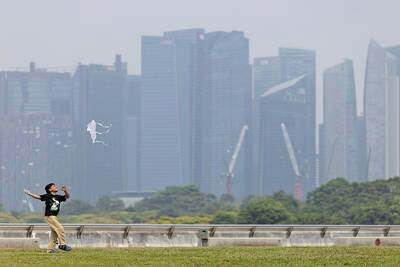
Singapore’s air quality hit an unhealthy level yesterday, as haze from forest fires raging in Indonesia continued to spread across swathes of Southeast Asia. The city-state is currently one of the 10 most-polluted major cities in the world, coming in at third in IQAir’s ranking. Kuching, in the Malaysian part of the island of Borneo, was No. 1. A government taskforce has “activated haze response plans” for schools, workplaces and community centers, Singaporean Minister for Sustainability and the Environment Grace Fu (傅海) said in a video message on Facebook. Most people could continue essential daily activities, but the elderly or vulnerable should

PAINSTAKING PROCESS: Ice makers freeze water for up to 72 hours, replace tainted water with a fresh batch once freezing begins, and are constantly stirring In the historic Japanese city of Kanazawa, craftsmen painstakingly shape and slice blocks of ice destined to chill negronis in some of the world’s trendiest bars. The men work for Kuramoto Ice, a century-old company in Ishikawa on the Sea of Japan coast and one of dozens of Japanese firms producing ultra-clear, premium ice. This luxury product, believed by those in the industry to melt more slowly than regular blocks, is a staple of Japan’s cocktail culture, but its popularity is also spilling over to bars abroad, from the US to Australia, who pay as much as ¥200 (US$1.28) per cube. Kuramoto Ice

WAR CRIMES? An investigation found that a network of countries are supplying Sudan’s RSF with weapons, including drone blamed for large civilian casualties Foreign weapons, military technology, fighters and logistical networks are helping sustain Sudan’s conflict and expanding the warring parties’ ability to strike deep into civilian areas, a UN fact-finding mission said in a report published yesterday, warning that some attacks might amount to war crimes. Sudan’s war erupted in April 2023 following a power struggle between Sudan’s military and the Rapid Support Forces (RSF) ahead of a planned transition to civilian rule. The conflict has devastated the country, displaced more than 14 million people and created what the UN has described as one of the world’s worst humanitarian crises. The UN mission said

‘BYE BYE’: Judge William Tam said after hearing arguments for a leniency that a sentence would be given as soon as possible in Joshua Wong’s second prosecution Hong Kong democracy advocate Joshua Wong (黃之鋒) yesterday pleaded guilty to conspiracy to collude with foreign forces to endanger national security under a Beijing-imposed law. It was the second prosecution of Wong, a former student leader in the democracy movement in the territory and one of its most recognizable faces, under the National Security Law introduced in Hong Kong in 2020 to quell massive anti-government protests the year before. Wong, 29, who wore a blue shirt, appeared thinner as he entered his plea. After hearing his lawyer’s arguments for a lesser prison term, Judge William Tam (譚耀豪) said that a sentence would be


 RSS
RSS