

China will make full use of coal as a vital part of its energy strategy, leaders and officials said during the nation’s annual gathering of parliament this week, as it bids to balance economic stability with its longer-term climate goals.
Following a speech by Chinese President Xi Jinping (習近平) reiterating the importance of coal, delegates from across the country called for more investment in coal technology and new policies to shore up profits for coal enterprises.
Xi told a National People’s Congress delegation from the top coal-producing region of Inner Mongolia that China, the world’s biggest greenhouse gas emitter, was “rich in coal, poor in oil and short of gas,” and “could not part from reality.”
He said green transition was a process, and China could not simply “slam the brakes” on coal.
Xi last year pledged to “control” coal use over the 2021-2025 period and start cutting consumption in 2026, as part of China’s contribution to the fight against global warming.
However, growing energy security worries have already driven mining output to record highs and seen new coal-fired power plants go into construction.
Delegates tried to bridge the gap between developing coal and curbing emissions by calling for more investment in clean and “smart” coal technologies, including carbon capture and storage.
They also called for measures to release more supply onto the market and further develop the coal chemical industry, published minutes of closed-door meetings showed.
Support was also needed to encourage technological innovations that could transform coal power into a low-carbon energy source, said Shu Yinbiao (舒印彪), a delegate with the advisory body known as the China People’s Political Consultative Conference (CPPCC) and chairman of state utility Huaneng.
China also needs to establish a long-term mechanism to ensure coal and power firms could remain profitable and guarantee supplies, the official People’s Daily newspaper quoted Shu as saying.
Jin Penghui (金鵬輝), another CPPCC delegate and head of the Shanghai branch of the central bank, called for public funds to be made available to boost efficiency and reduce emissions from coal.
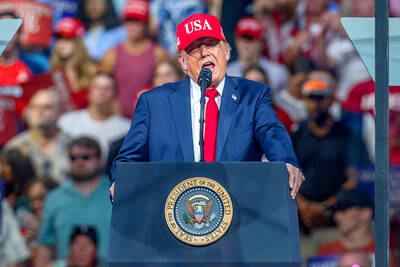
US President Donald Trump on Wednesday threatened to take action against the EU if it moves forward with European Commission President Ursula von der Leyen’s proposal to make Canada the bloc’s first associate member. “If they do that, if I think it’s at all a hostile act; I will put very serious tariffs or stop trading with Europe on many things,” Trump told reporters en route to an event in North Carolina, calling the proposal “laughable.” “If it’s a good intention, that’s fine. If it’s a bad intention, we’ll put very heavy tariffs on Europe,” he said. Von der Leyen made the proposal

The US military came close to boarding a Chinese vessel in the Middle East earlier this year based on a flawed intelligence report prepared with the help of artificial intelligence (AI), CNN said on Friday. US intelligence indicated the ship was carrying nuclear weapons-related components, leading US forces to prepare to intercept it, the broadcaster reported, citing four anonymous sources familiar with the incident. However, the operation was called off after officials determined that an AI chatbot used by an analyst had misidentified the material the ship was carrying. The report was “entirely false,” but “almost started a war,” CNN quoted one source

French President Emmanuel Macron today embarks on a rare and symbolic visit to a remote French territory in the North Atlantic, hosting Canadian Prime Minister Mark Carney at a time of growing tensions with Washington. The three-day visit to Saint Pierre and Miquelon, a three-island archipelago of less than 6,000 people just 25km off Newfoundland, would be the first by a French president in more than a decade. The trip to France’s only remaining possession in North America, a vestige of the huge territories Paris once controlled in what is now Canada and the US, carries immense symbolic resonance. Macron insists that US
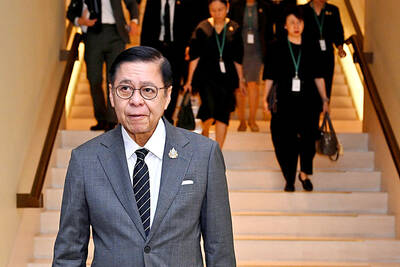
SEEKING AN AGREEMENT: The Cambodian foreign minister said Phnom Penh aimed to build trust through the mediation process, not further escalate tensions Thailand yesterday said that Cambodia was playing the victim in a dispute over maritime resources, as the Southeast Asian neighbors took their feud to international mediators a year after deadly clashes over their land border. Cambodia, which initiated the case before the Permanent Court of Arbitration (PCA) in Singapore, said it hoped the hearings would yield a peaceful resolution for both countries. In May, Thailand unilaterally pulled out of a bilateral framework agreement that aimed to resolve overlapping maritime border claims, but denied any link to their land dispute. Cambodia subsequently initiated a UN-backed conciliation process at the PCA, saying it hoped to


 RSS
RSS