


Proposals for matchmaking committees within unions and a drive to encourage more graduate students to have babies triggered a frosty reception on social media, as officials brainstormed ways to raise China’s plunging birthrate.
In all, delegates to China’s annual meeting of parliament submitted more than 20 suggestions for ways to produce more children in a country that did not scrap a decades-long policy restricting couples to a single offspring until 2016.
The plan from a Chinese Communist Party secretary at a pharmaceutical firm in Hubei Province for “marriage committees” within trade unions to provide matchmaking services was widely criticized on microblogging platform Sina Weibo.
“Marriage is for happiness, not to meet goals,” one critic said.
Also panned was another suggestion that master’s and doctoral students should be encouraged to marry and reproduce.
“So I’m studying a master’s to birth a baby for you? Why not establish a school [for this], where people can graduate once they’ve given birth to enough,” wrote one user in a post that got about 5,000 likes.
The steep decline in China’s birthrate to last year’s record low, fueled in part by the high cost of raising children in cities, has been met with growing alarm by officials.
In a major shift last year, China announced that couples could have up to three children, but the decision was met with doubts over whether it would make much difference and questions on what supportive measures would be rolled out.
Although proposals submitted by ordinary delegates at the rubber-stamp parliament are largely symbolic, they allow matters of public concern to be discussed and in theory will also be considered by policymaking committees.
Other proposals submitted to the National People’s Congress, which started on Saturday last week and finishes today, focused on ways of alleviating pressures facing families and working women.
They included preferential tax policies, waiving kindergarten fees for a third child and penalties for employers who discriminate against parents with multiple children.
Many Sina Weibo users took the opportunity to criticize the historic tactics China had taken to control population growth.
“This is crazy, when it was the time of family planning there was forced sterilization and abortion,” said one user whose comment received more than 2,000 likes. “Now they want three children. Are women just machines?”


Through the noise of rushing papers and whirring belts at a print factory in Kyoto, two creators watch their photo essay come to life in broadsheet form — part of an effort to win new audiences in the age of artificial intelligence (AI). Despite the decline of the publishing industry, self-publication and handmade “zine” magazines are growing in popularity in Japan, reflecting the nation’s enduring love of paper in the digital era. While speaking to Agence France-Presse at the plant, his hands black with ink, one of the creators, Kazuma Obara, said: “I think [paper] is a medium that engages all five
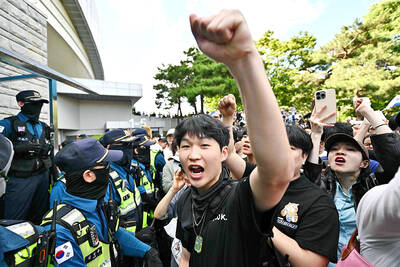
‘ABSURD MISTAKE’: The election commission said that there had been a failure to anticipate turnout after 14 polling stations ran short of ballot papers South Korean riot police yesterday cleared protesters from a Seoul polling station after a 35-hour blockade sparked by a shortage of ballot papers during local elections earlier this week. Wednesday’s election was the first nationwide vote since South Korean President Lee Jae-myung took office following the ouster of Yoon Suk-yeol over his short-lived martial law declaration. Lee’s ruling Democratic Party swept most races, but failed to flip the crucial Seoul mayoral seat. The South Korean National Election Commission apologized, blaming a failure to anticipate turnout after 14 polling stations in Seoul ran short of ballot papers. Some polling stations stayed open until 10pm to

France experienced its hottest spring on record, the French weather service said on Tuesday, after an exceptional early heat wave that also broke highs for the season in England and Wales. Meteo-France said the average nationwide temperature over March to May was 13.8°C — about 1.7°C above the norm, and surpassing records set in 2011 and 2020. “The warmest spring since records began in 1900,” it said in a bulletin. All three months were warmer than average, but the onset of an “unprecedented heatwave” late last month pushed the mercury to highs typically seen at the height of the summer. “Our country had never

A Sherpa guide was found crawling to base camp on Mount Everest a week after he went missing and was reunited with his family, who had given up hope he would return. Dawa Sherpa was last seen on Friday last week descending the mountain, but he did not reach base camp even though his client did. The pair were among the last climbers on the mountain as the climbing season came to an end and the route was dismantled. Dawa was located by a cleaning crew on Thursday morning as he was crawling down the snowy slopes around the Khumbu Icefall, just above


 RSS
RSS