


China’s birthrate has fallen to its lowest level in six decades, barely outnumbering deaths last year despite major government efforts to increase population growth and stave off a demographic crisis.
Across China, 10.62 million babies were born last year, a rate of 7.52 per thousand people, the Chinese National Bureau of Statistics said yesterday. In the same period 10.14 million deaths were recorded, a mortality rate of 7.18 per thousand, producing a population growth rate of just 0.34 per 1,000 people.
The growth rate is the lowest since 1960, and adds to the findings of May last year’s once-per-decade census, which found an average annual rise of 0.53 percent, down from 0.57 percent reported from 2000 to 2010.
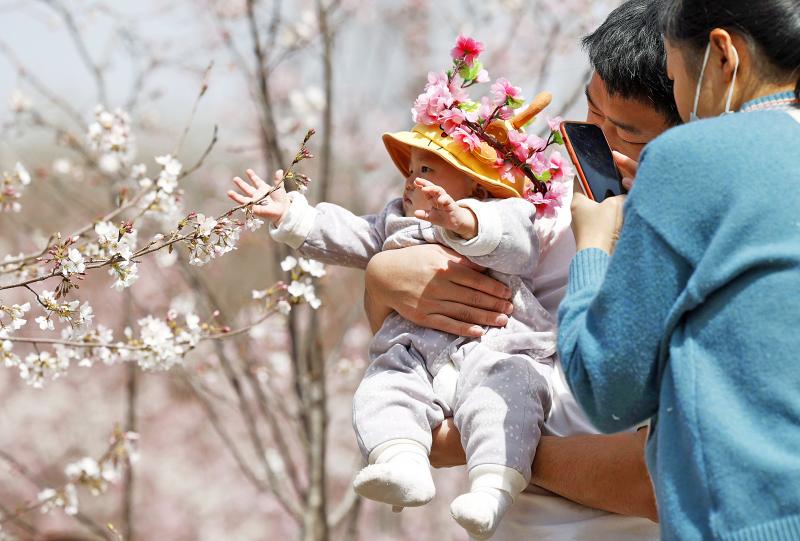
Photo: AP
China, as with much of east Asia, is in the grip of a population crisis with lowering birthrates and predictions of imminent negative population growth, along with an aging population. Yesterday’s figures showed the proportion of over-60s in China rose from 18.7 percent in 2020 to 18.9 percent.
“The demographic challenge is well known, but the speed of population aging is clearly faster than expected,” Pinpoint Asset Management chief economist Zhiwei Zhang said. “This suggests China’s total population may have reached its peak in 2021. It also indicates China’s potential growth is likely slowing faster than expected.”
Beijing has announced major reforms to address the decline, including raising the retirement age. A three-child limit has replaced the two-child policy that was introduced in 2016, and had sparked a slight increase in births before falling again.
The high cost of living, delayed marriages and lack of social mobility are frequently cited as contributing factors to young Chinese people’s reluctance to have children. In response, Beijing has banned expensive private tutoring, and pledged better access to childcare and maternity leave.
University of California Irvine professor Wang Feng (王豐), who specializes in Asian demographics, said the results showed that root causes run deeper than the policymakers realized.
“The policies announced last year are mostly rhetoric, or at most like band-aids,” he said. “Without addressing the deeply rooted causes discouraging young Chinese from getting married and having children, from gender inequality to high living cost, what we are seeing now is likely just the beginning of a further decline in birthrate and a prolonged process of population decline in China.”
China also faces potential instability on the economic front, with GDP data published alongside the population findings revealing a dramatic slowdown in the final months of last year.
China, the world’s second-largest economy, reported a GDP rise of 8.1 percent year-on-year, beyond the government’s predictions of 6 percent, but with growth concentrated in the first half of the year. In the fourth quarter, it rose by 4 percent, down from 4.9 percent in the third quarter.
“The domestic economy is under the triple pressures of demand contraction, supply shock and weakening expectations,” bureau director Ning Jizhe (寧吉?) said.
The past year has seen extraordinary levels of change in consumer habits and of government intervention in major Chinese industries. Retail sales growth dropped from 3.9 percent in November to 1.7 percent last month.
“Economic growth is clearly under pressure,” Zhang said, adding that outbreaks of the Omicron variant of SARS-CoV-2 exacerbated the downside risk.
Construction has slumped and property sales were battered amid a crisis in development, most notably the ongoing financial difficulties of property developer Evergrande.
Government intervention into the US$1 billion private tutoring industry and continued crackdowns on the tech sector have also seen waves of layoffs. An emissions-reduction push, supply chain issues and bans on imported coal have been blamed, alongside rising power prices.
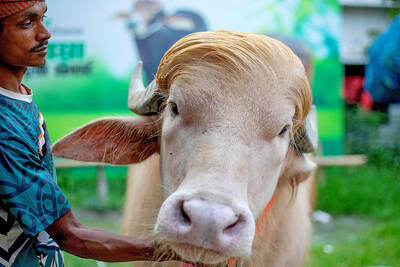
Crowds in Bangladesh are flocking to snap photographs with an unlikely social media star — an albino buffalo with flowing blond hair nicknamed “Donald Trump” that is due to be sacrificed within days. Owner Zia Uddin Mridha, 38, said his brother named the 700kg bull over its flowing helmet of hair resembling the signature look of the US president. “My younger brother picked this name because of the buffalo’s extraordinary hair,” he said at his farm in Narayanganj, just outside the capital, Dhaka. Mridha said that a constant stream of curious visitors — social media fans, onlookers and children — have come throughout

It began as a satirical online project. Now millions of young people in India are flocking to it as an outlet for their frustration. A parody political party called the Cockroach Janta Party, with the insect as its symbol, has exploded across India’s social media by turning absurdist humor into protest. Memes and short videos mocking corruption, joblessness and political dysfunction have flooded social media sites, where millions of users are embracing the cockroach — known for its ability to survive harsh conditions — as a tongue-in-cheek symbol of endurance. The online movement’s rise has been unusually rapid. The Cockroach Janta Party (CJP)
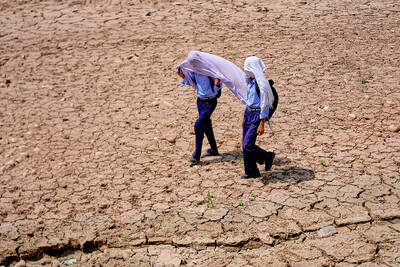
HOTTER: While Indians are accustomed to summer heat, climate change has caused northwestern India to warm faster than other parts of the country, an academic said Roads and markets have emptied during afternoons and some farmers have switched to nighttime work to avoid scorching temperatures as a heat wave grips large parts of India. The India Meteorological Department forecast maximum temperatures for yesterday of about 45°C in the capital, New Delhi, where authorities have opened temporary “cooling zones” to help people cope. The weather department warned that conditions would likely persist across several northern regions in the coming days, with temperatures staying well above seasonal averages. Authorities urged people to stay indoors during the hottest hours and take precautions against heat-related illnesses. India declares a heat wave whenever maximum temperatures
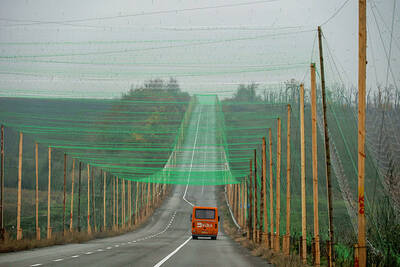
BIGGER ROLE: Beijing has said it maintains an impartial stance on the war in Ukraine, but by training Russian troops, China is far more involved than previously known China’s armed forces secretly trained about 200 Russian military personnel in China late last year, and some have since returned to fight in Ukraine, according to three European intelligence agencies and documents seen by Reuters. While China and Russia have held a number of joint military exercises since Moscow’s full-scale invasion of Ukraine in 2022, Beijing has repeatedly said that it is neutral in the conflict and presents itself as a peace mediator. The covert training sessions, which predominantly focused on the use of drones, were outlined in a dual-language Russian-Chinese agreement signed by senior Russian and Chinese officers in Beijing on


 RSS
RSS