


US Ambassador to South Korea Harry Harris has said privately that he does not plan to stay on beyond the November US presidential election, regardless of whether US President Donald Trump wins another term, five sources told reporters.
Harris, a 40-year veteran of the US Navy who started in Seoul in 2018 after Trump appointed him, has expressed increasing frustration with the tensions and drama of his tenure, the sources said, all speaking on condition of anonymity because of the diplomatic sensitivity of the issue.
“He’s been wanting to stay only until November rather than serving in the second term even if Trump wins it,” one source with direct knowledge of the issue said.

Photo: EPA-EFE
A spokesman for the US embassy in Seoul did not directly address Harris’ plans, but said the ambassador “remains energized to continue to serve the United States.”
“His commitment to strengthening the US-ROK alliance through active engagement with government interlocutors, the wonderful people, and the independent media in the Republic of Korea remains ironclad,” the spokesman said.
The US Department of State did not immediately respond to a request for comment.
Harris’ predecessors each served about three years and generally enjoyed good personal rapport with South Koreans, but his time in Seoul has been marked by increasing acrimony between the two longtime allies.
The US ambassador has become the public face of what many South Koreans see as overbearing policies embraced by the Trump administration in the name of “America First.”
Although polls show wide South Korean support for the alliance in general, people there have balked at Trump’s demands that Seoul pay billions of dollars more for a US troop presence in the country.
The military cost-sharing agreement lapsed in December last year, and the failure to strike a new deal has led to more than 4,000 South Korean workers being put on unpaid leave.
The previous October, a group of South Korean students climbed over a wall into the grounds of the ambassador’s residence in Seoul to protest against the US troop presence in the country, sparking complaints from the State Department over lax security by South Korean police.
In December, protesters also destroyed portraits of Harris during a demonstration outside the embassy as they chanted “Harris out. We are not a US colony. We are not an ATM machine.”
Friction also developed over US insistence that the South limit its engagement with North Korea until Trump had made progress in denuclearization talks.
The South Korean Ministry of Foreign Affairs summoned Harris in August last year after US officials expressed disappointment over its decision to end an intelligence-sharing pact with Japan.
“He would’ve never imagined something like that, because both countries, as allies, would usually put on a nice face once you get out of the meeting room even if there’s a disagreement,” a second source said of Harris’ reaction to the ministry’s public disclosure of the acrimonious meeting.
Harris was an admiral leading the US Navy’s Pacific Commandbefore being named ambassador.
It is unclear whether Harris has already tendered his resignation, but as part of his retirement plans he has built a house in Colorado, three sources said.
Harris has also been the target of racially charged acrimony over his Japanese heritage. Born in Japan to a Japanese mother and an American father, Harris faced increasingly personal attacks — even from high-level South Korean officials — as a simmering historic dispute between Seoul and Tokyo erupted again last year.
Some South Koreans mocked Harris’ mustache by likening it to those worn by the Japanese colonial leaders who ruled the Korea Peninsula from 1910 to 1945.
Harris said in January that he was aware that his mustache had become “a point of some fascination here,” but he was the US ambassador to Korea, “not the Japanese-American ambassador to Korea.”
The first source said that Harris never complained about the pressures of the job, but that it had become clear some of the personal attention was weighing on him.
“He wouldn’t openly say he’s stressed out or like ‘life is hard’ — he’s a four-star admiral and has been through a lot,” the source said.
“But no one likes to deal with people who are ungrateful for your hard work, and throwing racist slurs isn’t the right way to treat an ally who has such deep ties and fondness for your country,” the source added.

When a hiker fell from a 55m waterfall in wild New Zealand bush, rescuers were forced to evacuate the badly hurt woman without her dog, which could not be found. After strangers raised thousands of dollars for a search, border collie Molly was flown to safety by a helicopter pilot who was determined to reunite the pet and the owner. A week earlier, an emergency rescue helicopter found the woman with bruises and lacerations after a fall at a rocky spot at the waterfall on the South Island’s West Coast. She was airlifted on March 24, but they were forced to

HIGH HOPES: The power source is expected to have a future, as it is not dependent on the weather or light, and could be useful for places with large desalination facilities A Japanese water plant is harnessing the natural process of osmosis to generate renewable energy that could one day become a common power source. The possibility of generating power from osmosis — when water molecules pass from a less salty solution to a more salty one — has long been known. However, actually generating energy from that has proved more complicated, in part due the difficulty of designing the membrane through which the molecules pass. Engineers in Fukuoka, Japan, and their private partners think they might have cracked it, and have opened what is only the world’s second osmotic power plant. It generates

Hundreds of Filipinos and tourists flocked to a sun-bleached field north of Manila yesterday, on Good Friday, to witness one of the country’s most blood-soaked displays of religious fervor, undeterred by rising fuel prices. Scores of bare-chested flagellants with covered faces walked barefoot through the dusty streets of Pampanga Province’s San Fernando as they flogged their backs with bamboo whips in the scorching heat. Agence France-Presse (AFP) journalists said they saw devotees deliberately puncturing their skin with glass shards attached to a small wooden paddle to ensure their bleeding during the ritual, a way to atone for sins and seek miracles from
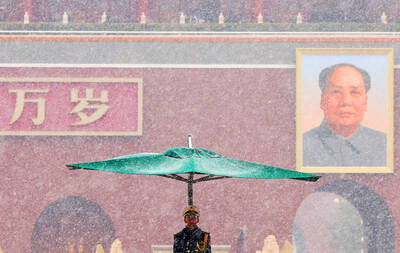
Chinese dissident artist Gao Zhen (高兟), famous for making provocative satirical sculptures of former Chinese leader Mao Zedong (毛澤東), was tried on Monday over accusations of “defaming national heroes and martyrs,” his wife and a rights group said. Gao, 69, who was detained in 2024 during a visit from the US, faces a maximum three-year prison sentence, said his wife, Zhao Yaliang (趙雅良), and Shane Yi, a researcher at the Chinese Human Rights Defenders group which operates outside the nation. The closed-door, one-day trial took place at Sanhe City People’s Court in Hebei Province neighboring the capital, Beijing, and ended without a


 RSS
RSS