


Underfed and chained up for endless hours, many elephants working in Thailand’s tourism sector could starve, be sold to zoos or be shifted into the illegal logging trade, campaigners warned, as the COVID-19 pandemic leads to a slump in the number of visitors.
Before the coronavirus, life for the kingdom’s estimated 2,000 elephants working in tourism was already stressful, with abusive methods often used to “break them” into giving rides and performing tricks at money-spinning animal shows.
With global travel paralyzed the animals are unable to pay their way, including the 300kg of food a day a captive elephant needs to survive.
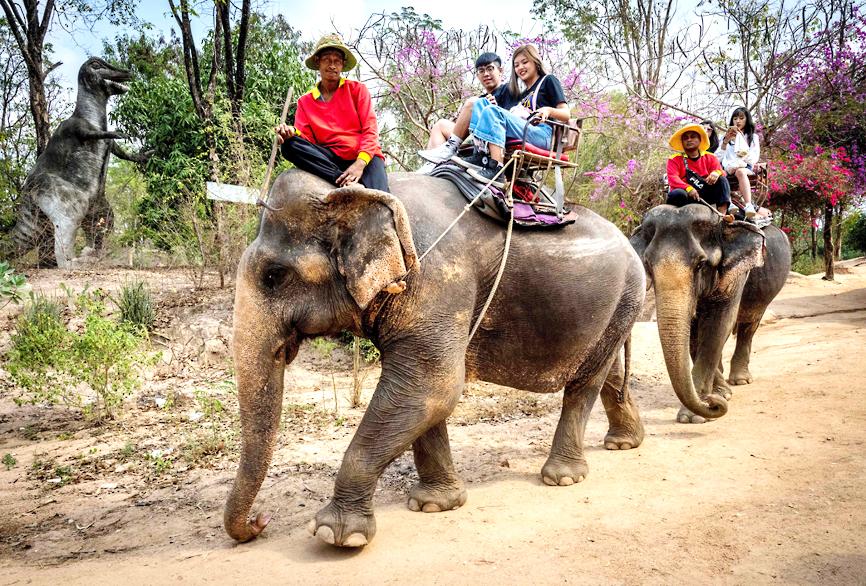
Photo: AFP
Elephant camps and conservationists warned that hunger and the threat of renewed exploitation lie ahead, without an urgent bailout.
“My boss is doing what he can, but we have no money,” Kosin, a mahout — or elephant handler — said of the Chiang Mai camp where his elephant, Ekkasit, is living on a restricted diet.
Chiang Mai is Thailand’s northern tourist hub, an area of rolling hills dotted by elephant camps and sanctuaries ranging from the exploitative to the humane.
Footage from another camp in the area showed lines of elephants tethered by a foot to wooden poles, some visibly distressed, rocking their heads back and forth.
About 2,000 elephants are “unemployed” as the coronavirus eviscerates the tourist industry, Thai Elephant Alliance Association president Theerapat Trungprakan said.
A lack of cash is limiting the fibrous food available to the elephants, “which will have a physical effect,” he said.
Wages for the mahouts who look after them have dropped by 70 percent.
Theerapat fears the elephants could soon be used in illegal logging activities along the Thailand-Myanmar border — in breach of a 30-year-old law banning the use of elephants to transport wood.
Others “could be forced [to beg] on the streets,” he said.
It is yet another twist in the saga of the exploitation of elephants, which animal rights campaigners have long been fighting to protect from the abusive tourism industry.
Chinese visitors, who make up the majority of Thailand’s 40 million tourists per year, plunged by more than 80 percent in February.
By last month, the travel restrictions had extended to Western nations.
With elephants increasingly malnourished due to the loss of income, the situation is “at a crisis point,” Elephant Nature Park owner Saengduean Chailert said.
Her sanctuary for about 80 rescued elephants only allows visitors to observe the creatures, a philosophy at odds with venues that have them performing tricks and offering rides.
She has organized a fund to feed elephants and help mahouts in almost 50 camps nationwide, fearing the only options would soon be limited to zoos, starvation or logging work.
For those restrained by short chains all day, the stress could lead to fights breaking out, said Saengduean, of camps that can no longer afford medical treatment for their elephants.
Calls are mounting for the Thai government to fund stricken camps to ensure the welfare of elephants.
“We need 1,000 baht [US$30] a day for each elephant,” Elephant Rescue Park manager Apichet Duangdee said.
Freeing his eight mammals rescued from circuses and loggers into the forests is out of the question, as they would likely be killed in territorial fights with wild elephants.
He is planning to take out a 2 million baht loan to keep his elephants fed.
“I will not abandon them,” he said.

Two medieval fortresses face each other across the Narva River separating Estonia from Russia on Europe’s eastern edge. Once a symbol of cooperation, the “Friendship Bridge” connecting the two snow-covered banks has been reinforced with rows of razor wire and “dragon’s teeth” anti-tank obstacles on the Estonian side. “The name is kind of ironic,” regional border chief Eerik Purgel said. Some fear the border town of more than 50,0000 people — a mixture of Estonians, Russians and people left stateless after the fall of the Soviet Union — could be Russian President Vladimir Putin’s next target. On the Estonian side of the bridge,

Jeremiah Kithinji had never touched a computer before he finished high school. A decade later, he is teaching robotics, and even took a team of rural Kenyans to the World Robotics Olympiad in Singapore. In a classroom in Laikipia County — a sparsely populated grasslands region of northern Kenya known for its rhinos and cheetahs — pupils are busy snapping together wheels, motors and sensors to assemble a robot. Guiding them is Kithinji, 27, who runs a string of robotics clubs in the area that have taken some of his pupils far beyond the rural landscapes outside. In November, he took a team

Civil society leaders and members of a left-wing coalition yesterday filed impeachment complaints against Philippine Vice President Sara Duterte, restarting a process sidelined by the Supreme Court last year. Both cases accuse Duterte of misusing public funds during her term as education secretary, while one revives allegations that she threatened to assassinate former ally Philippine President Ferdinand Marcos Jr. The filings come on the same day that a committee in the House of Representatives was to begin hearings into impeachment complaints against Marcos, accused of corruption tied to a spiraling scandal over bogus flood control projects. Under the constitution, an impeachment by the

Exiled Tibetans began a unique global election yesterday for a government representing a homeland many have never seen, as part of a democratic exercise voters say carries great weight. From red-robed Buddhist monks in the snowy Himalayas, to political exiles in megacities across South Asia, to refugees in Australia, Europe and North America, voting takes place in 27 countries — but not China. “Elections ... show that the struggle for Tibet’s freedom and independence continues from generation to generation,” said candidate Gyaltsen Chokye, 33, who is based in the Indian hill-town of Dharamsala, headquarters of the government-in-exile, the Central Tibetan Administration (CTA). It


 RSS
RSS