


Illegal exports of Somalian charcoal earned al-Shabaab militants tens of millions of US dollars in the past year and also financed violations of an arms embargo by clan-based militia that could fuel warlord tensions, UN investigators said in a new report.
The Somalia-Eritrea Monitoring Group, which oversees compliance with UN sanctions on the two countries, said it had counted 161 vessels exporting charcoal from Somalia’s southern ports of Kismayu and Barawe between June last year and May.
The UN Security Council prohibited charcoal exports from Somalia in February 2012 in a bid to cut off funds for al-Shabaab, a militant group that has been fighting for control of Somalia for years and enforces strict Shariah law in areas it occupies.
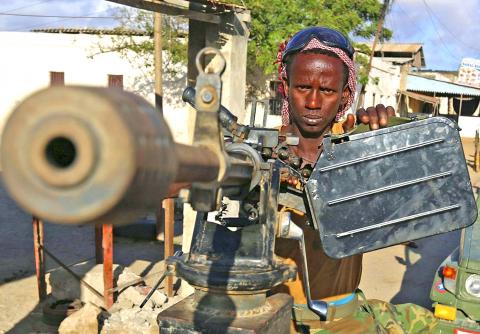
Photo: Reuters
“The total international market value of charcoal exported in 2013 and 2014 can be estimated as upwards of US$250 million and could be much more, given that the group may not have identified all shipments,” the monitors said in a confidential 482-page annual report, seen by reporters on Friday.
“The scale of the international trade in Somalian charcoal is largely consistent with its previous findings,” it said.
A third of the 161 shipments were in the names of two businessmen linked to al-Shabaab, said the monitoring group, and the shipments were primarily destined for the United Arab Emirates, Oman and Kuwait.
The group said charcoal was mainly exported from Kismayu and Barawe between June last year and January and shipments since January were primarily made from Kismayu, where port operations are supervised by the Ras Kamboni militia and the Kenyan military, which is part of an African Union peacekeeping force in Somalia.
The Kenyan military has denied allegations by the UN monitors that it aided illegal charcoal exports.
“The monitoring group has obtained information that, while businessmen linked to al-Shabaab ... continue to trade in charcoal freely, charcoal proceeds have also helped to finance the purchase of military vehicles by Ras Kamboni,” it said.
The council imposed an arms embargo on Somalia in 1992 to cut the flow of weapons to feuding warlords, who had ousted former Somalian president Mohamed Siad Barre and plunged the nation into civil war. In 2012, Somalia held its first vote to elect a president and prime minister since 1991.
“The import of vehicles, in violation of the arms embargo, is an example of how the unchecked scramble for charcoal revenue has contributed to the arming of the environment, which is likely to contribute more to historical clan tensions relating to the control of Kismayu,” the monitors said.
Dozens of people were killed last year when clan leader Barre Hirale’s forces battled for control of Kismayu from Ras Kamboni loyal to Ahmed Madobe, who was chosen by a regional assembly to preside over the surrounding Jubbaland region.
Hirale laid down arms and joined reconciliation talks in August.
The UN monitors said al-Shabaab had shifted most of its exports to Kismayu earlier this year to “disguise the operations of those traders working most closely with al-Shabaab in Barawe.”
However, this week military strikes drove al-Shabaab out of Barawe, their last major coastal stronghold.
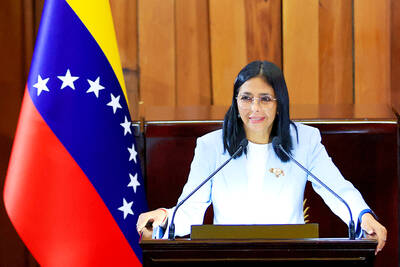
VAGUE: The criteria of the amnesty remain unclear, but it would cover political violence from 1999 to today, and those convicted of murder or drug trafficking would not qualify Venezuelan Acting President Delcy Rodriguez on Friday announced an amnesty bill that could lead to the release of hundreds of prisoners, including opposition leaders, journalists and human rights activists detained for political reasons. The measure had long been sought by the US-backed opposition. It is the latest concession Rodriguez has made since taking the reins of the country on Jan. 3 after the brazen seizure of then-Venezuelan president Nicolas Maduro. Rodriguez told a gathering of justices, magistrates, ministers, military brass and other government leaders that the ruling party-controlled Venezuelan National Assembly would take up the bill with urgency. Rodriguez also announced the shutdown
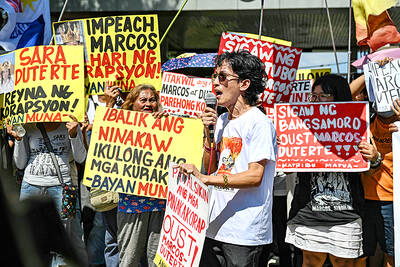
Civil society leaders and members of a left-wing coalition yesterday filed impeachment complaints against Philippine Vice President Sara Duterte, restarting a process sidelined by the Supreme Court last year. Both cases accuse Duterte of misusing public funds during her term as education secretary, while one revives allegations that she threatened to assassinate former ally Philippine President Ferdinand Marcos Jr. The filings come on the same day that a committee in the House of Representatives was to begin hearings into impeachment complaints against Marcos, accused of corruption tied to a spiraling scandal over bogus flood control projects. Under the constitution, an impeachment by the
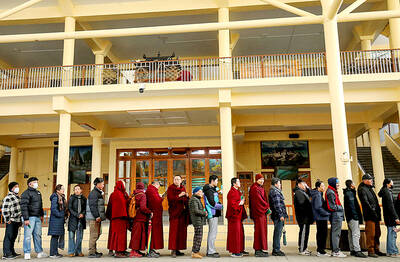
Exiled Tibetans began a unique global election yesterday for a government representing a homeland many have never seen, as part of a democratic exercise voters say carries great weight. From red-robed Buddhist monks in the snowy Himalayas, to political exiles in megacities across South Asia, to refugees in Australia, Europe and North America, voting takes place in 27 countries — but not China. “Elections ... show that the struggle for Tibet’s freedom and independence continues from generation to generation,” said candidate Gyaltsen Chokye, 33, who is based in the Indian hill-town of Dharamsala, headquarters of the government-in-exile, the Central Tibetan Administration (CTA). It

A Virginia man having an affair with the family’s Brazilian au pair on Monday was found guilty of murdering his wife and another man that prosecutors say was lured to the house as a fall guy. Brendan Banfield, a former Internal Revenue Service law enforcement officer, told police he came across Joseph Ryan attacking his wife, Christine Banfield, with a knife on the morning of Feb. 24, 2023. He shot Ryan and then Juliana Magalhaes, the au pair, shot him, too, but officials argued in court that the story was too good to be true, telling jurors that Brendan Banfield set


 RSS
RSS