

Chinese President Xi Jinping’s (習近平) phrasing to “combat Taiwanese independence forces” is not new despite a perceived escalation in Beijing’s rhetoric, Mainland Affairs Council Deputy Chairman Liang Wen-chieh (梁文傑) yesterday said.
Xi yesterday reiterated his firm opposition to Taiwanese independence and external interference in a speech marking the 77th anniversary of the founding of the People’s Republic of China.
He called for efforts “to resolutely fight secessionist forces seeking ‘Taiwanese independence,’ oppose external interference and promote the peaceful development of cross-strait relations to advance national reunification,” the state-run Xinhua news agency reported.
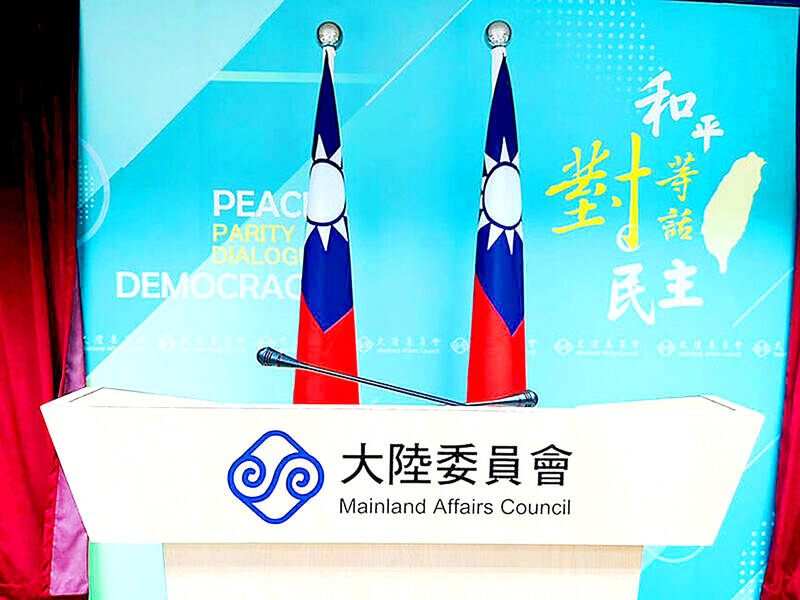
Photo: Taipei Times
Xi called on China to “take solid steps to achieve the great national rejuvenation” in remarks made at a reception at the Great Hall of the People in Beijing, Xinhua reported.
Some observers have interpreted Xi’s remarks on Taiwan as an escalation in rhetoric, pointing to him replacing the term “oppose” Taiwanese independence, which had been commonly used in the past, with a pledge to “resolutely fight Taiwanese independence separatist forces.”
Liang said the phrase was not new.
Chinese People’s Political Consultative Conference Chairman Wang Huning (王滬寧) used the phrase at a Central Committee Taiwan Affairs Work Conference in February 2024, and the wording was subsequently included in a Chinese government work report issued in March 2024, Liang said.
Xi also used the same wording at a ceremony marking the 103rd anniversary of the founding of the Chinese Communist Party on July 1 that year, he added.
After the phrase was used at the Taiwan Affairs Work Conference, China began taking a series of concrete actions, including holding regular military exercises, sending military aircraft across the Taiwan Strait median line, deploying coast guard vessels to harass ships in waters around Kinmen County, and labeling Taiwanese politicians, prosecutors and judicial officials as “Taiwanese independence elements,” Liang said.
Additional reporting by Reuters

The National Police Agency’s Third Special Police Corps yesterday said that from May to July, it intercepted five smuggling operations from China, seizing more than 70,000 counterfeit Beyblades with an estimated infringement value of NT$34.45 million (US$1.08 million). It added that any bootleg unit that reached the local market could present hidden health hazards to players. Beyblades, a line of spinning toy tops used in competitive gaming and developed in Japan by toy company Takara Tomy, have become popular in Taiwan, making them a target for fraudsters. The Third Special Police Corps, dedicated to safeguarding maritime borders and trade lines,

Five customers who made purchases at 7-Eleven stores across Taiwan won the top NT$10 million (US$313,716) special prize in the July-August uniform invoice lottery, including one who spent just NT$27 on photocopying, the convenience store chain said today. The five special prize winners made their purchases at stores in Taoyuan, Taipei, Taichung and Kaohsiung, 7-Eleven operator President Chain Store Corp said. The five winning purchases included NT$29 spent on snacks at a store in Taoyuan's Zhongli District (中壢), NT$27 on photocopying at a store in Taipei's Zhongzheng District (中正), NT$139 on City Cafe coffee and daily necessities at a store in Taipei's
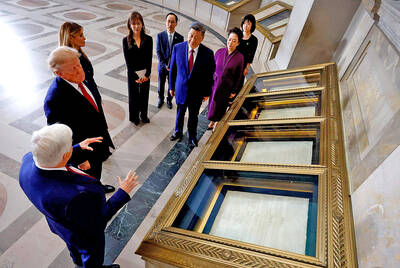
Chinese President Xi Jinping (習近平) reportedly cut short his visit to the National Archives in Washington after the Chinese delegation objected to plans to view the Treaty of San Francisco, sources in Washington’s media circles said. Xi and his wife, Peng Liyuan (彭麗媛), concluded their three-day state visit to the US on Friday after having tea with US President Donald Trump and first lady Melania Trump at the White House and visiting the archives. Chinese democracy advocates and members of pro-China groups gathered outside the venue during Xi’s visit, with the two groups exchanging competing slogans while police kept them separated. The US

TRICKY ISSUE: Taiwan’s defense of the ROC in WWII could conflict with the government’s narrative on Taiwanese history and identity, an academic said Chinese President Xi Jinping (習近平) had no standing to discuss US-China relations in World War II (WWII), as the People’s Republic of China did not exist at that time, Mainland Affairs Council (MAC) Deputy Minister Shen Yu-chung (沈有忠) said yesterday. Taipei would ensure that Washington has a clear understanding that it was the Republic of China (ROC), not the People’s Republic of China (PRC), that was a steadfast ally of the US in WWII, Shen said. Shen was referring to a White House fact sheet released on Friday about Xi’s meeting with US President Donald Trump in Washington. It said that “the two


 RSS
RSS