

About one in six people receiving care for non-communicable diseases (NCDs) experience preventable harm, the Taiwan Alliance of Patients’ Organizations said yesterday, calling for better patient safety governance through enhanced patient engagement.
As part of World Patient Safety Day, observed annually on Sept. 17, the alliance invited the Joint Commission of Taiwan, Taiwan Healthcare Reform Foundation and the Formosa Cancer Foundation to raise public awareness on safe care for people with NCDs.
NCDs are chronic conditions, such as cardiovascular diseases, cancers, diabetes and chronic respiratory diseases, that affect people of all ages and mostly require continued care throughout life.
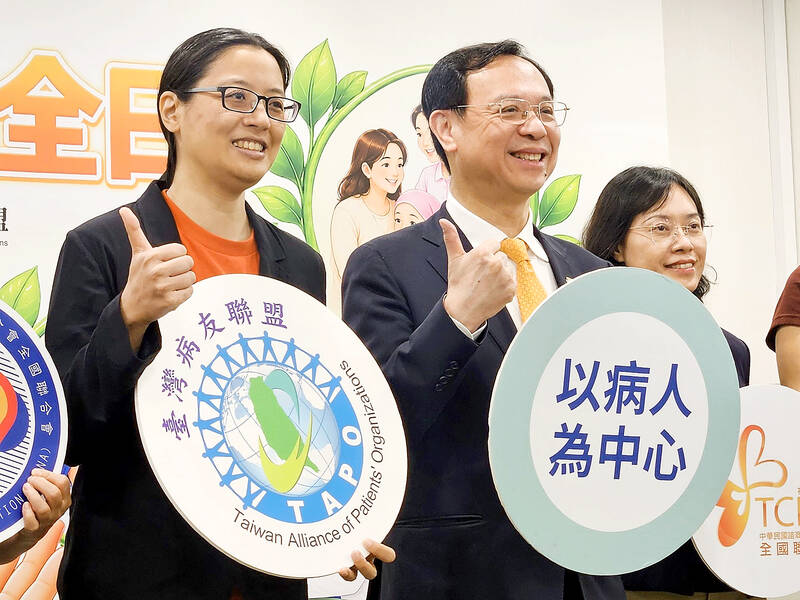
Photo: CNA
Alliance chairman Wu Hung-lai (吳鴻來) said a new WHO-commissioned analysis found that about one in six people living with NCDs experience preventable harm during their medical care.
The rate of preventable harm is about three times higher than that of the general population, and medication-related problems are the most common source of harm, he said.
The WHO proposed ways to improve care for people with NCDs, including partnering with people with lived experience of such diseases; improving prevention and risk assessment; and providing early detection, accurate diagnosis and integrated management, Wu said.
They also include securing access, and safe use of medicines and medical devices; and strengthening care coordination, continuity and transitions of care, he said.
“Patient participation is key to improving medical quality and patient safety, and that it should not only be limited to ‘encouraging patients to speak up,’ but also ‘engaging patients in patient safety governance,’” he added.
NCDs often require long-term, interdisciplinary and cross-setting care, he said, adding that people with NCDs are crucial partners who can identify risks throughout the care journey.
Institutionalized mechanisms should also be established to involve patients and advocacy groups in patient safety event reporting and improvement, and overall patient safety governance, he added.
Minister of Health and Welfare Shih Chung-liang (石崇良) said people with NCDs often require long-term medication, and comorbidities might also increase medication use, making them at high risk for safety events.
The commission has since 2003 made “medication adverse event control” an annual goal, he said.
That is still an important goal this year, but the focus has shifted from “avoiding giving the wrong medication” to “proper medication use,” he added.
The Healthy Taiwan Deep Cultivation Program launched last year also subsidized hospitals that introduced smart medical equipment, such as automated “three checks and five rights” to prevent medication errors, he said.
Patient safety requires patient participation, as relying only on the efforts of the government and healthcare providers yield very limited results, Shih said.
When establishing annual patient safety goals, the ministry invites patient advocacy groups to to help improve clinical environments and patient safety, he added.

A Hualien pomelo farmer refused to sell to China after the country announced it would permit more Taiwanese pomelo imports, prompting widespread support from Taiwanese consumers, who rallied to buy his fruit. China’s Taiwan Affairs Office last month said that China’s General Administration of Customs registered an additional 79 Taiwanese pomelo orchards and packing facilities in Hualien County, allowing more Taiwanese producers to export pomelos to China. “I am a Hualien fruit farmer and I refuse to sell to China,” Liu Tzu-hao (劉子豪) from Ruisui Township (瑞穗) said in an online post. Liu is a well-known farmer in the community and has served

A Chinese military drone was spotted conducting reconnaissance off Taitung County as President William Lai (賴清德) visited Pingtung County this morning to inspect a drill of the armed forces’ precision-strike capabilities, prompting the military to closely monitor its actions. Today was the final day of a three-day military exercise at Jioupeng Base (九鵬基地) to test the joint combat capabilities of the armed forces and coast guard. The exercise began on Wednesday simulating air defense interception and yesterday tested long-range strike capabilities and new air defense weapons. This morning, the military conducted a final exercise involving air defense, anti-ship and drone operations. Military sources said

UPDATE: The submarine would need to undergo combined systems testing and crew training for navy personnel before it is ready for mission, an expert said Taiwan’s first domestically built submarine, the Hai Kun (Narwhal, 海鯤), could be delivered to the navy as early as next month, military expert and Taiwan Association for Security and Development chairman Chi Tung-yun (紀東昀) said yesterday. The submarine was yesterday morning observed departing for its 21st sea trial and its 15th submerged test. The vessel missed the initial delivery deadline of November last year due to “testing delays,” its primary contractor, shipbuilder CSBC Corp, Taiwan, said in June. The contractor also cited “political pressure from China” in procuring critical equipment. All testing operations are in the final stages, with the
OCT. 31: The antiviral drugs Tamiflu and Eraflu have been distributed to about 4,000 medical facilities nationwide for people in seven groups who develop flu-like symptoms As the domestic influenza epidemic enters its peak season and continues to escalate, the Centers for Disease Control (CDC) yesterday announced that publicly funded influenza antiviral drugs for seven eligible groups have been extended to Oct. 31, allowing those who develop flu-like symptoms to receive the medication without undergoing a rapid influenza test. The CDC has extended the expanded use of flu antiviral drugs to seven groups: healthcare and influenza-prevention personnel; residents and staff at nursing homes, long-term care facilities and similar institutions; kindergarten and daycare workers and home-based caregivers; students from kindergarten through high school, vocational high school and the


 RSS
RSS