

Taiwan debuted its first-ever national pavilion at the InnonTrans global transportation technology trade fair in Berlin on Tuesday, aimed at demonstrating resilient railway solutions and attracting international partners, officials said at the event.
Organized by the Ministry of Transportation and Communications’ Railway Bureau, the Taiwan Pavilion at InnoTrans has 14 partners from academia, research institutes and the private sector, including Taiwan High Speed Rail Corp.
The exhibit is centered on smart transit and rail resilience, highlighting Taiwanese strengths across 5G, artificial intelligence (AI) of things, smart rail system integration and other industries, Railway Bureau Director-General Young Cheng-chung (楊正君) said.
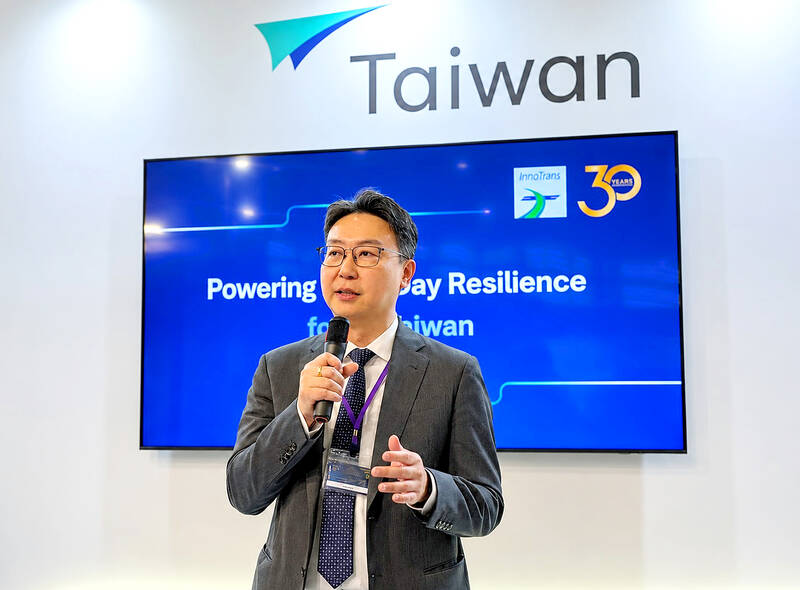
Photo: CNA
Taiwanese companies have booths at the event, but the pavilion serves as a platform for the domestic rail sector to gain global visibility and to build international partnerships, Young said.
The ministry said that 26 Taiwanese firms are hosting exhibits at the event, which runs through tomorrow.
Minister of Transportation and Communications Chen Shih-kai (陳世凱) told the opening ceremony that although Taiwan is small geographically, its century-long development of traditional trains, high-speed rail, urban metro systems and light rail reflects its ambitions in rail transport.
Taiwan would apply its expertise in AI, virtual simulations and information technology to bolster its capabilities in train design, electromechanics, system integration and safety verification, improving its capability to facilitate the growth of the rail industry in Taiwan, Chen said.

A Hualien pomelo farmer refused to sell to China after the country announced it would permit more Taiwanese pomelo imports, prompting widespread support from Taiwanese consumers, who rallied to buy his fruit. China’s Taiwan Affairs Office last month said that China’s General Administration of Customs registered an additional 79 Taiwanese pomelo orchards and packing facilities in Hualien County, allowing more Taiwanese producers to export pomelos to China. “I am a Hualien fruit farmer and I refuse to sell to China,” Liu Tzu-hao (劉子豪) from Ruisui Township (瑞穗) said in an online post. Liu is a well-known farmer in the community and has served

A Chinese military drone was spotted conducting reconnaissance off Taitung County as President William Lai (賴清德) visited Pingtung County this morning to inspect a drill of the armed forces’ precision-strike capabilities, prompting the military to closely monitor its actions. Today was the final day of a three-day military exercise at Jioupeng Base (九鵬基地) to test the joint combat capabilities of the armed forces and coast guard. The exercise began on Wednesday simulating air defense interception and yesterday tested long-range strike capabilities and new air defense weapons. This morning, the military conducted a final exercise involving air defense, anti-ship and drone operations. Military sources said

UPDATE: The submarine would need to undergo combined systems testing and crew training for navy personnel before it is ready for mission, an expert said Taiwan’s first domestically built submarine, the Hai Kun (Narwhal, 海鯤), could be delivered to the navy as early as next month, military expert and Taiwan Association for Security and Development chairman Chi Tung-yun (紀東昀) said yesterday. The submarine was yesterday morning observed departing for its 21st sea trial and its 15th submerged test. The vessel missed the initial delivery deadline of November last year due to “testing delays,” its primary contractor, shipbuilder CSBC Corp, Taiwan, said in June. The contractor also cited “political pressure from China” in procuring critical equipment. All testing operations are in the final stages, with the

OCT. 31: The antiviral drugs Tamiflu and Eraflu have been distributed to about 4,000 medical facilities nationwide for people in seven groups who develop flu-like symptoms As the domestic influenza epidemic enters its peak season and continues to escalate, the Centers for Disease Control (CDC) yesterday announced that publicly funded influenza antiviral drugs for seven eligible groups have been extended to Oct. 31, allowing those who develop flu-like symptoms to receive the medication without undergoing a rapid influenza test. The CDC has extended the expanded use of flu antiviral drugs to seven groups: healthcare and influenza-prevention personnel; residents and staff at nursing homes, long-term care facilities and similar institutions; kindergarten and daycare workers and home-based caregivers; students from kindergarten through high school, vocational high school and the


 RSS
RSS