

The Health Promotion Administration’s (HPA) Health Token program, which is to launch next week, has partnered with major convenience stores and supermarkets, HPA Director-General Shen Ching-fen (沈靜芬) said yesterday.
FamilyMart, 7-Eleven and PX Mart, as well as World Gym, Fitness Factory and Curves are participating in the first phase of the program, Shen said.
The program is to launch on Thursday next week for National Health Insurance (NHI) cardholders aged 18 or older, including foreign residents, with tokens redeemable from Dec. 1, she said.
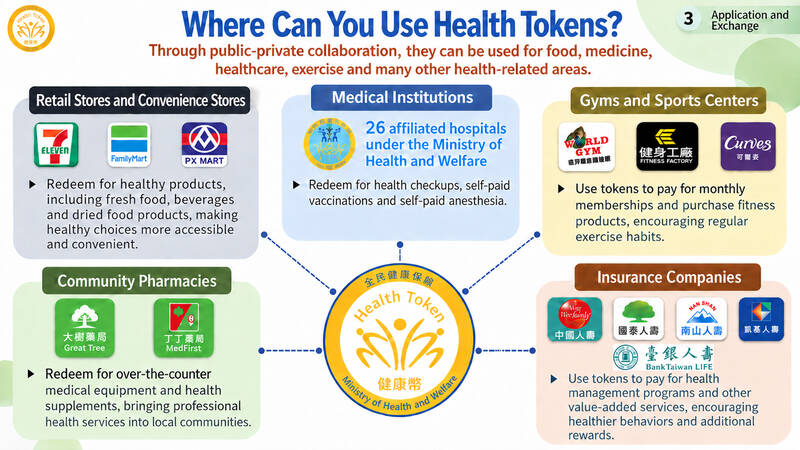
Photo courtesy of the Health Promotion Administration
The tokens are modeled on a similar program in Singapore and would reward healthy behaviors, such as getting medical checkups and vaccinations, with rewards including healthy food and beverages, discounted access to gyms and sports facilities, reduced healthcare costs and health insurance benefits, she said.
People can earn tokens via an app for publicly funded health checkups and cancer screenings and publicly or self-funded vaccinations, including COVID-19, influenza and pneumococcal vaccines, Shen said, adding that those actions would earn 800 to 1,350 tokens.
The HPA estimates that people could accumulate 3,700 to 13,150 tokens in two years, depending on age group and health risks, she added.
The program is a collaboration between the public and private sectors, with supermarkets and convenience stores, pharmacies, medical institutions, sports venues and insurance providers involved, she said.
At 7-Eleven, FamilyMart and PX Mart, people can redeem fresh produce, drinks and dried goods, while World Gym, Fitness Factory and Curves would offer discounts on monthly passes and exercise-related products, she said.
The HPA has also partnered with pharmacy chains, including Great Tree and Wellcare, to offer medical devices and nutritional supplements in exchange for tokens, she said.
Participating life insurance providers include Taiwan Life Insurance Co, Cathay Life Insurance Co, Fubon Life Insurance Co, Nanshan Life Insurance Co, KGI Life Insurance Co and BankTaiwan Life Insurance Co, she said.
About 26 Ministry of Health and Welfare hospitals would allow people with NHI cards to redeem tokens for self-paid health examinations, vaccinations and anesthesia, she added.
From next week, people can earn 200 tokens the first time they log into the health token section of the NHI’s app and 100 tokens for completing the lifestyle assessment, she said.
People do not need to keep receipts or apply for tokens individually, as all records would be automatically credited through the system, she said.
From Oct. 1, people could link their accounts on the NHI app with the Health GO App to begin redeeming health-related products, Shen said.
Redemption requires at least 1,000 tokens, she said.
Moreover, those who download both apps between Thursday next week and Nov. 30, and complete identity verification and registration can enter a lottery to win NT$200 digital merchandise vouchers, she said.
The lottery would run for eight consecutive weeks, with 3,600 winners selected each week, she said.
A year-end bonus draw on Dec. 7 would select 200 people from those who completed account linking from Nov. 26 to 30 to win an Apple Watch, she added.
The health token program is to be extended to school-age children in later phases, Minister of Health and Welfare Shih Chung-liang (石崇良) said.

A Hualien pomelo farmer refused to sell to China after the country announced it would permit more Taiwanese pomelo imports, prompting widespread support from Taiwanese consumers, who rallied to buy his fruit. China’s Taiwan Affairs Office last month said that China’s General Administration of Customs registered an additional 79 Taiwanese pomelo orchards and packing facilities in Hualien County, allowing more Taiwanese producers to export pomelos to China. “I am a Hualien fruit farmer and I refuse to sell to China,” Liu Tzu-hao (劉子豪) from Ruisui Township (瑞穗) said in an online post. Liu is a well-known farmer in the community and has served

A Chinese military drone was spotted conducting reconnaissance off Taitung County as President William Lai (賴清德) visited Pingtung County this morning to inspect a drill of the armed forces’ precision-strike capabilities, prompting the military to closely monitor its actions. Today was the final day of a three-day military exercise at Jioupeng Base (九鵬基地) to test the joint combat capabilities of the armed forces and coast guard. The exercise began on Wednesday simulating air defense interception and yesterday tested long-range strike capabilities and new air defense weapons. This morning, the military conducted a final exercise involving air defense, anti-ship and drone operations. Military sources said

UPDATE: The submarine would need to undergo combined systems testing and crew training for navy personnel before it is ready for mission, an expert said Taiwan’s first domestically built submarine, the Hai Kun (Narwhal, 海鯤), could be delivered to the navy as early as next month, military expert and Taiwan Association for Security and Development chairman Chi Tung-yun (紀東昀) said yesterday. The submarine was yesterday morning observed departing for its 21st sea trial and its 15th submerged test. The vessel missed the initial delivery deadline of November last year due to “testing delays,” its primary contractor, shipbuilder CSBC Corp, Taiwan, said in June. The contractor also cited “political pressure from China” in procuring critical equipment. All testing operations are in the final stages, with the
OCT. 31: The antiviral drugs Tamiflu and Eraflu have been distributed to about 4,000 medical facilities nationwide for people in seven groups who develop flu-like symptoms As the domestic influenza epidemic enters its peak season and continues to escalate, the Centers for Disease Control (CDC) yesterday announced that publicly funded influenza antiviral drugs for seven eligible groups have been extended to Oct. 31, allowing those who develop flu-like symptoms to receive the medication without undergoing a rapid influenza test. The CDC has extended the expanded use of flu antiviral drugs to seven groups: healthcare and influenza-prevention personnel; residents and staff at nursing homes, long-term care facilities and similar institutions; kindergarten and daycare workers and home-based caregivers; students from kindergarten through high school, vocational high school and the


 RSS
RSS