

The Walk for Wildlife Association yesterday in Taipei held a march urging the government to incorporate ecological governance into free-roaming animal management schemes to curb conflicts between strays and wildlife.
Association president Lee Tsung-chen (李宗宸) said this year’s march has four demands:
First, push for legislation for free-roaming animal management to reduce ecological conflicts.

Photo courtesy of the Walk for Wildlife Association
Second, to establish a scientific evaluation mechanism based on conflicts between wildlife and stray animals.
Third, to improve the animal shelter and relocation system to reduce the number of stray animal.
Fourth, to establish a biodiversity governance mechanism with clearly defined authority and responsibility to bridge the ecological governance gap.
The fourth demand is the most important, as many free-roaming animal issues originated from poor management by humans, Lee said.
With the ecological impacts caused by strays and their own animal welfare in mind, stray management should shift from a trap-neuter-return approach to a trap-neuter-shelter-adopt approach, he said.
“Let dogs and cats return to environments with proper care by humans, reducing the threat they pose to wildlife,” Lee said.
Policy effectiveness should translate into improvement levels instead of “what has been done,” Lee said.
The government usually points to the number of stray animals they have captured or sterilized, but whether such approaches improved the situations of people, strays and wildlife remains questionable, he said.
Chuang Chao (莊喬), who took part in the march, said he lives near a graveyard in New Taipei City’s Sindian District (新店) and has long suffered from loud barking by packs of stray dogs that frequent the area, drawn by food that well-intentioned residents leave out.
The barking disrupted his sleep for days, Chuang said, adding that over the past few years, he has talked with about 10 people who had fed stray dogs in the region.
“I chatted with all of them and asked how many dogs they knew, whether they understood the dogs’ situations, and what their next step or plan is for the dogs,” Chuang said.
While there used to be almost 30 free-roaming dogs around the graveyard, it is down to about seven due to Chuang’s communication with those feeding the dogs, he said.
Chuang said sterilization and a feeding ban on strays could help address the issue of free-roaming animals.
“What matters most is to apply strategies tailored to local conditions and start by changing people’s behavior,” he said.
Another marcher, Anrou Hu (胡安柔), said she has long been concerned about wildlife conservation, adding that she used to keep cats, rabbits and green iguana as pets.
“It’s a shame that such household pets got involved in conflicts with people or other animals simply because they wandered off or were abandoned,” Hu said.
Wild at Heart executive director Chen Hsien-cheng (陳憲政) said he is concerned about wildlife habitat protection, particularly where human development undermines natural habitats.
Coastal energy development projects are threatening Taiwanese humpback dolphins, while water diversion engineering could dry up Taitung County’s Jhihben wetlands and drive away local waterbirds, Chen said.
Protected wildlife populations such as humpback dolphins could dwindle with disappearing habitats, he said, adding that such losses might be irreversible or require high restoration costs.
Proper ecological impact assessments should be done prior to development, he added.
March lead organizer Chuang Po-jun (莊博鈞) said other issues, such as roadkill and habitat fragmentation or degradation are as important as free-roaming animals in terms of wildlife protection. However, most people are less aware of threats posed by stray animals, he said.
“People knew that clearing a forest would destroy wildlife’s homes, but they might not imagine how much unattended cats or dogs could harm other animals in the wild,” he said, adding participants could explore many other ecological issues at the event’s stalls.
The association said about 3,000 people participated in the march.

A Chinese military drone was spotted conducting reconnaissance off Taitung County as President William Lai (賴清德) visited Pingtung County this morning to inspect a drill of the armed forces’ precision-strike capabilities, prompting the military to closely monitor its actions. Today was the final day of a three-day military exercise at Jioupeng Base (九鵬基地) to test the joint combat capabilities of the armed forces and coast guard. The exercise began on Wednesday simulating air defense interception and yesterday tested long-range strike capabilities and new air defense weapons. This morning, the military conducted a final exercise involving air defense, anti-ship and drone operations. Military sources said

OCT. 31: The antiviral drugs Tamiflu and Eraflu have been distributed to about 4,000 medical facilities nationwide for people in seven groups who develop flu-like symptoms As the domestic influenza epidemic enters its peak season and continues to escalate, the Centers for Disease Control (CDC) yesterday announced that publicly funded influenza antiviral drugs for seven eligible groups have been extended to Oct. 31, allowing those who develop flu-like symptoms to receive the medication without undergoing a rapid influenza test. The CDC has extended the expanded use of flu antiviral drugs to seven groups: healthcare and influenza-prevention personnel; residents and staff at nursing homes, long-term care facilities and similar institutions; kindergarten and daycare workers and home-based caregivers; students from kindergarten through high school, vocational high school and the
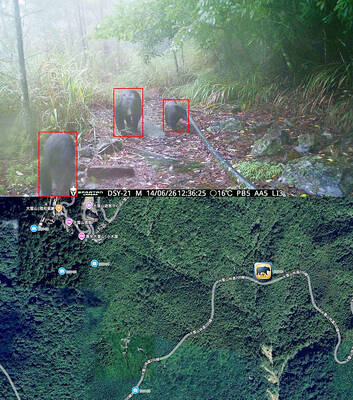
RARE PEEK: The footage released showed one of the bears staying in a cave for as long as 70 days, providing the first record of Formosan black bear’s overwintering The Forestry and Nature Conservation Agency yesterday released tracking records of released Formosan black bears for the first time, showing that they get much closer to human settlements than previously thought. The agency said it had captured two bears, Da Qu-ali (達古阿里) and Aziman (阿里曼), in indigenous villages in Hualien County and began to track them with a camera-mounted satellite collar after releasing them back into the wild. The results confirmed that the bears have moved from deep mountain areas into lowland hills closer to human communities, leading to an increase in human-bear conflicts, it said. The agency has introduced artificial intelligence-assisted early

DIPLOMATIC TOUR: Chinese President Xi Jinping began a series of overseas visits last month to Kyrgyzstan, Egypt and India, aimed at securing leverage, an official said Recent Chinese diplomatic and military moves are aimed at creating pressure ahead of a planned meeting between Chinese President Xi Jinping (習近平) and US President Donald Trump, National Security Council adviser Huang Chung-yen (黃重諺) said. Trump when visiting China in May extended an invitation to Xi to visit Washington on Sept. 24. China is yet to officially announce plans for Xi’s visit to the US. In an interview with the Liberty Times (sister paper of the Taipei Times) on Thursday, Huang said Xi’s overseas visits, China’s “gray zone” activities along the First Island Chain and efforts to expand its trade surplus with the


 RSS
RSS