

Refits to Chinese nuclear submarines to carry JL-3 intercontinental ballistic missiles would put much of the US in striking distance, Taiwanese defense analysts said in a report commissioned by the Mainland Affairs Council.
Researchers from National Defense University’s Graduate Institute of China Military Affairs Studies said that the Chinese People’s Liberation Army Navy (PLAN) in July test-fired a missile with a training warhead.
Chinese state media reported without elaborating that a PLAN nuclear-powered ballistic missile submarine (SSBN) launched a missile with a training warhead, which accurately hit the designated target area in the Pacific, the report said.
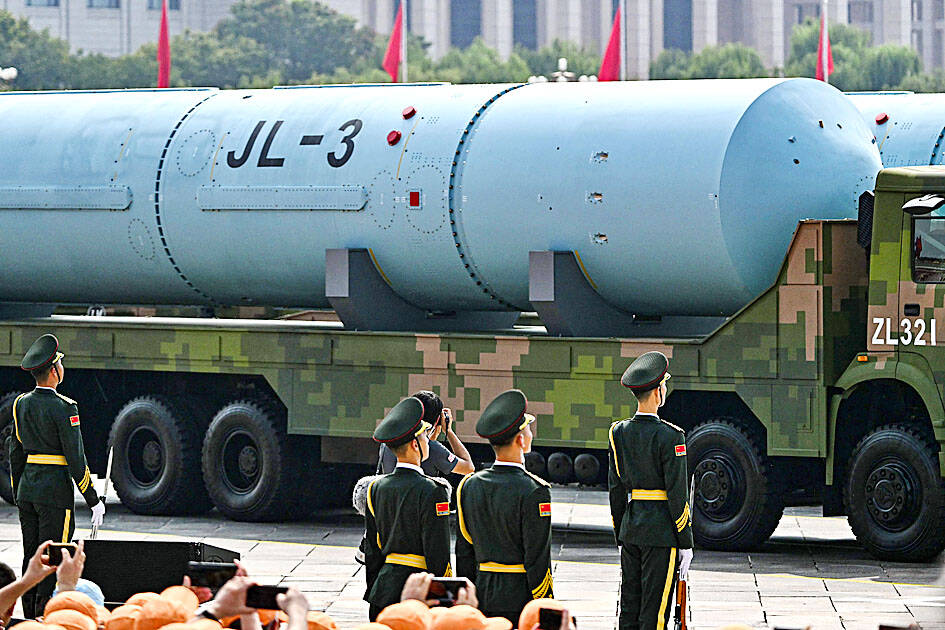
Photo: AFP
The launch was a rare display of the PLAN’s nuclear might, despite the taciturn announcement from Beijing, it said.
Taiwan and the US tracked the ballistic missile’s trajectory during its descent and concluded that the weapon, a JL-2 intercontinental ballistic missile, splashed down in international waters near Nauru in the southern Pacific, the report said.
Several Pacific nations have protested China’s missile test, as the warhead fell close to their exclusive economic zones, it said.
Citing Ministry of National Defense officials and military officers’ remarks at a Legislative Yuan meeting, the report said Taiwan was able to confirm that the Chinese SSBN launched the missile from the surface and not underwater.
The launch, which was tracked jointly by the Taiwanese and US intelligence organs, took place in the waters off southern Guangdong, they added.
The JL-2, a sub-launched missile with an effective range of about 6,000km to 7,000km, is widely used in the PLAN’s SSBN fleet, the report said.
Chinese state-affiliated media withheld almost all technical information about the launch, declining to identify the submarine or missile involved, its location at the time of launch, or the coordinates of the target, it said.
The vagueness of Beijing’s release about the live-fire test was intended to strengthen its deterrence posture without giving away information about its capabilities, it said.
The report said that the PLAN is refitting its Type-094 SSBNs to carry the newer JL-3 ballistic missiles.
US Strategic Command former commander Anthony Cotton testified in the US Congress that Beijing is treating the JL-3 retrofit, with the missile’s 10,000km range, as a top priority, the report said.
A PLAN SSBN equipped with JL-3s would be able to launch nuclear strikes at most of the continental US from the relative safety of China’s littoral waters, it said, a feat the JL-2 cannot replicate.
Taiwanese intelligence analysis indicated that the launch’s purpose was to certify the submarine’s capability to deploy the JL-2, not to unveil a new capability to the world, it said.
This could indicate that the PLAN has not yet fully certified the use of JL-3, suggesting that it is not deemed a fully operational weapon, the report said.
The PLAN continues improvement of the seaborne leg of its nuclear triad, including construction of next-generation vessels, developing improved missiles and holding its established patrol perimeters, it said.
The Chinese SSBN fired the test missile from the northern part of the South China Sea, which is consistent with the PLAN’s established pattern of deploying SSBN patrols out of the Hainan naval base.
The PLAN test launch has ramifications for regional security, highlighting inadequacy in US-China communication mechanisms regarding nuclear weapon tests, it said.
Washington and its NATO allies have formally acknowledged that the lack of communication channels are a risk that could lead to dangerous misunderstandings, the report said.
In addition, Pacific nations and neighbors were alarmed by the southern drift of the PLAN’s missile tests, which crossed the boundaries of the region’s nuclear-test free area, it said.
Taipei should carefully monitor the changes in Beijing’s relationship with Pacific nations, the report said.
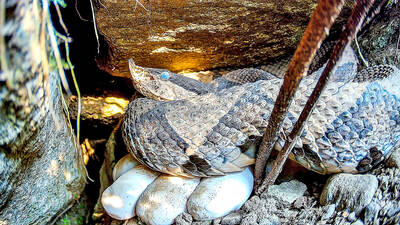
NATURE TAKES ITS COURSE: The agency’s head said he felt a sense of loss watching red-banded snakes eat the babies, as they had decided on non-intervention The Forestry and Nature Conservation Agency yesterday released a documentary on a hundred-pace viper that had incubated 16 eggs, all of which hatched, but only a baby viper escaped after they were attacked by red-banded snakes. The agency’s Taichung branch last year launched the viper reproduction monitoring project soon after forest rangers Lin Chun-yu (林俊佑) and Chou Chia-cheng (周家成) spotted a pregnant hundred-pace viper in a grass-covered burrow near a parking lot in Tbulan Village (松鶴部落). The Atayal village, in Taichung’s Heping District (和平), is headed by Ecyang Yapu, who was positive about the project and assisted in access control and power
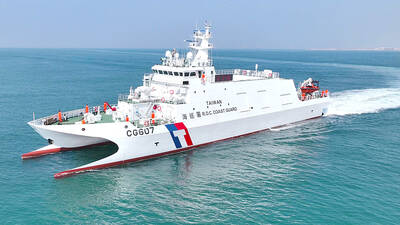
The Coast Guard Administration (CGA) yesterday said that it had deployed vessels to “monitor” Chinese ships operating in waters off the east coast. The CGA said it dispatched vessels in response to a China Coast Guard announcement that it had carried out another “routine law-enforcement patrol” in waters off the east coast. “The CGA firmly rejects China’s cognitive warfare campaign of ‘law enforcement in name, jurisdictional expansion in practice,’” it said on X. As of 11am yesterday, two China Coast Guard ships were “loitering and drifting” about 105 nautical miles (195km) and 74 nautical miles east of Green Island (綠島) respectively, it said. It
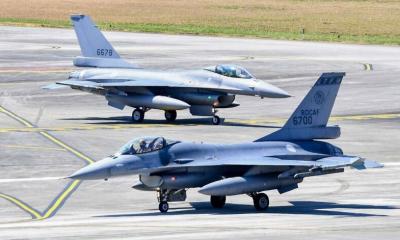
The first two F-16V Block 70 jets Taiwan purchased from the US were spotted unexpectedly turning back after departing from Hawaii yesterday, potentially further delaying delivery of the aircraft. Taiwan has purchased 66 of the F-16 C/D Block 70 jets to be deployed at Chihhang Air Base (志航基地) in Taitung County and operated by the air force's 7th Tactical Fighter Wing to defend Taiwan’s eastern region. Two single-seat jets, bearing serial No. 6727 and 6728, were spotted taking off from Hickam Field in Hawaii yesterday, observers said. Based on the precedent set during the delivery of Taiwan's older F-16 Block 20s, the new
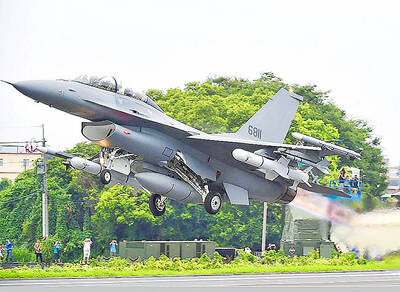
A sharp rise in compensation to be paid by air force officers who leave before completing their required service could indicate an increase in pilots leaving the military early, an analyst said on Friday, warning that the trend could worsen a shortage of experienced personnel. Chieh Chung (揭仲), a researcher at the Association for Strategic Foresight, issued the warning even though the number of volunteer military personnel is expected to increase next year. The planned headcount for volunteer military personnel, covering officers, noncommissioned officers (NCO) and enlisted soldiers, is 158,223 for next year, up 4,258 from 153,965 this year, Chieh said. The increase


 RSS
RSS