

Communications experts yesterday urged the legislature to expedite approval of the Executive Yuan’s nominees to the National Communications Commission (NCC), saying the agency’s prolonged leadership vacuum has undermined the public interest.
The experts were commenting at a meeting of the Legislative Yuan’s Transportation Committee prior to the official review of nominees.
The Executive Yuan nominated former Taipei Department of Legal Affairs commissioner Yuan Hsiu-hui (袁秀慧) as NCC chairwoman and National Sun Yat-sen University Institute of Marketing Communication professor Shaw Ping (蕭蘋) as vice chairwoman. The other nominees are Wang Yi-hui (王怡惠), Yu Chia-mu (游家牧), Chang Chun-yen (張春炎), Steve Chang (張克豪) and Chen Chun-mu (陳春木).
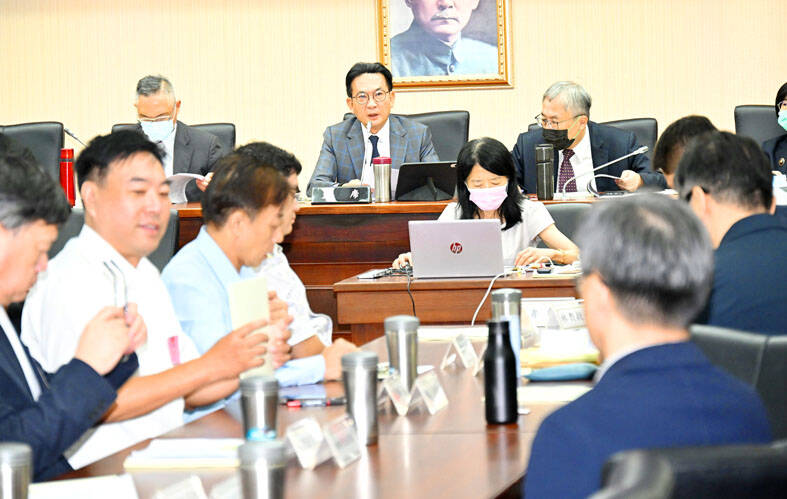
Photo: Lo Pei-de, Taipei Times
The communications authority is operating without any commissioners after the terms of the three remaining commissioners expired on July 31.
Hung Pu-chao (洪浦釗), an assistant professor at the University of Taipei’s Center for General Education, said that while the legislature can scrutinize the nominees, the stalled review process has affected radio-frequency equipment import approvals, as well as the approval and renewal of broadcasting licenses.
The ruling and opposition parties should swiftly get the review process back on track, Hung said.
Lin Cheng-yu (林承宇), a professor in Shih Hsin University’s Department of Radio, Television and Film, said that more than 700 cases are awaiting NCC rulings, including proposed changes to the business plans and shareholding structures of television news channels.
“The consequences of leaving the communications oversight agency dysfunctional are far greater than finding perfect candidates for the positions,” he said.
Once the commissioners are approved, they should work with the Ministry of Digital Affairs to promote a paid news revenue-sharing system, because content produced by news media is used by large online platforms free of charge, Lin said.
Chang Kun-sheng (張錕盛), an adjunct lecturer in Soochow University’s Department of Law, said that lawmakers should focus on the qualifications of nominees and avoid reviewing communications professionals through political lenses.
The NCC should rule independently based on professionalism without any political interference, and the principle should apply to controversial cases involving CTi News and Mirror News, he said.
CTi News’ broadcasting license was not renewed after the NCC cited repeated rule violations and failures in internal discipline and control, while management issues were reported at Mirror News after it obtained a broadcasting license in 2022.
The review of the two cases sparked controversies due to a lack of transparency, National Taiwan Normal University adjunct assistant professor Lin Kuan-yu (林寬裕) said.
While Taiwan has freedom of speech, media diversity has yet to be fully established, he said.
Shih Hsin University professor Wen Wei-chun (溫偉群) said the public does not trust the NCC, particularly when it comes to its criteria for penalizing news channels.
Some were told to improve their operations, while others were fined or had their licenses revoked, he said.
The commission should not intervene in the operation of news media simply because they gave more exposure to certain politicians, Wen said.
Shih Hsin University communications professor Jack Yu (游梓翔) said that the nominees should clearly state where they stand on the CTi News case and on an incident in which former Chinese Nationalist Party (KMT) Youth Department director Wei Chun-yu (韋淳祐) was visited by police seeking to verify information about a video that allegedly used artificial intelligence to mimic the voice of President William Lai (賴清德) to criticize the government’s handling of a cooking oil safety scandal.
Yuan Ze University information management professor Chou Yun-tsai (周韻采) said that all the nominees failed to indicate their positions on issues handled by the NCC, including radio spectrum policy, low Earth orbit satellites, international submarine communications cables and revenue sharing with digital platforms.
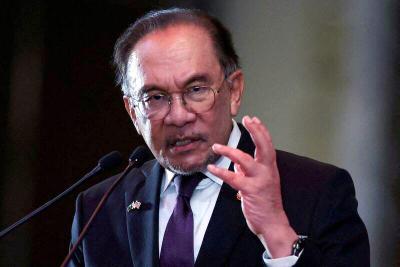
Malaysian Prime Minister Anwar Ibrahim’s remarks that Taiwan is a Chinese province seeking independence threaten regional peace and stability and could undermine Taiwanese businesses’ confidence in investing in Malaysia, the Ministry of Foreign Affairs (MOFA) said today. Anwar recently made remarks implying that Taiwan is a province seeking to separate from China, effectively legitimizing Beijing’s position on using force to take Taiwan, the ministry said in a statement. The Republic of China, Taiwan, is a sovereign, independent country and is not subordinate to the People’s Republic of China, MOFA said, adding that that fact would not be changed no matter
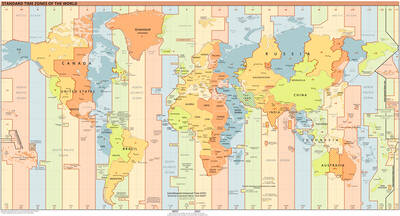
UNNECESSARY?: While some said that the switch would mean more sunlight exposure for workers, others said the government should promote flexible working hours instead An online debate has resurfaced on whether Taiwan should switch to the same time zone as Japan, with supporters citing its geographic location and saying that China would have no right to object. The debate erupted on Threads when users suggested that Taiwan should stop using the same time zone as China, Malaysia and Singapore, GMT+8, and instead switch one hour ahead to the same time zone as Japan and South Korea, GMT+9, which it is geographically closer to. Under GMT+9 the sun would set later year-round, meaning that people would see sunlight after getting off work even in the winter and
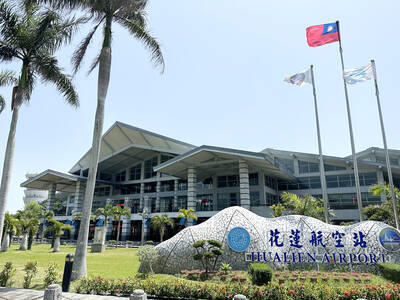
The Civil Aviation Administration (CAA) yesterday confirmed that Uni Air has submitted an application to suspend its Taipei-Hualien flights due to persistently low passenger rates. The airline, which is the only operator of the Taipei-Hualien route, proposed to suspend the service after Mandarin Airlines, another domestic flight carrier, applied to suspend flights to Hualien departing from Kaohsiung and Taichung earlier this year. The average load factor of the Taipei-Hualien flights during the first six months was 24.2 percent, CAA data showed. The average seat occupancy rate dropped even further to 17 percent last month, even though it was the beginning
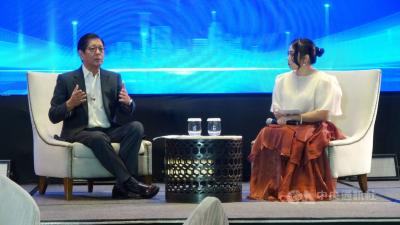
Philippine President Ferdinand Marcos Jr today said that the Philippines would not allow any attacks from its territory in the event of a conflict in the Taiwan Strait, as it “has no desire to be a belligerent nation in the region.” Marcos later said that his country would continue to follow the “one China” policy while maintaining its existing ties with Taiwan within that framework. The Philippine president made the comments while attending the Foreign Correspondents Association of the Philippines Presidential Luncheon in Manila. He was asked whether he would allow the US military to launch an attack from Philippine bases in the


 RSS
RSS