


Prosecutors yesterday said they are seeking to detain three people for forging documents to export Nvidia Corp artificial intelligence (AI) chips to China, in Taiwan’s first crackdown on semiconductor smuggling.
The trio is accused of making fraudulent declarations about sales of AI servers manufactured by US-headquartered Super Micro Computer Inc so that they could ship them to China, Hong Kong and Macau, in contravention of US trade rules.
Super Micro assembles AI chips from the likes of Nvidia into systems that are installed in data centers, and used to train and run models such as OpenAI’s ChatGPT.
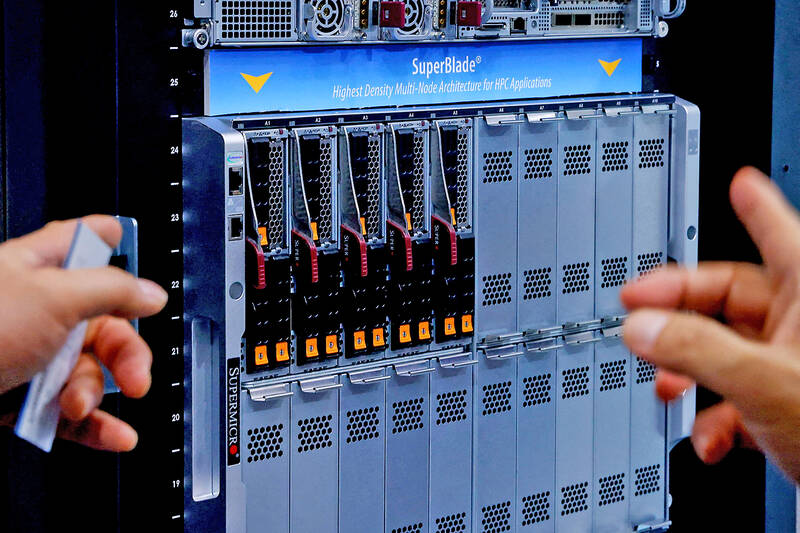
Photo: Ann Wang, Reuters
Washington has restricted sales of the hardware to China since 2022.
The defendants “fully knew” that sales of the servers are “strictly regulated” by the US, the Keelung District Prosecutors’ Office said.
They “conspired to purchase the servers in Taiwan and export them using fraudulent documentation. They are consequently suspected of offenses including forgery of documents under the Criminal Code,” it said.
The office executed search warrants at 12 locations on Wednesday, including the defendants’ residences, the office said, adding that the trio, along with related witnesses, were apprehended and interviewed.
Super Micro’s servers are also the subject of the biggest chip smuggling prosecution in the US, where authorities arrested the firm’s cofounder — who has pled not guilty — for allegedly diverting billions of dollars worth of Nvidia chips to China.
That case reverberated from Silicon Valley to Southeast Asia, a sign that Washington is getting serious about addressing chip smuggling.
The challenge is industrywide. Hardware made by companies including Dell Technologies Inc and Hewlett Packard Enterprise Co has also appeared in alleged illicit chip trade rings detailed by prosecutors in the US and Singapore.
At no point have authorities publicly accused the various server makers of wrongdoing across the cases, of which there are now at least seven, including the Taiwan one.
The crackdown marks a significant step for Taipei, which for years stood on the sidelines of AI chip export debates.
Under President William Lai (賴清德), Taiwan has been increasingly assertive in protecting its technological edge, including by prosecuting trade secret leakage and imposing unprecedented export restrictions on two major Chinese chip champions.
Lai also promised last year to address unspecified US concerns regarding export controls, which have been Washington’s primary tool for constraining China’s AI ambitions.
The move does not mean that Taiwan is matching US curbs on processors from Nvidia and Advanced Micro Devices Inc.
The US’ rules require companies to seek Washington’s permission for virtually all AI chip exports to China, and Taipei — like other Asian capitals — has long been reluctant to take such an aggressive step.

NATIONAL SECURITY: Authorities are working to confirm the identities of the military personnel involved and investigating possible illegal conduct and regulatory violations Authorities are probing possible national security implications after Kinmen police and immigration officers on Sunday found a Chinese woman allegedly posing as a tourist while engaging in prostitution involving more than 10 military personnel. The woman, surnamed Chen (陳), has since been deported, authorities said, adding that investigators are still working to confirm the identities of those implicated, as the records only listed code names and aliases. The case stemmed from a report received by the Kinmen District Prosecutors’ Office on Friday last week from the Jinhu Precinct of the Kinmen County Police Bureau. On Sunday, police, along with the National Immigration

GLOBALGIVING: ‘ Caving to external pressure is not acceptable for an organization that has cultivated justice reform and human rights for 30 years,’ one NGO said A slew of non-government organizations (NGOs) have withdrawn from the GlobalGiving fundraising platform after it announced it would use “Chinese Taipei” instead of “Taiwan” from next month. The Taiwan Good Rice Association wrote on Facebook on Friday that it was informed on April 28 via a teleconference call of the change, which was made because the platform wanted to operate in China. Taiwan Good Rice is to terminate all cooperative relationships with GlobalGiving in response to the platform’s “unilateral and non-negotiable” decision to remove references to Taiwan, the NGO said. “Taiwan is in the official name of Taiwan Good Rice Association and the
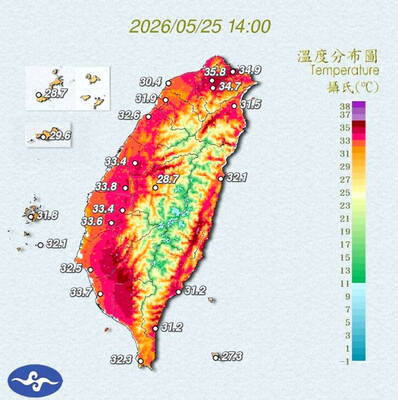
STAY COOL: The HPA recommended that people stay hydrated, use air-conditioning or fans while indoors, wear loose-fitting clothes and walk in the shade while outdoors Employers must implement measures such as installing cooling equipment, and providing drinking water and rest breaks for outdoor workers starting from Monday next week, the Taipei Department of Labor said on Sunday. Employers who fail to comply could face fines of NT$30,000 to NT$300,000 under the Occupational Safety and Health Act (職業安全衛生法), the department said. Businesses in Taipei employing fewer than 100 workers, as well as registered self-employed workers with labor insurance coverage, could receive on-site assessments and guidance from occupational safety consultants to help them apply for central government subsidies to implement or improve heat-protection measures, it said. Under the Ministry of

Chinese Nationalist Party (KMT) Chairwoman Cheng Li-wun (鄭麗文) yesterday briefed her party’s Central Standing Committee regarding her scheduled visit to the US between Monday next week and June 16, saying that her purpose would be to persuade the US that the Republic of China (ROC) Constitution was a “one China” constitution that would foster stable and peaceful cross-strait relations. The ROC Constitution is the most important defense for all Taiwanese citizens, as it upholds our democracy and has contributed to our robust economy, which aligns with international and US interests, she said. “We would not be troublemakers and drag the US under,”


 RSS
RSS