


The First Island Chain should be a place for “peace and prosperity,” Chinese Nationalist Party (KMT) Chairwoman Cheng Li-wun (鄭麗文) said in an interview with CNN, according to a statement from the KMT.
Calling the First Island Chain, which includes Taiwan, Japan and South Korea, a Cold War-era concept associated with military confrontation, Cheng said a “chain of peace and prosperity” would promote cooperation and shared development by linking the countries with China’s coastal regions and Southeast Asia through economic exchanges, the statement said.
East Asia should not become a battleground for zero-sum competition, but instead serve as a driving force for global peace and prosperity, she said.
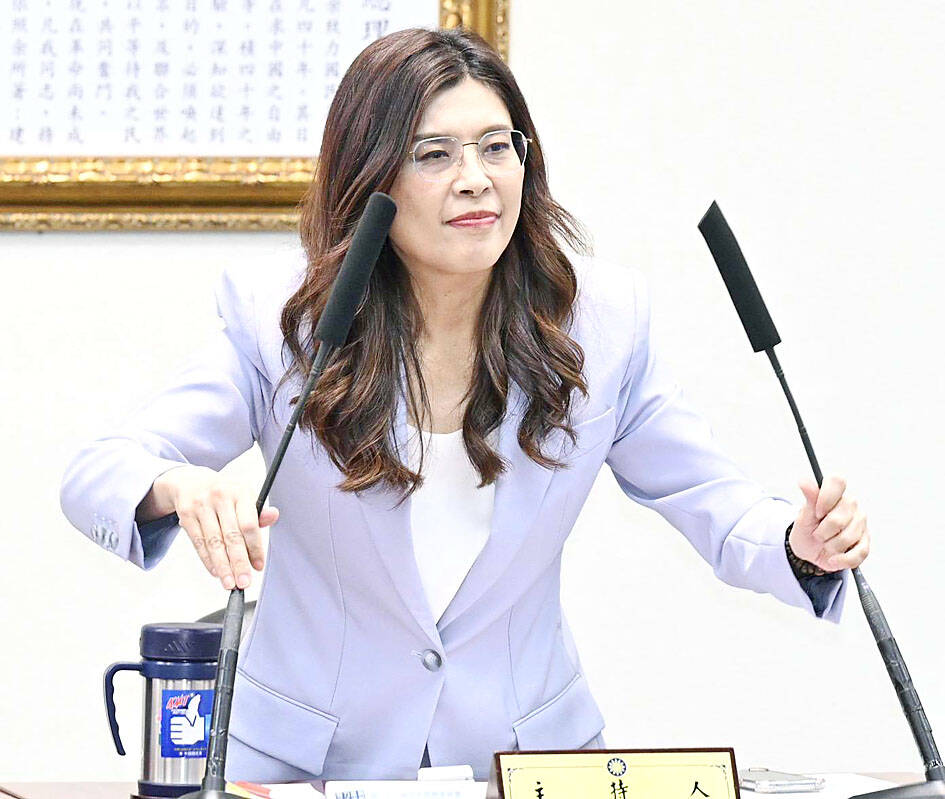
Photo: Lo Pei-de, Taipei Times
Conflict in East Asia would have enormous repercussions worldwide, she said, adding that the international community should work together to reduce the risk of confrontation and prevent war.
Taiwan’s globally significant semiconductor industry and position in supply chains mean that peace in the Taiwan Strait is not only vital to Taiwan, but also to global economic security and regional stability, she said.
“Taiwan does not want to become the next Ukraine,” CNN quoted Cheng as saying.
She added that weapons alone would not keep Taiwan safe.
Cheng, who is scheduled to visit the US next month, said Taiwan should not be forced to choose between Washington and Beijing.
“Being friendly to the US does not necessarily mean there’s animosity toward China,” she told CNN.
The KMT supports deepening cooperation with the US, while believing that there should be sustained and stable communication and exchanges across the Strait to avoid misjudgement and rising tensions, she said.
The KMT has long upheld the Constitution and the so-called “1992 consensus” to promote cross-strait exchanges, with safeguarding peace across the Strait and public safety as the core goal, the KMT statement quoted her as saying.
The “1992 consensus,” a term former Mainland Affairs Council chairman Su Chi (蘇起) in 2006 admitted making up in 2000, refers to a tacit understanding between the KMT and the Chinese government that both sides of the Strait acknowledge there is “one China,” with each side having its own interpretation of what “China” means.
Regarding her trip to China, where she met with Chinese President Xi Jinping (習近平) last month, the CNN article said it would have seemed unlikely for Cheng to meet the Chinese president given that she advocated for Taiwanese independence as a student activist.
“It may seem that I have a common language with Xi Jinping,” Cheng said. “But because there are so many differences between the two sides of the Strait, it is critical that we find a common foundation. I believe this is the only way where we can avoid war.”
Taiwanese cherish democracy, freedom and their current way of life, and any exchanges must be based on respect, peace and pragmatism, the KMT statement quoted her as saying.
However, in the CNN interview, she added: “If Taiwan pursues independence, yes, they have expressed that they will use military force.”
Speaking of the Legislative Yuan’s approval of a supplementary defense budget on Friday, which fell short of the NT$1.25 trillion (US$39.8 billion) requested by the Executive Yuan, she said the KMT “is the solid staunch supporter of Taiwan’s national defense.”
The opposition-controlled legislature passed the budget bill by a 59-0 margin with 48 abstentions, with total spending capped at NT$780 billion.
“A lot of that US$40 billion budget is very vague,” she said, referring to the Cabinet’s original proposal. “It is impossible for us to just blankly authorize the entire package.”
The KMT backs specific and clearly defined US arms procurement projects that meet Taiwan’s defense needs, particularly those that already have letters of offer and acceptance, which should be prioritized and processed swiftly, the KMT statement quoted her as saying.
As an opposition force in the legislature, the KMT also has a responsibility to monitor government spending, and oppose blank-check authorizations and opaque budgeting, she said, adding that such oversight reflects the accountability expected in a mature democracy.
Amid rapidly changing international conditions, the KMT would continue to pursue three key goals — strengthening national defense, maintaining peace through dialogue and deepening international cooperation — to ensure Taiwan’s security, stability and prosperity, she said.
“When the KMT returns to power, military confrontations and activities will decrease, and the possibility of war will be totally prevented,” she told CNN.
The article said that she continues to dodge questions that she might run for president in 2028.
“My work now is to strive and spare no efforts to make sure that the KMT can win the local elections this year. And prepare the KMT so we can return to power in 2028,” Cheng said. “I think in the next two to three years, the fate of Taiwan is going to be a very determining moment.”
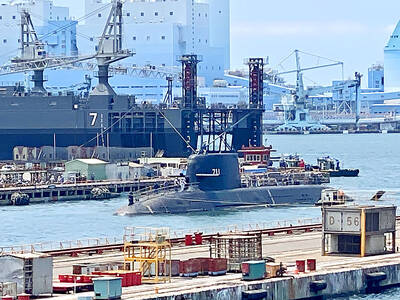
AGING: While Japan has 22 submarines, Taiwan only operates four, two of which were commissioned by the US in 1945 and 1946, and transferred to Taiwan in 1973 Taiwan would need at least 12 submarines to reach modern fleet capabilities, CSBC Corp, Taiwan chairman Chen Cheng-hung (陳政宏) said in an interview broadcast on Friday, citing a US assessment. CSBC is testing the nation’s first indigenous defense submarine, the Hai Kun (海鯤, Narwhal), which is scheduled to be delivered to the navy next month or in July. The Hai Kun has completed torpedo-firing tests and is scheduled to undergo overnight sea trials, Chen said on an SET TV military affairs program. Taiwan would require at least 12 submarines to establish a modern submarine force after assessing the nation’s operational environment and defense

A white king snake that frightened passengers and caused a stir on a Taipei MRT train on Friday evening has been claimed by its owner, who would be fined, Taipei Rapid Transit Corp (TRTC) said yesterday. A person on Threads posted that he thought he was lucky to find an empty row of seats on Friday after boarding a train on the Bannan (Blue) Line, only to spot a white snake with black stripes after sitting down. Startled, he jumped up, he wrote, describing the encounter as “terrifying.” “Taipei’s rat control plan: Release snakes on the metro,” one person wrote in reply, referring
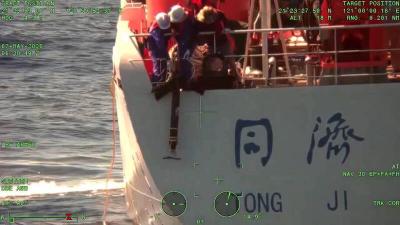
The coast guard today said that it had disrupted "illegal" operations by a Chinese research ship in waters close to the nation and driven it away, part of what Taipei sees a provocative pattern of China's stepped up maritime activities. The coast guard said that it on Thursday last week detected the Chinese ship Tongji (同濟號), which was commissioned only last year, 29 nautical miles (54km) southeast of the southern tip of Taiwan, although just outside restricted waters. The ship was observed lowering ropes into the water, suspected to be the deployment of scientific instruments for "illegal" survey operations, and the coast
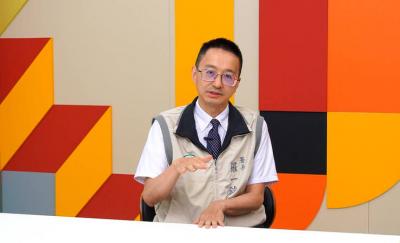
Taiwan’s two cases of hantavirus so far this year are on par with previous years’ case numbers, and the government is coordinating rat extermination work, so there should not be any outbreaks, Centers for Disease Control (CDC) Director-General Philip Lo (羅一鈞) said today in an interview with the Liberty Times (the Taipei Times’ sister newspaper). An increase in rat sightings in Taipei and New Taipei City has raised concerns about the spread of hantavirus, as rats can carry the disease. In January, a man in his 70s who lived in Taipei’s Daan District (大安) tested positive posthumously for hantavirus, Taiwan’s


 RSS
RSS