


The Democratic Progressive Party (DPP) yesterday accused the opposition parties of helping aggressors “demolish Taiwan’s defenses,” after the Legislative Yuan passed a special defense budget that was only two-thirds of the amount requested by the central government.
The NT$780 billion (US$24.82 billion) bill passed by the Chinese Nationalist Party (KMT) and the Taiwan People’s Party (TPP) did not include funding for Taiwan-US technical cooperation in defense technology, preventing the development of a client-vendor relationship with allies, DPP caucus secretary-general Fan Yun (范雲) said.
Excluding NT$64 billion dedicated to joint research and development signals to Taiwan’s allies that the nation is not interested in defending itself and is rejecting deeper technical exchanges with the US, she said.

Photo: Fang Pin-chao, Taipei Times
The opposition also cut Taiwan’s lauded uncrewed aerial vehicle (UAV) programs, including coastal surveillance drones, smart vertical take-off and landing drones, and counter-drone systems, she added.
At a time when international media are deeming Taiwan a rising star in global efforts to grow “non-red” supply chains, the slashes raise the question of whether the KMT and the TPP are deliberately disarming Taiwan, Fan said.
The opposition also defunded other systems essential in fighting a modern war, including artificial intelligence (AI)-boosted command and control, and the Taiwan Tactical Network team awareness kits, she said.
There would be no money for expanding assembly lines or building a self-sufficient defense industry, which the government has been working toward for the past two years, she said.
“Are protective masks, night vision devices, ammunition, propellants and primers not important to frontline troops? Why would anyone oppose Taiwan’s self-sufficiency [in military equipment]?” Fan asked.
A defense official speaking on condition of anonymity said the limited budget would cripple key capabilities in drones and air defense needed to counter Chinese aggression.
Since KMT Chairwoman Cheng Li-wun (鄭麗文) met with Chinese President Xi Jinping (習近平) last month, the opposition has fed the public “feeble excuses” for its reluctance to pass the military spending bill, the official said.
Those included a purported desire to summon President William Lai (賴情德) to answer questions about national defense at legislative hearings, examine US letters of offer for arms sales and approve procurement funding year-by-year, they said.
“The only thing that has not changed about these reasons is that the opposition is stalling and compressing Taiwan’s window of opportunity to develop self-defense capabilities when they are needed most,” the official said.
The Legislative Yuan removed 40 percent of the administration’s special budget earmarked for obtaining anti-ballistic missile interceptors and 210,000 UAVs, and supporting an indigenous defense industry, the official said.
Also gone are the military’s plans for AI-assisted command and control, growing the defense industrial base and ensuring Taiwanese forces have the capability to survive a first strike in case of a conflict with the Chinese People’s Liberation Army, they said.
“These happened to be the most critical capabilities the nation needs most to protect Taiwanese lives,” the official said. “China is increasing its budget for weapons as our lawmakers slash ours.”
Washington had uncharacteristically allowed an extension on arms sales to Taiwan, but the opposition’s refusal to provide funding for the deal would cost the nation its credibility and priority spot in delivery schedules, they said.
“The loss of the international community’s confidence in Taiwan’s resolve to defend itself would significantly reduce our allies’ willingness to support the nation at its time of need,” the official added.
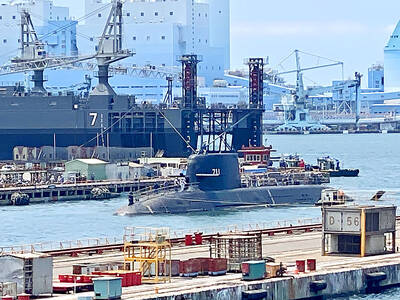
AGING: While Japan has 22 submarines, Taiwan only operates four, two of which were commissioned by the US in 1945 and 1946, and transferred to Taiwan in 1973 Taiwan would need at least 12 submarines to reach modern fleet capabilities, CSBC Corp, Taiwan chairman Chen Cheng-hung (陳政宏) said in an interview broadcast on Friday, citing a US assessment. CSBC is testing the nation’s first indigenous defense submarine, the Hai Kun (海鯤, Narwhal), which is scheduled to be delivered to the navy next month or in July. The Hai Kun has completed torpedo-firing tests and is scheduled to undergo overnight sea trials, Chen said on an SET TV military affairs program. Taiwan would require at least 12 submarines to establish a modern submarine force after assessing the nation’s operational environment and defense

A white king snake that frightened passengers and caused a stir on a Taipei MRT train on Friday evening has been claimed by its owner, who would be fined, Taipei Rapid Transit Corp (TRTC) said yesterday. A person on Threads posted that he thought he was lucky to find an empty row of seats on Friday after boarding a train on the Bannan (Blue) Line, only to spot a white snake with black stripes after sitting down. Startled, he jumped up, he wrote, describing the encounter as “terrifying.” “Taipei’s rat control plan: Release snakes on the metro,” one person wrote in reply, referring
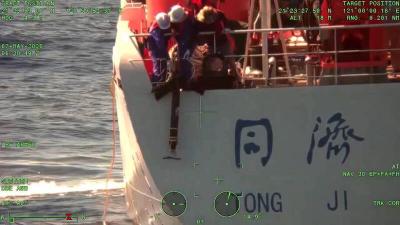
The coast guard today said that it had disrupted "illegal" operations by a Chinese research ship in waters close to the nation and driven it away, part of what Taipei sees a provocative pattern of China's stepped up maritime activities. The coast guard said that it on Thursday last week detected the Chinese ship Tongji (同濟號), which was commissioned only last year, 29 nautical miles (54km) southeast of the southern tip of Taiwan, although just outside restricted waters. The ship was observed lowering ropes into the water, suspected to be the deployment of scientific instruments for "illegal" survey operations, and the coast

Taiwan’s two cases of hantavirus so far this year are on par with previous years’ case numbers, and the government is coordinating rat extermination work, so there should not be any outbreaks, Centers for Disease Control (CDC) Director-General Philip Lo (羅一鈞) said today in an interview with the Liberty Times (the Taipei Times’ sister newspaper). An increase in rat sightings in Taipei and New Taipei City has raised concerns about the spread of hantavirus, as rats can carry the disease. In January, a man in his 70s who lived in Taipei’s Daan District (大安) tested positive posthumously for hantavirus, Taiwan’s


 RSS
RSS