


President William Lai (賴清德) has departed Eswatini following a surprise trip to Africa in defiance of Beijing’s efforts to thwart his diplomatic outreach, a source said yesterday.
Lai is returning to Taiwan by again using the private plane of Eswatini’s monarch, a person familiar with his plans said, asking not to be identified because of the sensitivity of the travel.
Lai’s planned departure to Eswatini on April 22 was postponed after the Seychelles, Mauritius and Madagascar revoked overflight permits for the president’s chartered plane, moves that Lai’s office attributed to China’s “economic coercion” of the African nations.
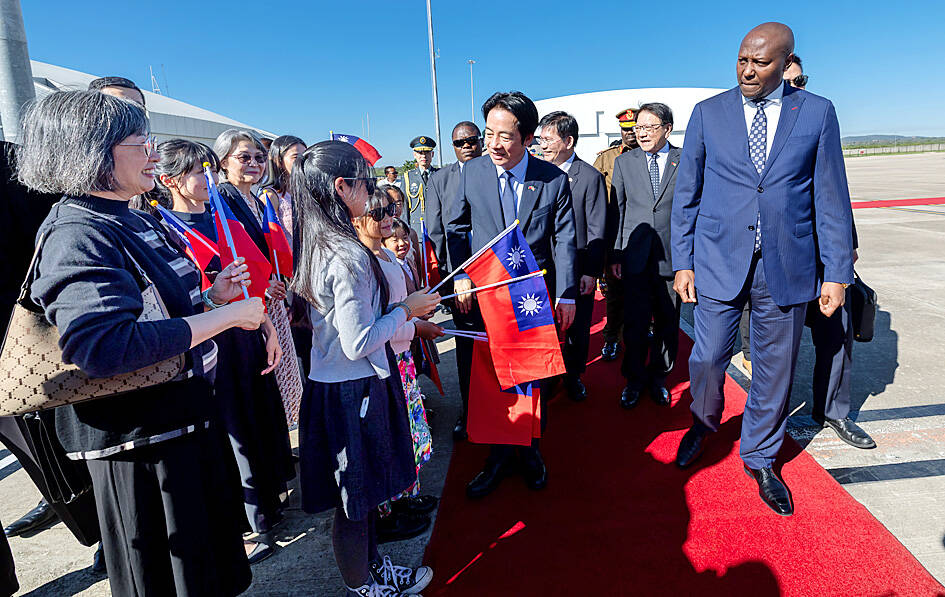
Photo: screen grab from the Presidential Office’s Flickr page
Local media reported that the president traveled to Eswatini on Saturday aboard King Mswati III’s private jet, flying directly from Taipei to Eswatini.
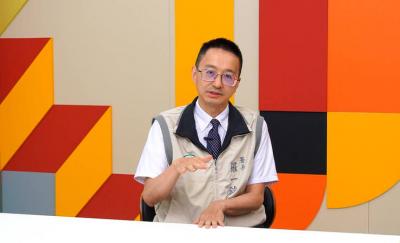
In Taipei yesterday, Chinese Nationalist Party (KMT) Legislator Hsu Yu-chen (許宇甄) said Lai traveling to the Kingdom of Eswatini on a chartered plane provided by the African diplomatic ally raises national security concerns.
While consolidating diplomatic ties is important and Lai deserves recognition for his efforts, the king’s jet lacks the secure communications equipment of Taiwan’s presidential aircraft, which is equipped with a military-standard encrypted command-and-control system to ensure real-time communication with the Hengshan Military Command Center, Hsu said.
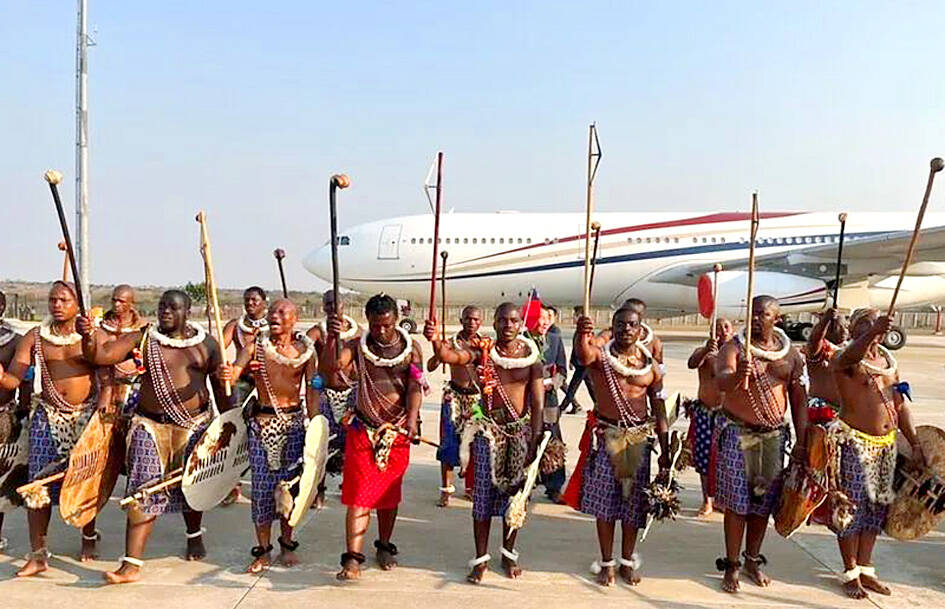
Photo from James Jseng’s Facebook
“If a cross-strait emergency were to arise mid-flight, would the president be left relying on a civilian satellite phone to issue commands?” she said.
“While the government says it maintains real-time control over national security, the absence of military-grade encrypted communications means the 14-hour journey [to Eswatini] could have effectively become a ‘command vacuum,’ leaving national security in a highly uncertain state,” she said.
The concerns remain for the return flight, Hsu added.
She also disagreed with Deputy Minister of Foreign Affairs Francois Wu’s (吳志中) defense of the “arrive then announce” strategy for world leaders traveling abroad, which Wu said had been used by US President Donald Trump, as well as former US presidents.
“That is utterly misleading,” Hsu said.
US presidential trips are kept confidential until arrival only when the head of state is visiting conflict zones, such as in Iraq, Afghanistan or Ukraine, to avoid security risks, she said.
However, Eswatini is an ally, making the unannounced arrival not only disrespectful to the African nation, but also a deliberate move to foment a quasi-war atmosphere in Taiwan, she said.
In some cases, it is “more justifiable” for heads of state to make diplomatic visits aboard charter flights of a foreign nation, such as when Ukrainian President Volodymyr Zelenskiy visited the US aboard a US military aircraft, or when North Korean leader Kim Jong-un traveled to Singapore on a charter plane of Chinese state-run Air China, Hsu said.
However, the Republic of China (ROC) has its own presidential aircraft, which flies the national flag to demonstrate the nation’s sovereignty, she said.
It creates a diplomatic predicament when the commander-in-chief of Taiwan’s armed forces has to rely on a foreign charter plane to visit an allied country, she said.
From an international law perspective, a head-of-state aircraft is typically regarded as a mobile extension of a sovereign territory, entitled to full immunity and jurisdictional protections, she said.
However, the king’s Airbus A340-313 used by Lai is owned by the Eswatini government and operated by foreign pilots, Hsu said.
If a technical incident or legal dispute were to occur during the president’s 14-hour return flight, primary jurisdiction would lie with Eswatini rather than the ROC, she said.
“Entrusting the head of state’s legal and physical security entirely to a foreign crew operating under a fundamentally different legal system represents a significant constitutional risk, which could be seen as diminishing the nation’s standing and effectively ceding a measure of sovereignty,” she said.
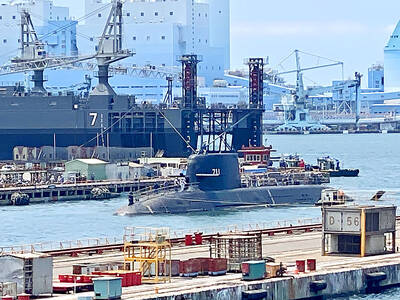
AGING: While Japan has 22 submarines, Taiwan only operates four, two of which were commissioned by the US in 1945 and 1946, and transferred to Taiwan in 1973 Taiwan would need at least 12 submarines to reach modern fleet capabilities, CSBC Corp, Taiwan chairman Chen Cheng-hung (陳政宏) said in an interview broadcast on Friday, citing a US assessment. CSBC is testing the nation’s first indigenous defense submarine, the Hai Kun (海鯤, Narwhal), which is scheduled to be delivered to the navy next month or in July. The Hai Kun has completed torpedo-firing tests and is scheduled to undergo overnight sea trials, Chen said on an SET TV military affairs program. Taiwan would require at least 12 submarines to establish a modern submarine force after assessing the nation’s operational environment and defense

A white king snake that frightened passengers and caused a stir on a Taipei MRT train on Friday evening has been claimed by its owner, who would be fined, Taipei Rapid Transit Corp (TRTC) said yesterday. A person on Threads posted that he thought he was lucky to find an empty row of seats on Friday after boarding a train on the Bannan (Blue) Line, only to spot a white snake with black stripes after sitting down. Startled, he jumped up, he wrote, describing the encounter as “terrifying.” “Taipei’s rat control plan: Release snakes on the metro,” one person wrote in reply, referring
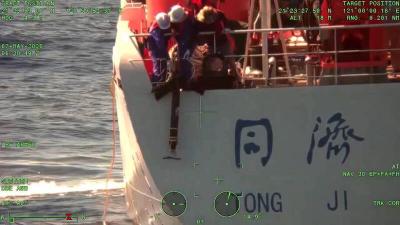
The coast guard today said that it had disrupted "illegal" operations by a Chinese research ship in waters close to the nation and driven it away, part of what Taipei sees a provocative pattern of China's stepped up maritime activities. The coast guard said that it on Thursday last week detected the Chinese ship Tongji (同濟號), which was commissioned only last year, 29 nautical miles (54km) southeast of the southern tip of Taiwan, although just outside restricted waters. The ship was observed lowering ropes into the water, suspected to be the deployment of scientific instruments for "illegal" survey operations, and the coast
Taiwan’s two cases of hantavirus so far this year are on par with previous years’ case numbers, and the government is coordinating rat extermination work, so there should not be any outbreaks, Centers for Disease Control (CDC) Director-General Philip Lo (羅一鈞) said today in an interview with the Liberty Times (the Taipei Times’ sister newspaper). An increase in rat sightings in Taipei and New Taipei City has raised concerns about the spread of hantavirus, as rats can carry the disease. In January, a man in his 70s who lived in Taipei’s Daan District (大安) tested positive posthumously for hantavirus, Taiwan’s


 RSS
RSS