


There must be stronger transparency, oversight and emergency protocols for those with significant political influence who visit China in order to protect national security, Premier Cho Jung-tai (卓榮泰) said this morning, as Chinese Nationalist Party (KMT) Chairwoman Cheng Li-wun (鄭麗文) departed for China.
Any such figures visiting China should publicize which Chinese Communist Party (CCP) officials they met with, Cho said during an interpellation session at the legislature.
If any illegal activity is discovered, the government must enact a "post-disaster" plan, he added.
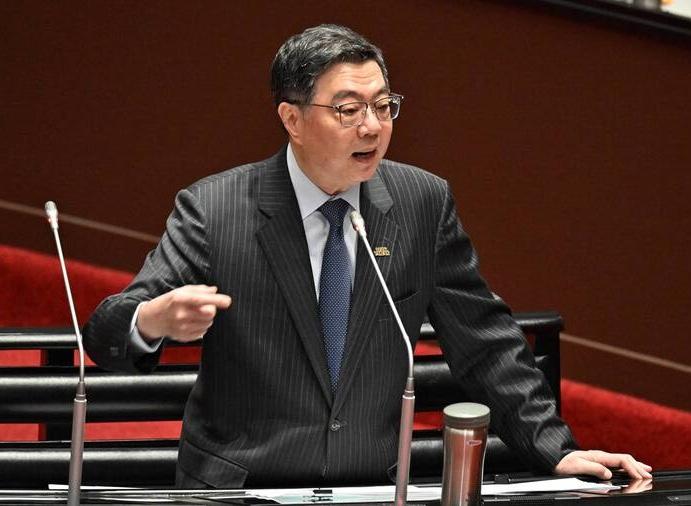
Photo: Liu Hsin-de, Taipei Times
Any engagement with the CCP by political representatives must be subject to strong public and media scrutiny, he added.
The comments come ahead of Cheng’s six-day trip to China, where she may meet with Chinese President Xi Jinping (習近平).
There has been speculation that the KMT had proposed postponing consultations over the special defense budget from Thursday until next week, once Cheng has returned from Beijing.
Civil servants must undergo a joint review by the Mainland Affairs Council (MAC) and the Ministry of the Interior before traveling to China, Democratic Progressive Party Legislator Puma Shen (沈伯洋) said today.
However, political party leaders are not subject to the same regulations, raising concerns over what is discussed during these trips and how authorities can monitor it, he said.
The Cabinet has proposed amendments to the Act Governing Relations Between the People of the Taiwan Area and the Mainland Area (臺灣地區與大陸地區人民關係條例) to include legislators as “designated personnel” subject to review, MAC Minister Chiu Chui-cheng (邱垂正) said.
The amendments would also require all elected officials to publicly disclose any contact with CCP, government or military entities in China, he said.
The government had discussed extending these regulations to those deemed to have significant political influence, but the proposal was tabled, as it would be difficult to define given Taiwan’s many political parties, he said, but added that he “strongly supports” the idea.
Shen alternatively suggested that "significant political influence" should encompass chairpersons or vice chairpersons from political parties with a certain number of seats in the legislature.
Enforcement of the Anti-Infiltration Act (反滲透法) has been historically challenging due to the high burden of proof required, Chiu said.
Authorities are currently consulting with judges and prosecutors to improve evidentiary standards and strengthen enforcement, he added.

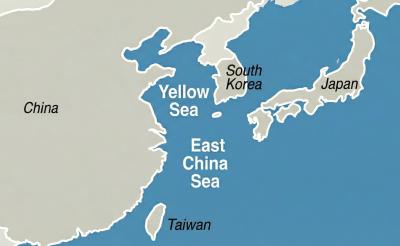
China has reserved offshore airspace in the Yellow Sea and East China Sea from March 27 to May 6, issuing alerts usually used to warn of military exercises, although no such exercises have been announced, the Wall Street Journal (WSJ) reported yesterday. Reserving such a large area for 40 days without explanation is an “unusual step,” as military exercises normally only last a few days, the paper said. These alerts, known as Notice to Air Missions (Notams), “are intended to inform pilots and aviation authorities of temporary airspace hazards or restrictions,” the article said. The airspace reserved in the alert is

South Korea is planning to revise its controversial electronic arrival card, a step Taiwanese officials said prompted them to hold off on planned retaliatory measures, a South Korean media report said yesterday. A Yonhap News Agency report said that the South Korean Ministry of Foreign Affairs is planning to remove the “previous departure place” and “next destination” fields from its e-arrival card system. The plan, reached after interagency consultations, is under review and aims to simplify entry procedures and align the electronic form with the paper version, a South Korean ministry official said. The fields — which appeared only on the electronic form
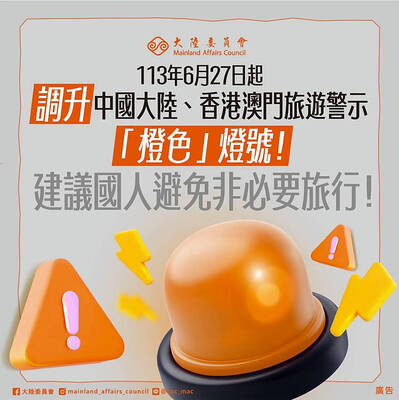
More than 6,000 Taiwanese students have participated in exchange programs in China over the past two years, despite the Mainland Affairs Council’s (MAC) “orange light” travel advisory, government records showed. The MAC’s publicly available registry showed that Taiwanese college and university students who went on exchange programs across the Strait numbered 3,592 and 2,966 people respectively. The National Immigration Agency data revealed that 2,296 and 2,551 Chinese students visited Taiwan for study in the same two years. A review of the Web sites of publicly-run universities and colleges showed that Taiwanese higher education institutions continued to recruit students for Chinese educational programs without

A bipartisan group of US senators has introduced a bill to enhance cooperation with Taiwan on drone development and to reduce reliance on supply chains linked to China. The proposed Blue Skies for Taiwan Act of 2026 was introduced by Republican US senators Ted Cruz and John Curtis, and Democratic US senators Jeff Merkley and Andy Kim. The legislation seeks to ease constraints on Taiwan-US cooperation in uncrewed aerial systems (UAS), including dependence on China-sourced components, limited access to capital and regulatory barriers under US export controls, a news release issued by Cruz on Wednesday said. The bill would establish a "Blue UAS


 RSS
RSS