


China has reserved offshore airspace over the Yellow Sea and East China Sea from March 27 to May 6, issuing alerts that are usually used to warn of military exercises, although no such exercises have been announced, the Wall Street Journal (WSJ) reported on Sunday.
Reserving such a large area for 40 days without explanation is an “unusual step,” as military exercises normally only last a few days, the paper said.
The alerts, known as notice to air missions (NOTAMs), “are intended to inform pilots and aviation authorities of temporary airspace hazards or restrictions,” the article said.
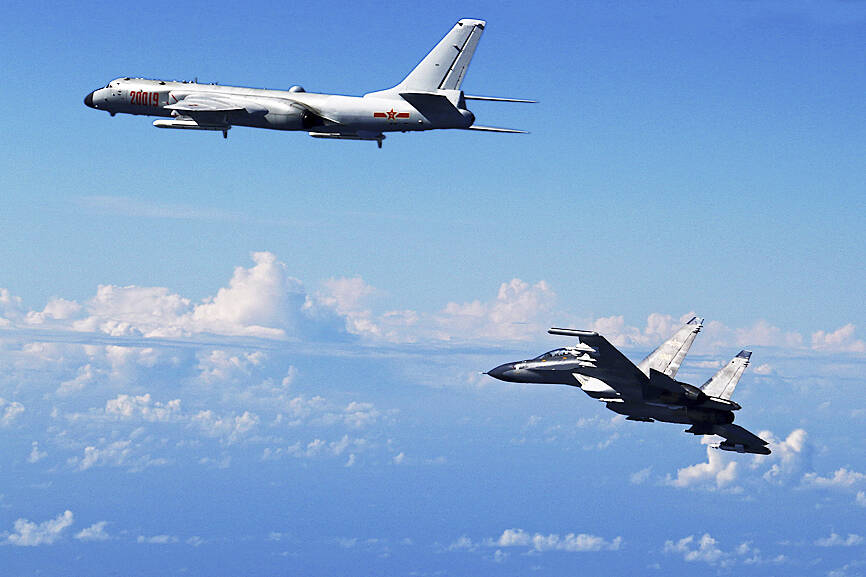
Photo: Shao Jing, Xinhua news agency via AP
The airspace reserved in the alert is hundreds of kilometers north of Taiwan and extends south from the Yellow Sea facing South Korea, to waters of the East China Sea facing Japan, the WSJ said, citing information from the US Federal Aviation Administration.
The reserved airspace has no vertical ceiling and is designated within NOTAMs as “SFC-UNL” (surface unlimited), it said, adding that while civil aviation seems unaffected, it would take coordination for aircraft to transit such areas.
Ray Powell, director of Stanford University’s SeaLight Project, which tracks Chinese maritime activity, told the paper that the SFC-UNL with “an extraordinary 40-day duration” combined with no announced exercise makes the alerts notable.
“That suggests not a discrete exercise, but a sustained operational readiness posture — and one that China apparently doesn’t feel the need to explain,” the WSJ quoted Powell as saying.
If the reserved airspace is linked to exercises, it “would represent a meaningful shift in how Beijing uses airspace control as a tool of military signaling,” he told the paper.
The Chinese Ministry of National Defense and the Chinese Civil Aviation Administration have not issued statements about the NOTAMs.
Past Chinese drills have focused on controlling routes that could be used by the US military in the event of a conflict over Taiwan, which the Journal said was not unusual.
The airspace could “provide an opportunity to practice the kinds of air combat maneuvers that would be required” to control routes that might be used by the US military in a potential conflict over Taiwan, the report quoted US Naval War College China Maritime Studies Institute director Christopher Sharman as saying.
China could be increasing its military presence while US attention is focused on the Middle East, the article said, citing a senior Taiwanese security official.
The airspace reservation is “clearly aimed at Japan,” as China attempts to deter US allies and erode US military influence in the Indo-Pacific region, the official said.
Lin Ying-yu (林穎佑), an associate professor in Tamkang University’s Graduate Institute of International Affairs and Strategic Studies, yesterday said that April is typically the peak period for Chinese military exercises.
That the air warning zones are closer to Japan and South Korea, suggest that potential exercises are not necessarily aimed at Taiwan nor are they related to Chinese Nationalist Party (KMT) Chairwoman Cheng Li-wun’s (鄭麗文) visit to China today.
China might resume “joint combat readiness patrols” to pressure Taiwan during or after Cheng’s potential meeting with Chinese President Xi Jinping (習近平), signaling that its military pressure and deterrence remain in place regardless of the state of cross-strait communications, he said.
Additional reporting Huang Chin-hsuan
The military has spotted two Chinese warships operating in waters near Penghu County in the Taiwan Strait and sent its own naval and air forces to monitor the vessels, the Ministry of National Defense (MND) said. Beijing sends warships and warplanes into the waters and skies around Taiwan on an almost daily basis, drawing condemnation from Taipei. While the ministry offers daily updates on the locations of Chinese military aircraft, it only rarely gives details of where Chinese warships are operating, generally only when it detects aircraft carriers, as happened last week. A Chinese destroyer and a frigate entered waters to the southwest
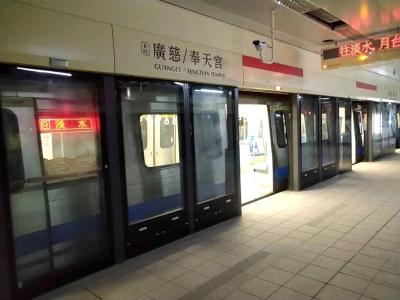
The eastern extension of the Taipei MRT Red Line could begin operations as early as late June, the Taipei Department of Rapid Transit Systems said yesterday. Taipei Rapid Transit Corp said it is considering offering one month of free rides on the new section to mark its opening. Construction progress on the 1.4km extension, which is to run from the current terminal Xiangshan Station to a new eastern terminal, Guangci/Fengtian Temple Station, was 90.6 percent complete by the end of last month, the department said in a report to the Taipei City Council's Transportation Committee. While construction began in October 2016 with an
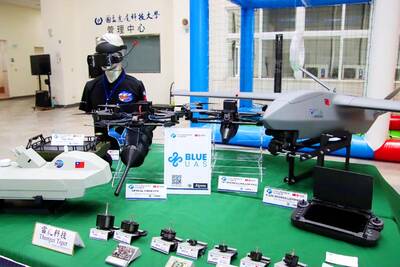
NON-RED SUPPLY: Boosting the nation’s drone industry is becoming increasingly urgent as China’s UAV dominance could become an issue in a crisis, an analyst said Taiwan’s drone exports to Europe grew 41.7-fold from 2024 to last year, with demand from Ukraine’s fight against Russian aggression the most likely driver of growth, a study showed. The Institute for Democracy, Society and Emerging Technology (DSET) in a statement on Wednesday said it found that many of Taiwan’s uncrewed aerial vehicle (UAV) sales were from Poland and the Czech Republic. These countries likely transferred the drones to Ukraine to aid it in its fight against the Russian invasion that started in 2022, it said. Despite the gains, Taiwan is not the dominant drone exporter to these markets, ranking second and fourth
Japanese Prime Minister Sanae Takaichi’s comment last year on Tokyo’s potential reaction to a Taiwan-China conflict has forced Beijing to rewrite its invasion plans, a retired Japanese general said. Takaichi told the Diet on Nov. 7 last year that a Chinese naval blockade or military attack on Taiwan could constitute a “survival-threatening situation” for Japan, potentially allowing Tokyo to exercise its right to collective self-defense. Former Japan Ground Self-Defense Force general Kiyofumi Ogawa said in a recent speech that the remark has been interpreted as meaning Japan could intervene in the early stages of a Taiwan Strait conflict, undermining China’s previous assumptions


 RSS
RSS