


China has reserved offshore airspace in the Yellow Sea and East China Sea from March 27 to May 6, issuing alerts usually used to warn of military exercises, although no such exercises have been announced, the Wall Street Journal (WSJ) reported yesterday.
Reserving such a large area for 40 days without explanation is an “unusual step,” as military exercises normally only last a few days, the paper said.
These alerts, known as Notice to Air Missions (Notams), “are intended to inform pilots and aviation authorities of temporary airspace hazards or restrictions,” the article said.
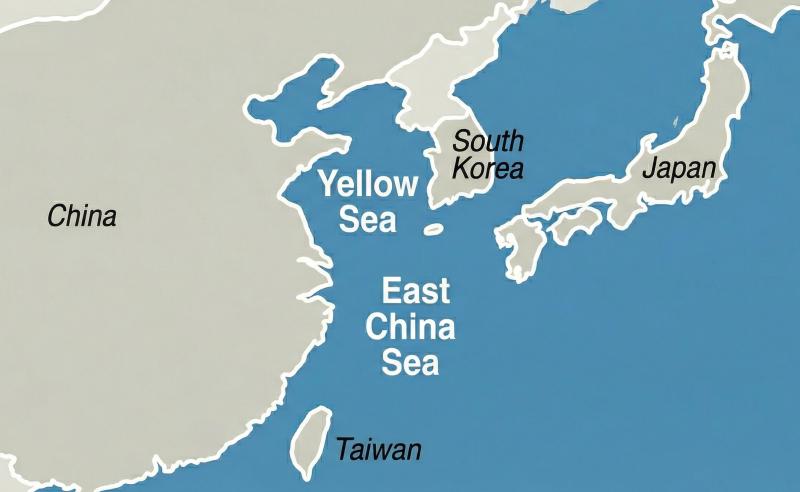
The airspace reserved in the alert is hundreds of kilometers north of Taiwan and extends south from the Yellow Sea facing South Korea, to waters of the East China Sea facing Japan, it said citing information from the US Federal Aviation Administration.
The reserved airspace has no vertical ceiling, which is designated within Notams as SFC-UNL.
While civil aviation seems unaffected, it would take coordination for aircraft to transit such areas, the report said.
“What makes this especially notable is the combination of SFC-UNL with an extraordinary 40-day duration — and no announced exercise,” said Ray Powell, director of Stanford University’s SeaLight Project, which tracks Chinese maritime activity.
“That suggests not a discrete exercise, but a sustained operational readiness posture — and one that China apparently doesn’t feel the need to explain,” Powell told the WSJ.
If the reserved airspace is in fact linked to exercises, it “would represent a meaningful shift in how Beijing uses airspace control as a tool of military signaling,” he said.
China’s Ministry of National Defense and Civil Aviation Administration have not issued statements about the Notams and did not respond to requests for comment, the report said, adding this is not unusual.
Past Chinese drills have focused on controlling routes that could be used by the US military in the event of a conflict over Taiwan, it said.
The reserved airspace could “provide an opportunity to practice the kinds of air combat maneuvers that would be required in such a scenario,” US Naval War College China Maritime Studies Institute director Christopher Sharman told the WSJ.
China could be increasing its active military presence while US attention is focused on the conflict in the Middle East, the article said, citing a senior Taiwanese security official.
The airspace reservation is “clearly aimed at Japan,” as China attempts to deter US allies and erode US military influence in the Indo-Pacific region, the official told the paper.

The Centers for Disease Control (CDC) yesterday reported the first case of a new COVID-19 subvariant — BA.3.2 — in a 10-year-old Singaporean girl who had a fever upon arrival in Taiwan and tested positive for the disease. The girl left Taiwan on March 20 and the case did not have a direct impact on the local community, it said. The WHO added the BA.3.2 strain to its list of Variants Under Monitoring in December last year, but this was the first imported case of the COVID-19 variant in Taiwan, CDC Deputy Director-General Lin Ming-cheng (林明誠) said. The girl arrived in Taiwan on

South Korea is planning to revise its controversial electronic arrival card, a step Taiwanese officials said prompted them to hold off on planned retaliatory measures, a South Korean media report said yesterday. A Yonhap News Agency report said that the South Korean Ministry of Foreign Affairs is planning to remove the “previous departure place” and “next destination” fields from its e-arrival card system. The plan, reached after interagency consultations, is under review and aims to simplify entry procedures and align the electronic form with the paper version, a South Korean ministry official said. The fields — which appeared only on the electronic form

A bipartisan group of US senators has introduced a bill to enhance cooperation with Taiwan on drone development and to reduce reliance on supply chains linked to China. The proposed Blue Skies for Taiwan Act of 2026 was introduced by Republican US senators Ted Cruz and John Curtis, and Democratic US senators Jeff Merkley and Andy Kim. The legislation seeks to ease constraints on Taiwan-US cooperation in uncrewed aerial systems (UAS), including dependence on China-sourced components, limited access to capital and regulatory barriers under US export controls, a news release issued by Cruz on Wednesday said. The bill would establish a "Blue UAS

The Ministry of Foreign Affairs (MOFA) is suspending retaliation measures against South Korea that were set to take effect tomorrow, after Seoul said it is updating its e-arrival system, MOFA said today. The measures were to be a new round of retaliation after Taiwan on March 1 changed South Korea's designation on government-issued alien resident certificates held by South Korean nationals to "South Korea” from the "Republic of Korea," the country’s official name. The move came after months of protests to Seoul over its listing of Taiwan as "China (Taiwan)" in dropdown menus on its new online immigration entry system. MOFA last week


 RSS
RSS