


China’s reportedly ban on Malaysian singer Fish Leong’s (梁靜茹) 2005 song Unfortunately Not You (可惜不是你) reflects a more aggressive effort by the Chinese Communist Party (CCP) to eliminate content that could resonate with the public, said the Mainland Affairs Council (MAC) in its latest quarterly report on China.
The report said the song, which contains no political content, drew the attention of Chinese internet authorities due to wordplay used online in discussions of abducted Venezuelan president Nicolas Maduro.
Internet users replaced characters in the song’s title — xi (惜), meaning “unfortunately,” and “ni” (你), meaning “you” — with homophones “Xi” (習), the surname of Chinese President Xi Jinping (習近平), and “ni” (尼), the first character in the Mandarin transliteration of Nicolas (尼可拉斯).
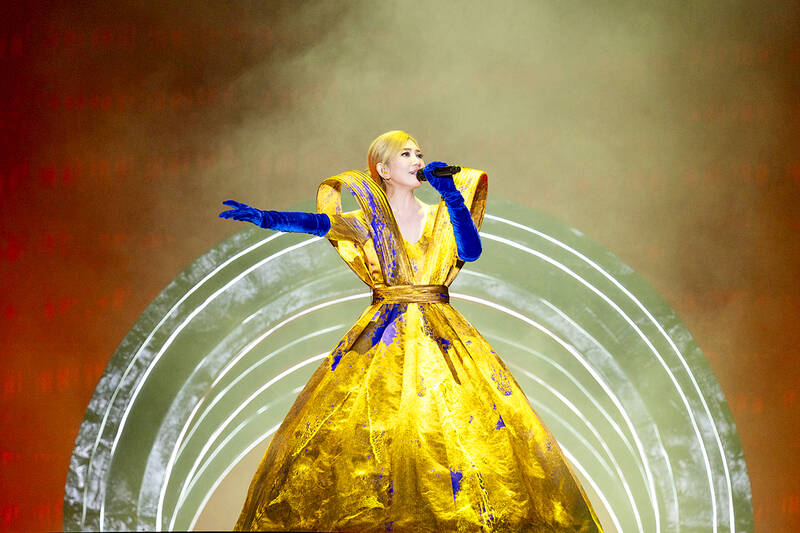
Photo courtesy of SuperDome
The altered phrase — “But Xi is not Nicolas” (可習不是尼) — could be interpreted, in the context of the original lyrics, as expressing regret that Xi, rather than Maduro, had not been captured.
The report cited similar incidents, including the removal of songs by Taiwanese singer Lin Sheng-hsiang (林生祥) from online platforms in China and restrictions on search terms related to Uyghur folk songs. Some Chinese internet users speculated that Lin was blacklisted for composing music for a Taiwanese documentary Eye of Democracy (民主之眼).
Such cases could indicate that the CCP is extending censorship beyond political commentary to include interdiction of how cultural content is used and interpreted, the report said.
Under this approach, the report said, the original intent of a work becomes irrelevant, adding that authorities might focus on whether it resonates with the public or could be repurposed to express certain ideas.
Removing cultural content from public platforms simply because it has been used as a homophone, allegory or outlet for frustration risks hollowing out the cultural sector, as creators and audiences increasingly resort to self-censorship, the report said.
Suppressing cultural works based on their “possible interpretations” could erode public discourse and imagination, diminishing not only freedom of expression but broader social vitality, it said.
The report said that the CCP’s cultural repression underscores its sensitivity to such influences, noting that authorities work with technology companies and use state-aligned online commentators to shape narratives and present China favorably on the international stage.
However, in a concert held by Leong in China’s Nanjing yesterday she performed a series of hit songs including Unfortunately Not You
Holding a concert in China requires all songs to be pre-approved, and only after passing review can they be performed.
The fact that the song was performed on stage effectively puts an end to speculation that the song is banned.
Additional reporting by Feng Yi-ning
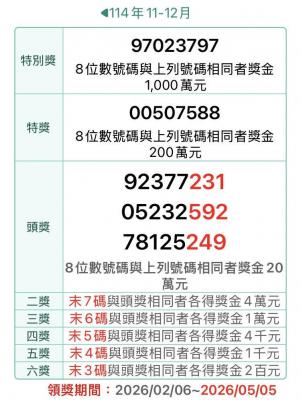
Seven of the 17 NT$10 million (US$311,604) winning receipts from the November-December uniform invoice lottery remain unclaimed as of today, the Ministry of Finance said, urging winners to redeem their prizes by May 5. The reminder comes ahead of the release of the winning numbers for the January-February lottery tomorrow. Among the unclaimed receipts was one for a NT$173 phone bill in Keelung, while others were for a NT$5,913 purchase at Costco in Taipei's Neihu District (內湖), a NT$49 purchase at a FamilyMart in New Taipei City's Tamsui District (淡水), and a NT$500 purchase at a tea shop in New Taipei City's
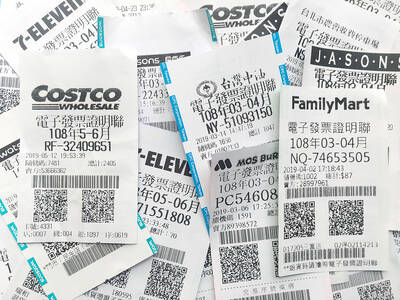
A NT$39 receipt for two bottles of tea at a FamilyMart was among the NT$10 million (US $312,969) special prize winners in the January-February uniform invoice lottery. FamilyMart said that two NT$10 million-winning receipts were issued at its stores, as well as two NT$2 million grand prizes and three NT$200,000 first prizes. The two NT$10 million receipts were issued at stores in Pingtung County and Yilan County’s Dongshan Township (冬山). One winner spent just NT$39 on two bottles of tea, while another spent NT$80 on water, tea and coffee, the company said. Meanwhile, 7-Eleven reported three NT$10 million winners — in New Taipei
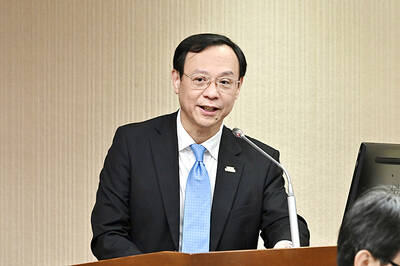
DISRUPTION: Most of the medical devices can be made domestically, so as long as the supply of raw materials is maintained, people do not have to worry, an official said Minister of Health and Welfare Shih Chung-liang (石崇良) yesterday said that the ministry is working with the Ministry of Economic Affairs (MOEA) to ask local plastic material suppliers to prioritize healthcare-related manufacturers to avoid a shortage. The minister was responding to reporters’ questions about concerns regarding the war in the Middle East having disrupted petrochemical supplies and driving up plastic packaging costs at the legislature’s Social Welfare and Environmental Hygiene Committee in Taipei yesterday. Shin Kong Wu Ho-Su Memorial Hospital deputy superintendent Hung Tzu-jen (洪子仁), who is also director of Taiwan College of Healthcare Executives, on Sunday said that he has heard
Taiwan is concerned that China could exploit the US’ war in the Middle East, with state media citing examples from the conflict to cast doubt on the efficiency of US weapons Taiwan would use to repel an invasion. Taiwanese officials said the resumption of Beijing’s large-scale air force incursions near Taiwan after an unusual decline show that China wants to take advantage of the redeployment of US forces from East Asia to the Middle East. “This is a moment for China to exercise influence,” a senior Taiwanese security official said, speaking on condition of anonymity. “What China is trying to create is a


 RSS
RSS