


Minister of National Defense Wellington Koo (顧立雄) said yesterday that Taiwan’s military has not considered sending troops to assist in the defense of the Strait of Hormuz, currently blocked by Iranian forces, amid calls for Taiwan to do so.
Since the US and Israel attacked Iran on Feb. 28, Iranian forces have taken military action against fuel tankers passing through the strait, through which around one-fifth of the world’s oil and liquefied natural gas (LNG) transits, sending global oil and LNG prices soaring.
In response, US President Donald Trump has asked the US’ allies to send ships to help secure the strait. In a joint statement issued on Thursday, Canada, the United Kingdom, France, Germany, Italy, the Netherlands and Japan expressed their readiness to “contribute to appropriate efforts” to ensure safe passage through the strait.

Photo: Chen Yi-kuan, Taipei Times
At a legislative session yesterday, Chinese Nationalist Party (KMT) Legislator Hsu Chiao-hsin (徐巧芯) asked Koo how Taiwan would respond if Trump asked it to help defend the strait.
Hsu cited Indo-Pacific Strategy Thinktank CEO Yaita Akio and former Pentagon official Tony Hu (胡振東), who have recommended that the Taiwanese government proactively signal to Trump its willingness to send troops to the strait to help secure it, thereby furthering bilateral ties.
Koo replied that the ministry “has not considered such an operation.”
“The mission of the armed forces is to defend Taiwan, Penghu, Kinmen and Matsu. Our entire focus is on the escalating gray zone harassment and potential military threats,” he said.
Koo noted that China has been prosecuting “high- intensity gray zone harassment” -- coercive actions short of an all-out war -- against Taiwan, by sending at least five ships to its vicinity daily.
The military will prioritize the Taiwan Strait and the Indo-Pacific region and continue gathering intelligence on enemy movements, he said.
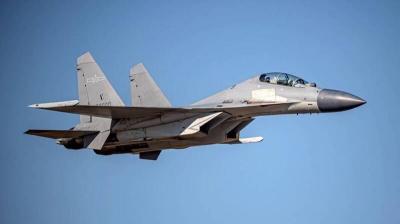
Eight Chinese naval vessels and 24 military aircraft were detected crossing the median line of the Taiwan Strait between 6am yesterday and 6am today, the Ministry of National Defense said this morning. The aircraft entered Taiwan’s northern, central, southwestern and eastern air defense identification zones, the ministry said. The armed forces responded with mission aircraft, naval vessels and shore-based missile systems to closely monitor the situation, it added. Eight naval vessels, one official ship and 36 aircraft sorties were spotted in total, the ministry said.
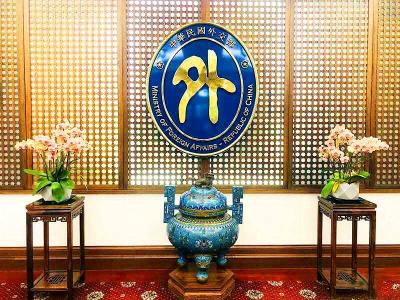
The Ministry of Foreign Affairs (MOFA) today said that if South Korea does not reply appropriately to its request to correct Taiwan’s name on its e-Arrival card system before March 31, it would take corresponding measures to alter how South Korea is labeled on the online Taiwan Arrival Card system. South Korea’s e-Arrival card system lists Taiwan as “China (Taiwan)” in the “point of departure” and “next destination” fields. The ministry said that it changed the nationality for South Koreans on Taiwan’s Alien Resident Certificates from “Korea” to “South Korea” on March 1, in a gesture of goodwill and based on the
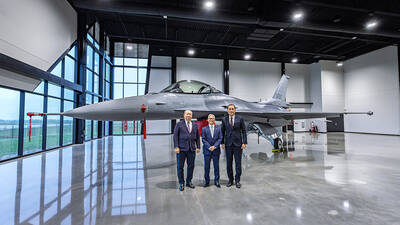
Taiwanese officials were shown the first of 66 F-16V fighter jets purchased by Taiwan from the United States, the Ministry of National Defense said yesterday, adding the aircraft has completed an initial flight test and is expected to be delivered later this year. A delegation led by Deputy Minister of National Defense Hsu Szu-chien (徐斯儉) visited Lockheed Martin’s F-16 C/D Block 70 (also known as F-16V) assembly line in South Carolina on March 16 to view the aircraft. The jet will undergo a final acceptance flight in the US before being delivered to Taiwan, the
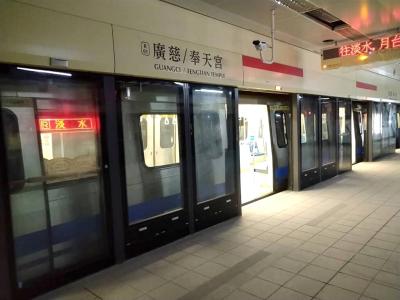
The New Taipei Metro's Sanyin Line and the eastern extension of the Taipei Metro's Tamsui-Xinyi Line (Red Line) are scheduled to begin operations in June, the National Development Council said today. The Red Line, which terminates at Xiangshan Station, would be connected by the 1.4km extension to a new eastern terminal, Guangci/Fengtian Temple Station, while the Sanyin Line would link New Taipei City's Tucheng and Yingge stations via Sanxia District (三峽). The council gave the updates at a council meeting reviewing progress on public construction projects for this year. Taiwan's annual public infrastructure budget would remain at NT$800 billion (US$25.08 billion), with NT$97.3


 RSS
RSS