


China poses a pressing threat, as its military buildup continues unabated, and effective deterrence is needed to make sure any attack would be very risky for Beijing, Minister of National Defense Wellington Koo (顧立雄) said yesterday.
China does not plan to invade Taiwan next year and seeks to control the nation without the use of force, the US intelligence community said on Wednesday, striking a measured tone on one of the world’s biggest potential flashpoints.
Beijing has stepped up pressure on the nation with frequent military drills. Taiwan’s democratically elected government rejects China’s sovereignty claims.
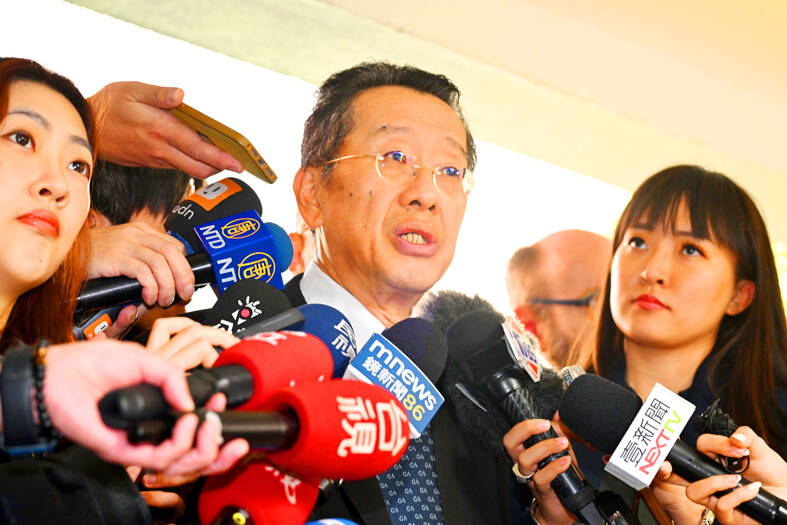
Photo: Chen I-kuan, Taipei Times
Asked about the US report, Koo said China has neither given up the option of using force against Taiwan nor slowed military spending.
“So its military expansion, and the threat it poses to us, remain very serious,” he said. “We need to make it feel like any plan to attack Taiwan would carry a high degree of risk: In other words, to make its assessment of a successful invasion very low.”
If China continues expanding its military while Taiwan’s defense capabilities do not improve, the likelihood of an attack would rise, Koo said.
“On the other hand, if our defense capabilities continue to improve and our deterrence grows stronger, then its calculation regarding an attack on Taiwan will decrease. That would have the effect of pushing back such a date [for invasion] again and again,” he said.
China’s Ministry of Foreign Affairs said Taiwan is an internal issue and that the US needs to “stop hyping up the ‘China threat’ theory.”
President William Lai (賴清德) has proposed US$40 billion in extra defense spending, but the plans have been slow to work their way through the legislature, where the opposition, which has the most seats, has complained the Cabinet’s budget proposal is too vague and that lawmakers cannot be expected to sign “blank checks.”
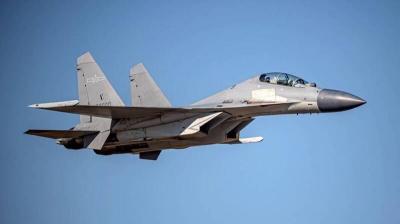
Eight Chinese naval vessels and 24 military aircraft were detected crossing the median line of the Taiwan Strait between 6am yesterday and 6am today, the Ministry of National Defense said this morning. The aircraft entered Taiwan’s northern, central, southwestern and eastern air defense identification zones, the ministry said. The armed forces responded with mission aircraft, naval vessels and shore-based missile systems to closely monitor the situation, it added. Eight naval vessels, one official ship and 36 aircraft sorties were spotted in total, the ministry said.
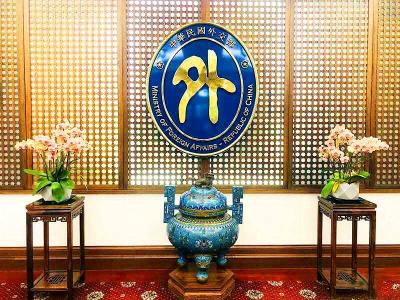
The Ministry of Foreign Affairs (MOFA) today said that if South Korea does not reply appropriately to its request to correct Taiwan’s name on its e-Arrival card system before March 31, it would take corresponding measures to alter how South Korea is labeled on the online Taiwan Arrival Card system. South Korea’s e-Arrival card system lists Taiwan as “China (Taiwan)” in the “point of departure” and “next destination” fields. The ministry said that it changed the nationality for South Koreans on Taiwan’s Alien Resident Certificates from “Korea” to “South Korea” on March 1, in a gesture of goodwill and based on the
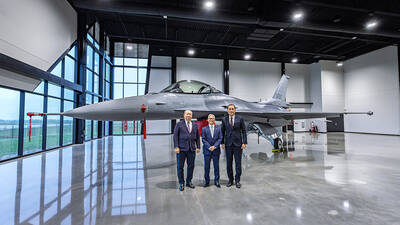
Taiwanese officials were shown the first of 66 F-16V fighter jets purchased by Taiwan from the United States, the Ministry of National Defense said yesterday, adding the aircraft has completed an initial flight test and is expected to be delivered later this year. A delegation led by Deputy Minister of National Defense Hsu Szu-chien (徐斯儉) visited Lockheed Martin’s F-16 C/D Block 70 (also known as F-16V) assembly line in South Carolina on March 16 to view the aircraft. The jet will undergo a final acceptance flight in the US before being delivered to Taiwan, the
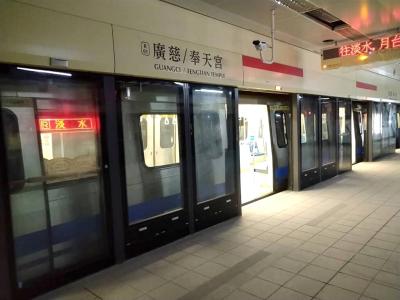
The New Taipei Metro's Sanyin Line and the eastern extension of the Taipei Metro's Tamsui-Xinyi Line (Red Line) are scheduled to begin operations in June, the National Development Council said today. The Red Line, which terminates at Xiangshan Station, would be connected by the 1.4km extension to a new eastern terminal, Guangci/Fengtian Temple Station, while the Sanyin Line would link New Taipei City's Tucheng and Yingge stations via Sanxia District (三峽). The council gave the updates at a council meeting reviewing progress on public construction projects for this year. Taiwan's annual public infrastructure budget would remain at NT$800 billion (US$25.08 billion), with NT$97.3


 RSS
RSS