


The Chinese public maintains relatively amicable sentiments toward Taiwan and strongly prefers non-military routes to improving cross-strait relations, a survey conducted by the US-based Carter Center and Emory University showed.
The “China Pulse” research project, which polled 2,506 adults between Oct. 27 last year and Jan. 1 this year, found that 86 percent of respondents support strengthening cultural ties, while 81 percent favor deepening economic interaction.
The report, co-authored by political scientists at Emory University and advisors at the Carter Center, indicates that the Chinese public views Taiwan’s importance through a lens of shared history and culture rather than geopolitical or technological competition.
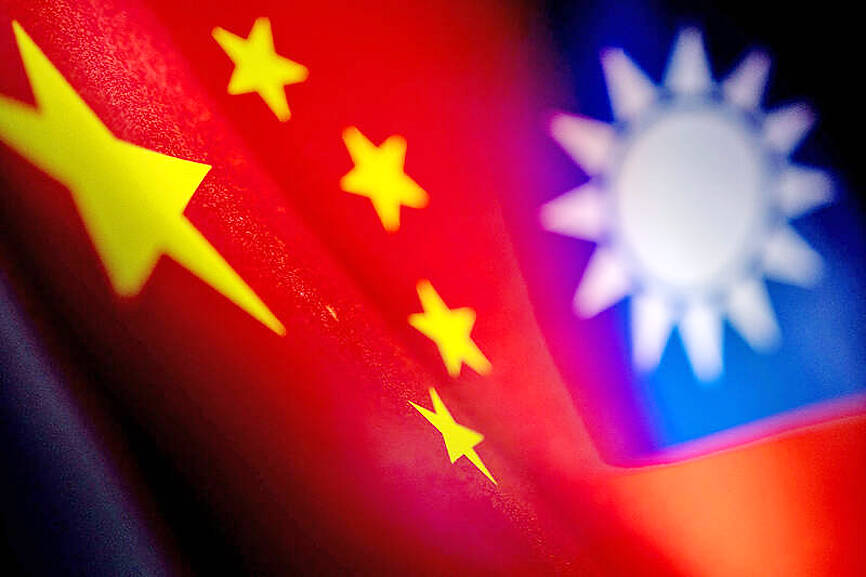
Photo: Reuters
Regarding Taiwan’s semiconductor industry, only 45 percent of Chinese respondents cited high-tech manufacturing as a key factor in Taiwan’s value.
Instead, 80 percent believe unification would resolve a “long-standing historical issue” and end the “century of humiliation.”
Despite the focus on peaceful engagement, the survey found no clear mandate for either pacifism or militarism.
The percentage of respondents who believe unification should not be achieved by force “under any circumstances” fell from 51 percent in a pilot poll between July 7 and Aug. 15 last year to 38 percent in the new poll.
However, half of the respondents said that the use of military force would only make the Taiwan issue worse.
In a hypothetical scenario where Taiwan declared independence, 81 percent of the Chinese public would support limited military operations on outlying islands.
In contrast, only 32 percent expressed support for a full-scale military attack against Taiwan.
Demographic data indicate that peaceful views are most prevalent among women, lower-income people and those with less formal education.
For instance, 54 percent of the lowest-earning respondents supported a peaceful-only approach, compared with roughly a quarter of high earners.
Ultimately, the findings indicate that while the Chinese public remains committed to unification in principle, there is significant reticence regarding the risks of a major conflict.
Most prefer a negotiated peace and policies that encourage Taiwanese students and businesspeople to live and work in China.
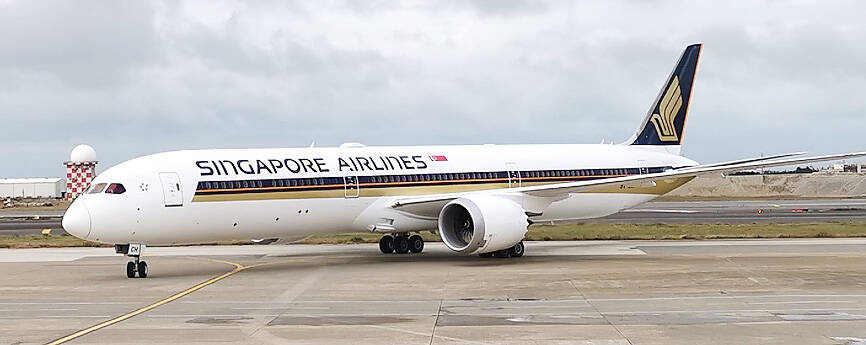
INCREASED CAPACITY: The flights on Mondays, Wednesdays, Fridays and Sundays would leave Singapore in the morning and Taipei in the afternoon Singapore Airlines is adding four supplementary flights to Taipei per week until May to meet increased tourist and business travel demand, the carrier said on Friday. The addition would raise the number of weekly flights it operates to Taipei to 18, Singapore Airlines Taiwan general manager Timothy Ouyang (歐陽漢源) said. The airline has recorded a steady rise in tourist and business travel to and from Taipei, and aims to provide more flexible travel arrangements for passengers, said Ouyang, who assumed the post in July last year. From now until Saturday next week, four additional flights would depart from Singapore on Monday, Wednesday, Friday
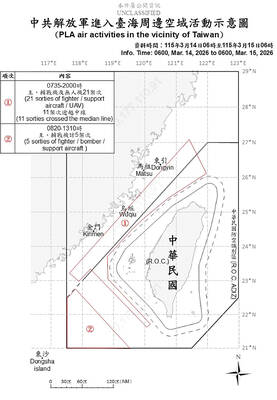
The Ministry of National Defense yesterday reported the return of large-scale Chinese air force activities after their unexplained absence for more than two weeks, which had prompted speculation regarding Beijing’s motives. China usually sends fighter jets, drones and other military aircraft around the nation on a daily basis. Interruptions to such routine are generally caused by bad weather. The Ministry of National Defense said it had detected 26 Chinese military aircraft in the Taiwan Strait over the previous 24 hours. It last reported that many aircraft on Feb. 25, when it spotted 30 aircraft, saying Beijing was carrying out another “joint combat

Taiwan successfully defended its women’s 540 kilogram title and won its first-ever men’s 640 kg title at the 2026 World Indoor Tug of War Championships in Taipei yesterday. In the women’s event, Taiwan’s eight-person squad reached the final following a round-robin preliminary round and semifinals featuring teams from Ukraine, Japan, Thailand, Vietnam, the Basque Country and South Korea. In the finals, they swept the Basque team 2-0, giving the team composed mainly of National Taiwan Normal University students and graduates its second championship in a row, and its fourth in five years. Team captain
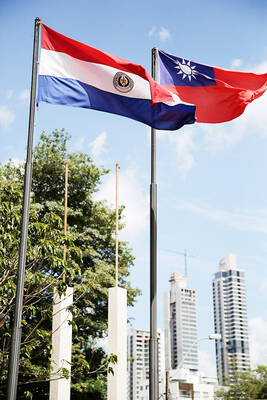
When Paraguayan opposition lawmaker Leidy Galeano returned from an all-expenses-paid tour of six Chinese cities late last year, she was convinced Paraguay risked missing out on major economic gains by sticking with longtime ally Taipei over Beijing — a message that participants on the trip heard repeatedly from Chinese officials. “Everything I saw there, I wanted for my country,” said Galeano, a member of the newly-formed Yo Creo party whose senior figures have spoken favorably about China. This trip and others like it — which people familiar with the visits said were at the invitation of the Chinese consulate in Sao Paulo


 RSS
RSS