


Democratic Progressive Party (DPP) lawmakers have voiced concerns, saying that several controversial bills are expected to be fast-tracked in the legislature, including a draft absentee voting act, referendum reforms, changes to nationality rules and outlying island development, sparking debate over election integrity, local autonomy and national security.
Bills expected to advance include the proposed absentee voting act, amendments to the Referendum Act (公民投票法), the Nationality Act (國籍法), and the Offshore Islands Development Act (離島建設條例).
The Taiwan People’s Party (TPP) caucus proposed a draft absentee voting act that would allow domestic voters to cast ballots via transferred votes or at designated polling stations.
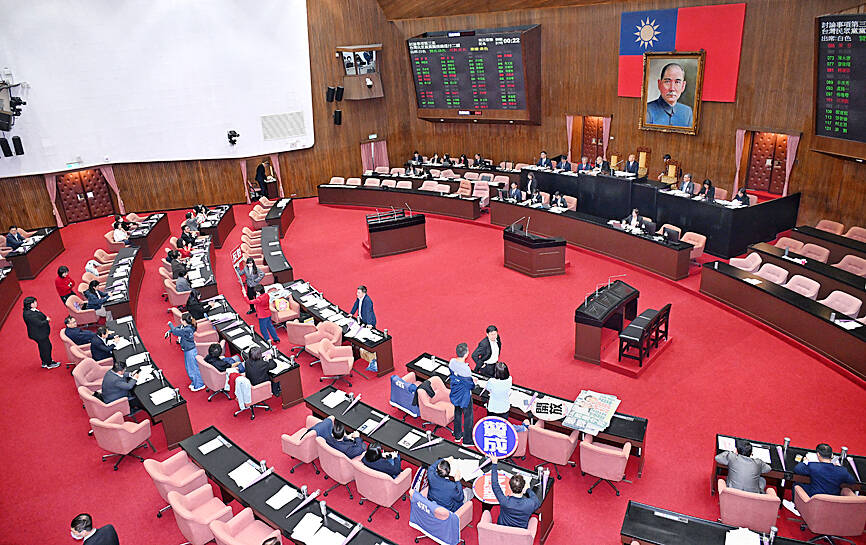
Photo: Fang Pin-chao, Taipei Times
“Eligible voters are those registered in the free area of the Republic of China, and legally entitled to vote in elections or referendums,” the TPP bill says, adding that it would cover presidential and vice-presidential elections, central and local offices, recalls, and nationwide referendums.
TPP caucus said the proposed bill aims to strengthen democracy by encouraging voter participation.
The bill would permit only domestic ballot transfers, TPP Legislator Chang Chi-kaisaid.
However, the Central Election Commission and the Ministry of the Interior said that implementing absentee voting could create administrative confusion, especially with about 8,900 ballots involved in upcoming local elections, potentially overwhelming local election offices.
Absentee voting could be exploited by hostile actors to manipulate voters and undermine electoral fairness, the ministry said.
The Chinese Nationalist Party (KMT) caucus’ proposed amendment to Referendum Act would allow future Constitutional Court rulings to be submitted to a referendum for citizens to decide whether to overturn them.
KMT Legislator Lo Chih-chiang (羅智強) said Constitutional Court decisions affect major national policies, and “greater democracy” requires controversial rulings be put to the people.
DPP caucus chief executive Chung Chia-pin (鍾佳濱) said that no democratic country with direct civic rights allows referendums to overturn constitutional rulings, asking how the KMT would determine a court acted illegally.
Separately, KMT Legislator Fu Kun-chi’s proposed amendment to the Nationality Act would allow Chinese citizens to run for public office in Taiwan without renouncing their nationality. Critics said the explanatory notes caused confusion over the law’s applicability to Chinese and overlap with the Act Governing Relations Between the People of the Taiwan Area and the Mainland Area (臺灣地區與大陸地區人民關係條例).
However, DPP Legislator Rosalia Wu (吳思瑤) said that all foreign nationals seeking political participation in Taiwan must renounce other nationalities and pledge allegiance to the Constitution.
Separately, KMT Legislator Chen Yu-jen’s (陳玉珍) proposed amendment to the Offshore Islands Development Act would allow “free trade demonstration zones” on outlying islands.
The DPP criticized the bill, saying it could allow Beijing to mislabel Chinese-made products, permit Chinese doctors to practice in Kinmen and Lienchiang (Matsu) counties, and economically integrate Kinmen with China’s Fujian Province, posing a military risk.
Civil society groups said the amendment would open the islands to China and could turn outlying islands into a “Chinese concession” or a demonstration area for the so-called “one country, two systems” model.
Chen said that the proposal’s focus is “to free Kinmen from restrictions and promote development,” and that the free trade zones are intended to boost the local economy, not compromise national security.

REASONS FOR TRAVEL: An assistant professor said that proposed amendments to penalize drivers if they used drugs overseas would not deter people from traveling People who operate a motor vehicle under the influence of marijuana would have their driver’s license revoked, even if they used the substance while overseas, the Ministry of Transportation and Communications said yesterday, citing proposed amendments to the Road Traffic Management and Penalty Act (道路交通管理處罰條例). The amendments would also authorize the government to revoke the licenses of people determined to have used Category 1 or Category 2 narcotics, even if they were not operating a vehicle while under the influence of drugs, as well as ban them from taking the license test for three years, the ministry said. People aged 18 or

GLOBALGIVING: ‘ Caving to external pressure is not acceptable for an organization that has cultivated justice reform and human rights for 30 years,’ one NGO said A slew of non-government organizations (NGOs) have withdrawn from the GlobalGiving fundraising platform after it announced it would use “Chinese Taipei” instead of “Taiwan” from next month. The Taiwan Good Rice Association wrote on Facebook on Friday that it was informed on April 28 via a teleconference call of the change, which was made because the platform wanted to operate in China. Taiwan Good Rice is to terminate all cooperative relationships with GlobalGiving in response to the platform’s “unilateral and non-negotiable” decision to remove references to Taiwan, the NGO said. “Taiwan is in the official name of Taiwan Good Rice Association and the

HEAVY WEATHER: Typhoon Jangmi is due to crash straight into the Ryukyus as airlines look to shift flights to larger aircraft or cancel flights to Okinawa entirely Taiwan’s international air carriers announced flight adjustments over the weekend as Typhoon Jangmi is forecast to hit the Ryukyu Islands today and tomorrow. The Central Weather Administration (CWA) upgraded Jangmi from a tropical storm to a typhoon at 8am yesterday, with the eye located 580km south of Naha city. It was moving north at 19kph. Today, China Airlines’ CI-120, CI-121, CI-122 and CI-123 flights between Taoyuan and Naha, Okinawa, have been canceled as well as CI-132 and CI-133 between Kaohsiung and Naha. EVA Air’s BR-112, BR-113, BR-186 and BR-185 flights between Taoyuan and Naha are also canceled. Low-cost carrier Tigerair Taiwan canceled IT-230,
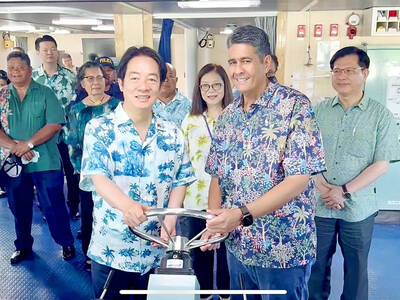
MULTIPRONGED APPROACH: China has sought to pressure Palau across a number of fronts, but the island nation has staunchly resisted overtures to ditch Taiwan Palau has been firm in backing Taiwan despite Chinese pressure that uses tourism economics, cyberattacks and criminal infiltration as tools to threaten the Pacific ally into renouncing its recognition of Taiwan as a sovereign state. The Presidential Office yesterday announced that Vice President Hsiao Bi-khim (蕭美琴) would visit Palau from Saturday to Wednesday next week at the invitation of Palauan President Surangel Whipps Jr. Whipps in April said in an interview that China had outspokenly asked Palau to “denounce Taiwan.” “And we have said: ‘We have no enemies, but nobody tells us who our friends are,’” he said. Whipps has told reporters multiple times


 RSS
RSS