


Premier Cho Jung-tai’s (卓榮泰) brief visit to the Tokyo Dome on Saturday — the first sitting Taiwanese premier to visit Japan since Taipei and Tokyo severed diplomatic ties 54 years ago — could be an indication that Japanese Prime Minister Sanae Takaichi’s government is redefining boundaries with Taiwan.
In 2004, then-premier You Si-kun briefly stopped in Okinawa while returning from a visit to diplomatic allies in Central America, but the stopover was necessitated by a typhoon.
Although Cho’s trip on Saturday was kept confidential and low-key — described simply as a visit to watch a baseball game with no political agenda — it still represents a departure from established practice, given the sensitivity of Taiwan-Japan relations for Tokyo’s ties with Beijing.

Photo: CNA
Since Takaichi took office, China has repeatedly pressured Japan over Taiwan-related issues. Traditionally, when relations between Japan and China deteriorate, Tokyo has tended to scale back visible engagement with Taiwan to avoid provoking Beijing.
Cho’s visit might indicate those diplomatic “unwritten rules” may be shifting under the Takaichi administration. The space for Taiwan-Japan interaction appears to be gradually expanding, and the limits of engagement may no longer be defined solely by Beijing.
Since Japan switched diplomatic recognition to China in 1972, Taiwan and Japan have maintained unofficial ties, with the Japan-Taiwan Exchange Association handling most consular and diplomatic functions in lieu of a formal embassy.

Photo: CNA
In the past few years, as security concerns in the Taiwan Strait have intensified, Japan’s government and political circles have shown increasing support for Taiwan. At the same time, Tokyo has generally avoided actions that would
challenge the framework established when it normalized relations with Beijing.
In practice, this has meant expanding exchanges with Taiwan while carefully controlling the level of official contact. Senior Taiwanese officials visiting Japan have typically done so in an extremely low-profile manner.
In 2022, then-vice president William Lai (賴清德) traveled to Tokyo privately to attend the funeral of Japanese prime minister Shinzo Abe following his assassination. Japanese authorities reportedly even confirmed whether Lai had a genuine personal relationship with Abe before allowing the visit.
Minister of Foreign Affairs Lin Chia-lung (林佳龍) also quietly visited Japan last year. In interviews with Japanese media, Lin said that he was traveling in a private capacity and noted that Taiwanese citizens enjoy visa-free entry to Japan, meaning he could visit as an ordinary traveler.
For decades, a diplomatic “red line” has existed between Japan and China regarding Taiwan. While Japan may deepen substantive relations with Taiwan, it has generally avoided actions that could be interpreted as recognizing Taiwan as a sovereign state or undermining the “one China” framework.
In practical terms, this means refraining from establishing formal diplomatic ties with Taiwan, avoiding official visits by senior leaders, steering clear of security alliances or military cooperation and not signing agreements implying Taiwanese sovereignty.
These limits have never been formally codified, but instead have evolved through diplomatic practice. Beijing effectively signals the boundaries through protests or political pressure when it believes they have been crossed.
Over time, this produced an informal rule in Japan: when relations with China worsen, interactions with Taiwan should not be overly visible.
After Takaichi took office, Japan-China relations quickly plummeted. Allowing a sitting Taiwanese premier to visit Japan — even if framed as a private baseball outing — risks inflaming tensions. Some Japanese media outlets have already raised the possibility of a Chinese backlash.
Last year, when Takaichi said during a parliamentary session that a Taiwan contingency could threaten Japan’s survival, China responded by increasing pressure on Tokyo — pressure that has yet to fully ease.
However, Beijing’s reaction appears to have had an unexpected domestic effect. In a snap House of Representatives election, Takaichi led the ruling Liberal Democratic Party to a historic victory with 316 seats. The result could indicate that for many Japanese voters, security concerns in the Taiwan Strait outweigh the diplomatic sensitivities of Japan-China relations.
Against this backdrop, Japan’s tacit approval of a visit by a sitting Taiwanese premier may signal that the Takaichi administration is redefining these diplomatic boundaries.
Wang Hung-jen (王宏仁), professor of political science at National Cheng Kung University, said Cho’s visit represents a more significant breakthrough than Lai’s condolence trip or Lin Chia-lung’s low-profile visit.
Despite continued Chinese pressure and ongoing tensions between Tokyo and Beijing,
Japan was still willing to facilitate Cho’s visit, Wang said. This might suggest the “China factor” shaping Japan’s Taiwan policy may be weakening.
Chen Fang-yu (陳方隅), associate professor of political science at Soochow University, said warming Taiwan-Japan relations are the result of years of diplomatic groundwork.
Through sustained diplomatic engagement, Taiwan’s senior officials can visit Japan in a private capacity, he said. The fact that such visits can receive visas and even be publicly reported represents a significant step forward in bilateral ties.
“As an abnormal country,” Taiwan must pursue diplomatic breakthroughs step by step, Chen said.
Additional reporting by Fang Wei-li

REASONS FOR TRAVEL: An assistant professor said that proposed amendments to penalize drivers if they used drugs overseas would not deter people from traveling People who operate a motor vehicle under the influence of marijuana would have their driver’s license revoked, even if they used the substance while overseas, the Ministry of Transportation and Communications said yesterday, citing proposed amendments to the Road Traffic Management and Penalty Act (道路交通管理處罰條例). The amendments would also authorize the government to revoke the licenses of people determined to have used Category 1 or Category 2 narcotics, even if they were not operating a vehicle while under the influence of drugs, as well as ban them from taking the license test for three years, the ministry said. People aged 18 or

GLOBALGIVING: ‘ Caving to external pressure is not acceptable for an organization that has cultivated justice reform and human rights for 30 years,’ one NGO said A slew of non-government organizations (NGOs) have withdrawn from the GlobalGiving fundraising platform after it announced it would use “Chinese Taipei” instead of “Taiwan” from next month. The Taiwan Good Rice Association wrote on Facebook on Friday that it was informed on April 28 via a teleconference call of the change, which was made because the platform wanted to operate in China. Taiwan Good Rice is to terminate all cooperative relationships with GlobalGiving in response to the platform’s “unilateral and non-negotiable” decision to remove references to Taiwan, the NGO said. “Taiwan is in the official name of Taiwan Good Rice Association and the

HEAVY WEATHER: Typhoon Jangmi is due to crash straight into the Ryukyus as airlines look to shift flights to larger aircraft or cancel flights to Okinawa entirely Taiwan’s international air carriers announced flight adjustments over the weekend as Typhoon Jangmi is forecast to hit the Ryukyu Islands today and tomorrow. The Central Weather Administration (CWA) upgraded Jangmi from a tropical storm to a typhoon at 8am yesterday, with the eye located 580km south of Naha city. It was moving north at 19kph. Today, China Airlines’ CI-120, CI-121, CI-122 and CI-123 flights between Taoyuan and Naha, Okinawa, have been canceled as well as CI-132 and CI-133 between Kaohsiung and Naha. EVA Air’s BR-112, BR-113, BR-186 and BR-185 flights between Taoyuan and Naha are also canceled. Low-cost carrier Tigerair Taiwan canceled IT-230,
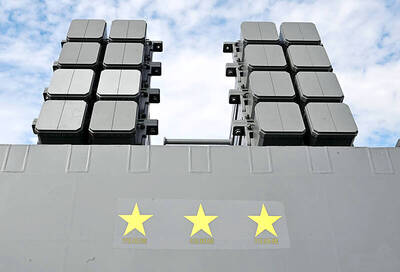
UPGRADE: The Kang Ding-class frigate is replacing its Chaparall missiles with Tien Chien II and Hua Yang VLS, which would provide it with long-range, 360° air defense Taiwan plans to produce 1,200 to 1,376 Hai Chien II missiles (海劍二, Sea Sword II) — also known as TC-2N — to serve as the standard air defense system of the navy’s surface combatant fleet, a source said yesterday. Last week, the Hai Chien II, the naval version of the Tien Kung II missile (天劍二, Sky Sword II), completed a live-fire test in waters off the National Chungshan Institute of Science and Technology’s Jiupeng facility (九鵬) in Pingtung County’s Manjhou Township (滿州). The MIM72 Chaparral and other dated air defense missiles that currently arm Taiwanese ships have inadequate range to combat Chinese


 RSS
RSS