


The Mainland Affairs Council (MAC) said it would submit evidence to the Central Election Commission (CEC) proving that Taiwan People’s Party Legislator Li Zhenxiu (李貞秀) was not qualified to register as a candidate, which would then determine whether it should file a lawsuit to invalidate her qualification.
“We were surprised to hear that Li said she did not submit the certificate renouncing her Chinese household registration until March last year,” MAC Minister Chiu Chui-cheng (邱垂正) said in an interview with the Chinese-language Liberty Times (sister paper of the Taipei Times) that was published yesterday.
Article 21 of the Act Governing Relations Between the People of the Taiwan Area and the Mainland Area (臺灣地區與大陸地區人民關係條例) stipulates that Chinese nationals can run for or hold public offices in Taiwan after having a registered household in Taiwan for 10 years.
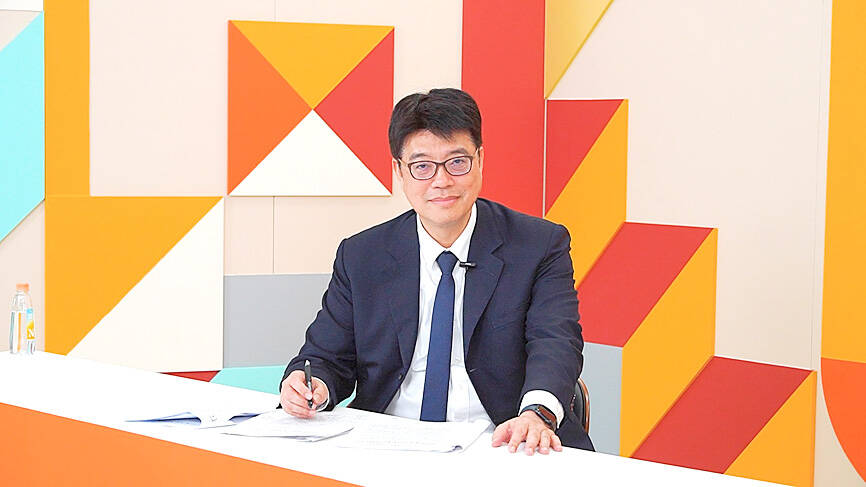
Photo: Chen Yu-jui, Taipei Times
An amendment to Article 9 of the act, which was passed in 2004, states that Taiwanese must not have a Chinese passport or household registration, or they would lose their Taiwanese citizenship.
Having only submitted proof of renouncing her Chinese household registration in March last year, Li has been a naturalized citizen for less than one year, Chiu said.
The National Immigration Agency does not have records of Li renouncing her Chinese household registration before March last year, he added.
“We do not think that she is qualified to register or run for elections based on the act. We will relay these facts to the CEC and hope that it would strictly enforce election laws,” Chiu said.
All Chinese spouses in Taiwan are required to renounce their Chinese household registration and submit proof within three months after obtaining a Taiwanese ID card, Chiu said, adding that the naturalization process would not be complete without these procedures.
Controversy surrounding Li’s qualifications have triggered doubts in other people about their own nationality status, the council said.
MAC Deputy Minister Liang Wen-chieh (梁文傑) said people in similar situations — as well as those who were born in China, who were born from marriages of Taiwanese and Chinese or who grew up in China before returning to Taiwan — are strongly advised to confirm with their parents or relatives whether they are registered Chinese citizens.
“We urge these people to ascertain their status with their parents, or issues may arise when they seek employment in the government,” Liang said.
Chiu said the council is monitoring the Chinese National People’s Congress and Chinese People’s Political Consultative Conference, which opened this week.
Aside from addresses given by Chinese President Xi Jinping (習近平) and Chinese People’s Political Consultative Conference Chairman Wang Huning (王滬寧), the council would also closely watch whether the Chinese Communist Party (CCP) presents new policies to facilitate cross-strait integration, Chiu said.
“The CCP is scheduled to review a draft act on the promotion of ethnic unity and progress during the two important political gatherings, which, if passed, would provide another legal basis for holding those whom they perceive as damaging ethnic unity and creating divisions, accountable. As this could affect Taiwanese, we will study the act and introduce countermeasures,” Chiu said.
Liang said that the council has conducted a preliminary review of the bill, which appears to be more of a declaration of moral values than an enforceable law.
“Overall, the act’s terms are vaguely defined, giving the Chinese government broad discretion to determine whether certain behaviors or statements are lawful,” Liang said.

REASONS FOR TRAVEL: An assistant professor said that proposed amendments to penalize drivers if they used drugs overseas would not deter people from traveling People who operate a motor vehicle under the influence of marijuana would have their driver’s license revoked, even if they used the substance while overseas, the Ministry of Transportation and Communications said yesterday, citing proposed amendments to the Road Traffic Management and Penalty Act (道路交通管理處罰條例). The amendments would also authorize the government to revoke the licenses of people determined to have used Category 1 or Category 2 narcotics, even if they were not operating a vehicle while under the influence of drugs, as well as ban them from taking the license test for three years, the ministry said. People aged 18 or

GLOBALGIVING: ‘ Caving to external pressure is not acceptable for an organization that has cultivated justice reform and human rights for 30 years,’ one NGO said A slew of non-government organizations (NGOs) have withdrawn from the GlobalGiving fundraising platform after it announced it would use “Chinese Taipei” instead of “Taiwan” from next month. The Taiwan Good Rice Association wrote on Facebook on Friday that it was informed on April 28 via a teleconference call of the change, which was made because the platform wanted to operate in China. Taiwan Good Rice is to terminate all cooperative relationships with GlobalGiving in response to the platform’s “unilateral and non-negotiable” decision to remove references to Taiwan, the NGO said. “Taiwan is in the official name of Taiwan Good Rice Association and the

HEAVY WEATHER: Typhoon Jangmi is due to crash straight into the Ryukyus as airlines look to shift flights to larger aircraft or cancel flights to Okinawa entirely Taiwan’s international air carriers announced flight adjustments over the weekend as Typhoon Jangmi is forecast to hit the Ryukyu Islands today and tomorrow. The Central Weather Administration (CWA) upgraded Jangmi from a tropical storm to a typhoon at 8am yesterday, with the eye located 580km south of Naha city. It was moving north at 19kph. Today, China Airlines’ CI-120, CI-121, CI-122 and CI-123 flights between Taoyuan and Naha, Okinawa, have been canceled as well as CI-132 and CI-133 between Kaohsiung and Naha. EVA Air’s BR-112, BR-113, BR-186 and BR-185 flights between Taoyuan and Naha are also canceled. Low-cost carrier Tigerair Taiwan canceled IT-230,

UPGRADE: The Kang Ding-class frigate is replacing its Chaparall missiles with Tien Chien II and Hua Yang VLS, which would provide it with long-range, 360° air defense Taiwan plans to produce 1,200 to 1,376 Hai Chien II missiles (海劍二, Sea Sword II) — also known as TC-2N — to serve as the standard air defense system of the navy’s surface combatant fleet, a source said yesterday. Last week, the Hai Chien II, the naval version of the Tien Kung II missile (天劍二, Sky Sword II), completed a live-fire test in waters off the National Chungshan Institute of Science and Technology’s Jiupeng facility (九鵬) in Pingtung County’s Manjhou Township (滿州). The MIM72 Chaparral and other dated air defense missiles that currently arm Taiwanese ships have inadequate range to combat Chinese


 RSS
RSS