


Chinese Nationalist Party (KMT) and Taiwan People’s Party (TPP) lawmakers yesterday agreed to deliberate on Friday the government’s military budget.
The move came following negotiations with the Democratic Progressive Party (DPP) and might signal that the KMT-TPP alliance could pass President William Lai’s (賴清德) eight-year defense budget.
A memo from the KMT-run National Policy Foundation showed that the party is leaning on lawmakers to back a separate bill that would earmark NT$350 billion (US$11.07 billion) for defense procurements, with “punitive articles” for delays, the Chinese-language United Daily News reported on Friday last week.
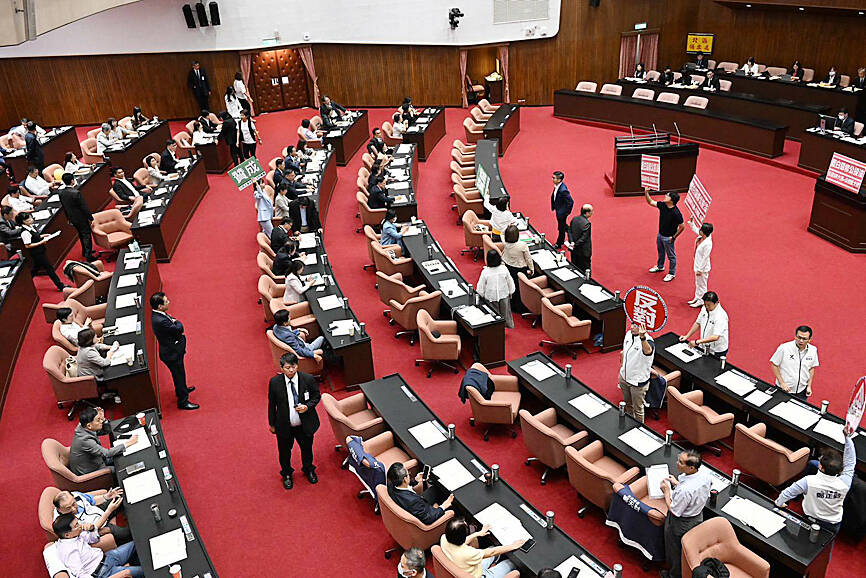
Photo: Taipei Times
However, the response from KMT politicians suggests a rift between the party leadership and its rank-and-file, with some saying that NT$350 billion would not be enough for the armed forces.
Taichung Mayor Lu Shiow-yen (盧秀燕) previously told KMT lawmakers that the US has expressed a preference for Taiwan to pass a NT$900 billion defense budget.
Former foundation executive Ling Tao (凌濤) wrote on Facebook yesterday that the nation needs NT$900 billion to pay for the equipment necessary for defense.
KMT Legislator Lo Ting-wei (羅廷瑋) on Monday said that KMT Legislator Hsu Chiao-hsin (徐巧芯) and several others support an NT$810 billion allocation instead of the leadership’s smaller proposal.
However, KMT Legislator Cheng Cheng-chien (鄭正鈐) backed the leadership’s proposal, saying that military spending should not involve “performative patriotism.”
The clashing visions would have to be resolved in the legislature, as only lawmakers, not party functionaries, have the authority to propose a budget to challenge the government’s bill.
Premier Cho Jung-tai (卓榮泰) yesterday criticized the KMT leadership’s proposal, saying that the Cabinet’s NT$1.25 trillion bill is an integrated package without superfluous elements for bargaining.
The planned “T-Dome” air defense program, artificial intelligence boosted kill chains and an improved domestic defense industry cannot be achieved without the allocation, he said.
The KMT leadership’s “punitive articles” would harm national security, Cho said.
KMT Culture and Communication Committee deputy director Yin Nai-ching (尹乃菁) on Monday said the “punitive articles” would not be in the party’s bill, but proposed as separate legislation.
The KMT’s shift in policy came after 37 US congressional members in a joint statement on Feb. 12 called on the legislature to approve the defense budget.
When the Legislative Yuan convened on Tuesday last week, Legislative Speaker Han Kuo-yu (韓國瑜) authorized inter-party negotiations on military spending and scheduled the Cabinet’s presentation on defense for Friday.

NATIONAL SECURITY: Authorities are working to confirm the identities of the military personnel involved and investigating possible illegal conduct and regulatory violations Authorities are probing possible national security implications after Kinmen police and immigration officers on Sunday found a Chinese woman allegedly posing as a tourist while engaging in prostitution involving more than 10 military personnel. The woman, surnamed Chen (陳), has since been deported, authorities said, adding that investigators are still working to confirm the identities of those implicated, as the records only listed code names and aliases. The case stemmed from a report received by the Kinmen District Prosecutors’ Office on Friday last week from the Jinhu Precinct of the Kinmen County Police Bureau. On Sunday, police, along with the National Immigration

GLOBALGIVING: ‘ Caving to external pressure is not acceptable for an organization that has cultivated justice reform and human rights for 30 years,’ one NGO said A slew of non-government organizations (NGOs) have withdrawn from the GlobalGiving fundraising platform after it announced it would use “Chinese Taipei” instead of “Taiwan” from next month. The Taiwan Good Rice Association wrote on Facebook on Friday that it was informed on April 28 via a teleconference call of the change, which was made because the platform wanted to operate in China. Taiwan Good Rice is to terminate all cooperative relationships with GlobalGiving in response to the platform’s “unilateral and non-negotiable” decision to remove references to Taiwan, the NGO said. “Taiwan is in the official name of Taiwan Good Rice Association and the

HEAVY WEATHER: Typhoon Jangmi is due to crash straight into the Ryukyus as airlines look to shift flights to larger aircraft or cancel flights to Okinawa entirely Taiwan’s international air carriers announced flight adjustments over the weekend as Typhoon Jangmi is forecast to hit the Ryukyu Islands today and tomorrow. The Central Weather Administration (CWA) upgraded Jangmi from a tropical storm to a typhoon at 8am yesterday, with the eye located 580km south of Naha city. It was moving north at 19kph. Today, China Airlines’ CI-120, CI-121, CI-122 and CI-123 flights between Taoyuan and Naha, Okinawa, have been canceled as well as CI-132 and CI-133 between Kaohsiung and Naha. EVA Air’s BR-112, BR-113, BR-186 and BR-185 flights between Taoyuan and Naha are also canceled. Low-cost carrier Tigerair Taiwan canceled IT-230,
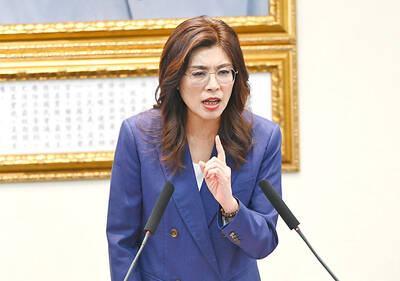
Chinese Nationalist Party (KMT) Chairwoman Cheng Li-wun (鄭麗文) yesterday briefed her party’s Central Standing Committee regarding her scheduled visit to the US between Monday next week and June 16, saying that her purpose would be to persuade the US that the Republic of China (ROC) Constitution was a “one China” constitution that would foster stable and peaceful cross-strait relations. The ROC Constitution is the most important defense for all Taiwanese citizens, as it upholds our democracy and has contributed to our robust economy, which aligns with international and US interests, she said. “We would not be troublemakers and drag the US under,”


 RSS
RSS